
PRIME MOVER
INDUSTRIES LIMITED
Top 5 Lightweight Materials for Flatbed Trailers in 2026: How High-Strength Steel & Aluminum Boost Payload by 18%
The global flatbed trailer market is undergoing a quiet revolution. With the market valued at USD 7.67 billion in 2024 and projected to reach USD 10.54 billion by 2033 at a 3.6% CAGR, the pressure is on manufacturers to deliver trailers that can carry more while weighing less. For fleet operators, every pound shaved from a trailer's empty weight translates directly into additional payload capacity—and additional revenue per trip.
Industry data shows that every 300 lbs removed from a flatbed trailer's design is worth approximately a 0.2% reduction in fuel costs. Multiply that across an entire fleet over hundreds of thousands of miles, and the numbers become compelling. This article explores the Top 5 lightweight materials reshaping the flatbed trailer industry in 2026 and examines how they are helping operators boost payload by up to 18% —and in some cases, even more.
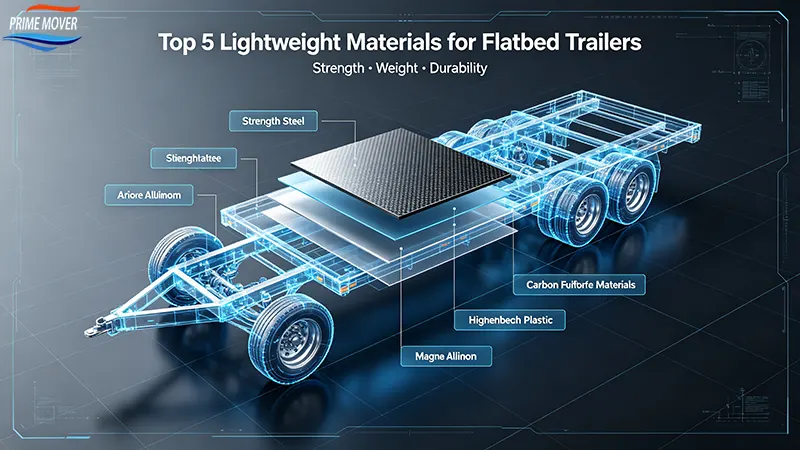
Material #1: High-Strength Steel (Advanced High-Strength Steel / AHSS)
Weight Reduction Potential: Up to 36%
High-strength steel remains the backbone of the flatbed trailer industry—but today's high-strength steels bear little resemblance to the heavy, rigid materials of the past. Advanced High-Strength Steels (AHSS) such as Strenx® 700 and Strenx® 960 are enabling manufacturers to achieve dramatic weight savings without sacrificing structural integrity.
A compelling case study comes from Hidroamerica, a Colombian transportation company that redesigned its flatbed trailers using 100% Strenx® 700 high-strength weather-resistant steel for the frame. The result? A 36% weight reduction compared to semi-trailers made with conventional ASTM A36 steel. The company's General Manager noted that beyond the weight savings, the reduced plate thickness also lowered manufacturing costs for cutting, welding, and machining.
SSAB, the manufacturer behind Strenx® steel, notes that "when you reduce the weight of the unit, you can increase the payload by the amount of weight you reduce". Another manufacturer, Schmitz Cargobull, leverages high-strength S700 fine-grain steel with optimized frame design to deliver "maximum stability with a minimum unladen weight".
Why it makes the Top 5: High-strength steel offers the best combination of strength, repairability, and cost-effectiveness. Steel remains the dominant material choice due to its durability, and it's easier to weld in the field without compromising the material's temper. For fleets operating in demanding environments—construction sites, gravel roads, or remote areas without specialized repair shops—high-strength steel provides peace of mind that aluminum sometimes cannot match.
Material #2: Aluminum Alloys (5000 & 6000 Series)
Weight Reduction Potential: 15–25% vs. Steel
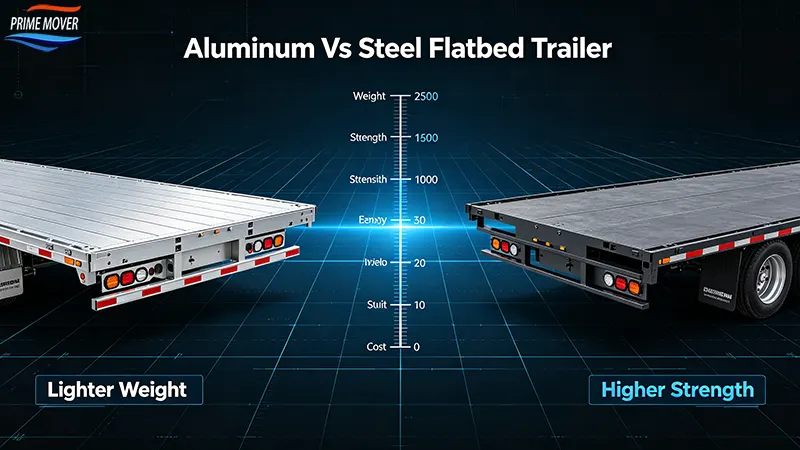
If high-strength steel is the workhorse, aluminum is the thoroughbred. All-aluminum flatbed trailers offer the lightest empty weight on the market—typically 9,000 to 10,500 lbs. This represents a weight savings of 2,000 to 4,000 lbs over a comparable all-steel trailer, translating directly into additional payload capacity.
A full-steel flatbed can weigh 15–25% more than an aluminum unit of similar length and axle package. That gap directly reduces a fleet's legal payload per trip. Great Dane estimates that an all-aluminum trailer is around 2,500 lbs lighter than its all-steel counterpart. As Brad Windy, Director of Application Engineering at Great Dane, explains: "If you're close to maxing out your load with a steel trailer, that extra 2,000 to 2,500 pounds can be the difference between two trips or one".
Industry leaders are taking notice. Fontaine is set to release its new 102-inch FORCE flatbed in early 2027, featuring an aluminum composition that cuts tare weight for higher payloads and improved corrosion resistance. Great Dane launched its lightweight AeroLite aluminum flatbed series in July 2025, designed specifically to improve payload capacity and corrosion resistance. Dorsey Trailer introduced the Aluminum Giant all-aluminum platform trailer series, offering 80,000 lbs evenly distributed capacity.
Why it makes the Top 5: Aluminum delivers maximum payload capacity for weight-sensitive routes. It resists surface corrosion without coatings—critical for northern climates, coastal operations, or fleets hauling corrosive cargo. It also holds resale value better in markets that prize payload and corrosion resistance. For long-haul palletized cargo on paved highways, aluminum with air suspension is the gold standard.
Material #3: Composite Materials (Fiber-Reinforced Polymers & Hybrid Composites)
Weight Reduction Potential: Up to 20%
Composite materials represent the frontier of flatbed trailer lightweighting. These materials—typically fiber-reinforced polymers combining glass, carbon, or natural fibers with resin matrices—offer exceptional strength-to-weight ratios that can rival or exceed metals.
The industry is seeing significant traction in composite adoption. Recent market analysis notes that "composite materials are gaining traction, combining lightweight properties with enhanced performance". A 2026 industry report confirms that "the transition from traditional steel to advanced composite materials has led to a 20% reduction in trailer weight without compromising strength".
One of the most dramatic innovations comes from Ridge Corporation, which unveiled its TRANSCORE™ all-composite trailer at the 2025 TMC Annual Meeting. The trailer features TRUE COMPOSITE construction—an eco-friendly, fully recyclable system utilizing natural components without bonding agents—and comes in nearly a full ton (2,000 lbs) lighter than previous trailer solutions. The design offers 20-year durability, improved fleet MPG, and increased billable freight capacity.
Even component-level composite applications are making a difference. Hyundai Translead incorporates composite panels in its medium-duty truck bodies, engineered to accommodate a wide variety of accessories and applications.
Why it makes the Top 5: Composites offer the highest future potential for weight reduction. They are corrosion-proof, require minimal maintenance, and can be molded into aerodynamic shapes that further improve fuel efficiency. With sustainability becoming a key purchasing criterion for European logistics companies, composites' recyclability and long service life (20+ years) make them increasingly attractive.
Material #4: Combination (Steel-Aluminum Hybrid / "Combo") Construction
Weight Reduction Potential: 1,000–2,500 lbs vs. All-Steel
Sometimes the best solution isn't choosing one material—it's combining the strengths of two. Combo flatbed trailers pair a steel main beam (for strength where it matters most) with aluminum flooring, cross-members, and side rails (for weight savings everywhere else).
The result is a practical middle ground: a typical combo flatbed weighs 10,500–12,000 lbs—saving 1,000–2,500 lbs versus an all-steel trailer. Price and tare weight land between steel and aluminum, making combo trailers the most popular choice for owner-operators because they offer a practical balance: lighter than steel, more affordable than full aluminum, and durable enough for heavy-duty use.
Great Dane recently released a reengineered Freedom combo flatbed trailer that is now nearly 200 lbs lighter than its predecessor. The engineering team redesigned three high-impact structural areas—the siderail, crossmembers, and upper coupler—to remove excess material while reinforcing high-stress areas. The company notes the Freedom can be further spec'd with lighter-weight flooring, wheels, and suspension products for even greater total payload capacity.
Fontaine's IMPACT flatbed takes a similar approach, featuring an aluminum deck with steel main beams and strategically spaced steel crossmembers, achieving a 52,000-lb rating in just 4 feet while minimizing weight. Its steel rear design enhances impact resistance and torsional stability.
Why it makes the Top 5: Combo construction offers the best balance of strength, weight, and cost. It's the practical choice for mixed-use fleets that need the durability of steel for concentrated loads (machinery, coils, dense building materials) but also want meaningful weight savings for improved fuel efficiency and payload. For the vast majority of fleet operators who don't fit neatly into "all-steel" or "all-aluminum" categories, combo is often the smartest choice.

Material #5: Advanced Flooring Materials (Composite Decking & Lightweight Hardwood Alternatives)
Weight Reduction Potential: Up to 50% of Floor Weight
While much of the lightweighting conversation focuses on frames and beams, the trailer deck—the floor upon which cargo rests—represents a significant opportunity for weight reduction that is often overlooked.
Traditional Apitong hardwood flooring, while durable, is heavy. Emerging alternatives include bamboo fiber-reinforced polypropylene composites and sandwich panel designs. Research from Oak Ridge National Laboratory has explored bamboo-thermoplastic composites as a sustainable, lightweight alternative for trailer decking, with test results showing the material withstanding 400 fatigue cycles with onset of failure only at the supports.
Even more dramatic, research from West Virginia University indicates that the weight of a typical van trailer floor can be reduced to half—or even less—using a sandwich panel design configuration. While this research focuses on van trailers, the principles are directly applicable to flatbed decking.
East Manufacturing has achieved notable results with its all-aluminum flatbed designs, reporting weight savings on a 48-foot flatbed that resulted in a 10% increase in strength under distributed load and 30% increase under concentrated load. The company's flatbed models maximize payload while delivering the strength and durability needed for all types of flatbed applications.
Even small component changes add up: aluminum wheels are generally 20–25% lighter than steel wheels, and the Jost Alumilight series aluminum landing gear is up to 50 lbs lighter per set than competitive landing gear.
Why it makes the Top 5: Flooring and component-level lightweighting offer incremental gains that compound. While a 50-lb reduction here and a 200-lb reduction there may seem small, combined with lighter frames, wheels, and landing gear, these savings can add up to hundreds of pounds of additional payload capacity—without any compromise to structural integrity.
The Payload Impact: How 18% (and More) Is Achieved
So how does all this add up to an 18% payload increase? The math is straightforward:
A typical all-steel flatbed trailer weighs approximately 12,000–13,500 lbs. An all-aluminum or advanced combo trailer can weigh as little as 9,000–10,500 lbs—a reduction of 2,000–4,000 lbs, or roughly 15–25% of the trailer's empty weight.
Under the U.S. federal gross vehicle weight limit of 80,000 lbs, every pound saved on the trailer's tare weight is a pound available for cargo. A fleet that saves 3,000 lbs on trailer weight can carry an additional 3,000 lbs of freight per trip—without exceeding legal weight limits. Over the course of a year, that adds up to fewer trips, less fuel, lower maintenance costs, and significantly higher profitability.
In extreme cases, the savings are even more dramatic. The Hidroamerica case study achieved a 36% weight reduction using high-strength steel alone. Ridge Corporation's all-composite TRANSCORE™ trailer comes in nearly a full ton lighter. These are not incremental improvements—they are transformative.
Choosing the Right Material for Your Fleet
There is no single "best" material for every operation. As Great Dane's Brad Windy advises: "Think about where the trailer's going to run, what it's going to haul, and who's going to maintain it. That'll usually point you in the right direction".
| Material | Best For | Trade-Off |
| High-Strength Steel | Extreme-duty applications, remote operations, concentrated heavy loads | Heavier; corrosion risk |
| Aluminum | Long-haul, weight-sensitive freight, northern climates | Higher upfront cost; specialized welding |
| Composites | Sustainability-focused fleets, maximum lightweighting | Emerging technology; higher cost |
| Combo (Hybrid) | Mixed-use fleets, balanced ROI | Not as light as all-aluminum |
| Advanced Flooring | All fleets looking for incremental gains | Requires spec'ing at time of order |
Prime Mover Industries: Your Partner in Lightweight Flatbed Solutions
As a Hong Kong-based enterprise established in 2014, Prime Mover Industries has positioned itself at the forefront of the global semi-trailer export market. The company's product portfolio includes flatbed trailers engineered with the latest lightweight materials—from high-strength steel frames to aluminum-composite hybrid designs—serving the diverse transportation needs of construction, logistics, agriculture, and heavy industry sectors worldwide.
With a strategic headquarters in one of the world's busiest logistics hubs, Prime Mover Industries offers international clients access to Asia-Pacific's dynamic growth markets while facilitating efficient global exports. The company's commitment to quality control, customer-specific customization, and cost-competitive manufacturing enables fleets worldwide to maximize payload, reduce fuel consumption, and improve overall operational efficiency.
Whether your operation demands the rugged durability of high-strength steel, the payload-maximizing benefits of aluminum, or the balanced performance of combo construction, Prime Mover Industries delivers tailored solutions that meet your specific requirements—and your bottom line.
Written by
Prime Mover Industries
Editor Wang
WhatsApp:+86-189 5386 6163
Email:wlei66@126.com
PRIME MOVER
INDUSTRIES LIMITED