
PRIME MOVER
INDUSTRIES LIMITED
5 Best Flatbed Trailer Materials: Q345 Steel vs Aluminum for Heavy Haul
The material choice for a flatbed trailer is the single most consequential engineering decision in heavy haul procurement. It determines tare weight, which determines legal payload. It determines corrosion behavior, which determines service life. It determines repairability, which determines downtime in remote operating environments. And it determines resale value, which determines total cost of ownership over a ten-year horizon.
Two materials dominate the global heavy haul flatbed trailer market in 2026: Q345B steel and aluminum alloy. Q345 is not a single product — it is a Chinese low-alloy high-strength structural steel grade with a minimum yield strength of 345 MPa, widely specified for flatbed trailer main beams because it balances strength, weldability, and cost. Aluminum alloy — primarily 5083 and 6061 series for trailer structures — trades absolute strength for dramatic weight reduction and inherent corrosion resistance.
Neither material is universally superior. The correct choice depends on cargo density, route conditions, annual mileage, maintenance capability, and the regulatory weight envelope of the operating jurisdiction. This article compares Q345 steel and aluminum across five critical dimensions: strength-to-weight ratio, corrosion resistance, payload and legal weight impact, repairability and maintenance, and total cost of ownership.
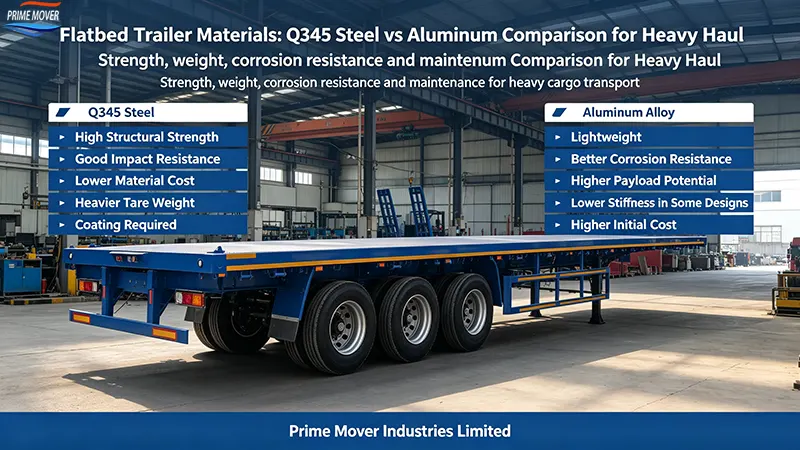
Material 1: Q345B Steel — The Heavy Haul Benchmark
Q345B steel is the default specification for heavy haul flatbed trailer main beams in Chinese manufacturing and a significant share of export production. The designation breaks down as follows: Q denotes yield strength, 345 refers to the minimum yield strength in MPa, and B indicates the quality grade with room-temperature impact testing.
Mechanical properties and typical specification
| Property | Q345B Specification |
|---|---|
| Minimum yield strength | 345 MPa |
| Tensile strength | 470–630 MPa |
| Density | 7.85 g/cm3 |
| Typical main beam cross-section | 500 mm height, 14 mm top flange, 16 mm bottom flange, 8 mm web |
| Heavy-duty upgrade | 20 mm top flange, 24 mm bottom flange |
| Weldability | Good; standard MIG/MAG and submerged arc welding |
| Corrosion protection | Requires sandblasting + epoxy primer + polyurethane topcoat |
The 500 mm beam height with 14/16 mm flanges is the industry-standard configuration for a 3-axle flatbed rated at 40 to 48 tons payload. The heavier 20/24 mm plate configuration pushes rated capacity toward 60 to 100 tons for multi-axle heavy haul applications. Q345B delivers this structural performance at a material cost significantly below high-strength alternatives like Q460 or Q690.
The limitation is weight. Steel at 7.85 g/cm3 is dense. A standard 48-foot steel flatbed trailer weighs approximately 12,000 to 13,500 lbs empty. That tare weight consumes payload capacity before a single kilogram of cargo is loaded.
Material 2: Aluminum Alloy — The Payload Multiplier
Aluminum alloy flatbed trailers use 5083 or 6061 series alloys for structural members, cross-members, and decking. The 5083 grade is preferred for welded structures exposed to harsh environments because it offers the highest strength of the non-heat-treatable alloys and excellent corrosion resistance. The 6061 grade is heat-treatable and used where higher strength is required after welding.
Mechanical properties and typical specification
| Property | Aluminum Alloy (5083 / 6061) |
|---|---|
| Minimum yield strength | 125–215 MPa (depending on temper and alloy) |
| Tensile strength | 275–310 MPa (5083-H321); 310 MPa (6061-T6) |
| Density | 2.66–2.70 g/cm3 (approximately one-third of steel) |
| Typical all-aluminum flatbed tare weight | 9,000–10,500 lbs (48–53 ft) |
| Weldability | Good with TIG/MIG; requires specialized procedure and skilled welders |
| Corrosion protection | Inherent oxide layer; no coating required for corrosion resistance |
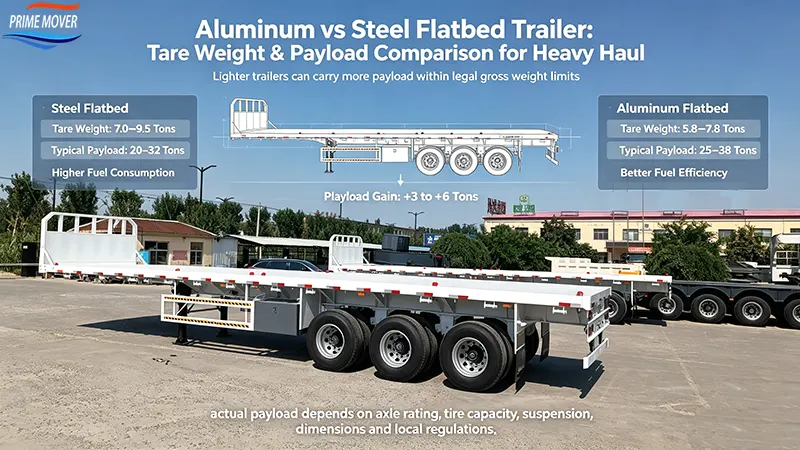
The density difference is the decisive engineering fact. Aluminum at roughly 2.7 g/cm3 is about one-third the density of steel at 7.85 g/cm3. Even though aluminum’s yield strength is lower, the weight saved per unit of structural performance is substantial. An all-aluminum flatbed trailer typically weighs 2,000 to 3,500 lbs less than a comparable steel trailer of the same length and axle configuration.
That weight difference translates directly into payload. Within the same gross vehicle weight limit, the aluminum trailer can legally carry 2,000 to 3,500 lbs more cargo on every trip.
Comparison 1: Strength-to-Weight Ratio
Raw yield strength favors steel decisively: Q345B at 345 MPa versus aluminum alloys at 125 to 215 MPa. But strength-to-weight ratio — the metric that matters for a moving vehicle — narrows the gap considerably.
| Material | Yield strength (MPa) | Density (g/cm3) | Strength-to-weight index |
|---|---|---|---|
| Q345B steel | 345 | 7.85 | 44.0 |
| 5083-H321 aluminum | 215 | 2.66 | 80.8 |
| 6061-T6 aluminum | 275 | 2.70 | 101.9 |
On a strength-to-weight basis, aluminum alloys outperform Q345B by a factor of roughly 1.8 to 2.3. This is why aluminum flatbed trailers can achieve comparable payload ratings with substantially lower tare weight. The engineering trade-off is in stiffness and fatigue behavior: steel beams deflect less under concentrated loads and tolerate higher stress cycles without cracking at weld toes.
For heavy haul applications with concentrated point loads — steel coils, machinery with small footprint contact points, or tracked equipment — Q345B’s higher absolute strength and stiffness remain advantageous. For distributed loads and weight-sensitive freight, aluminum’s strength-to-weight advantage dominates.
Comparison 2: Corrosion Resistance and Service Life
Corrosion is the primary determinant of flatbed trailer service life in coastal, northern, and tropical environments. The two materials behave in fundamentally different ways.
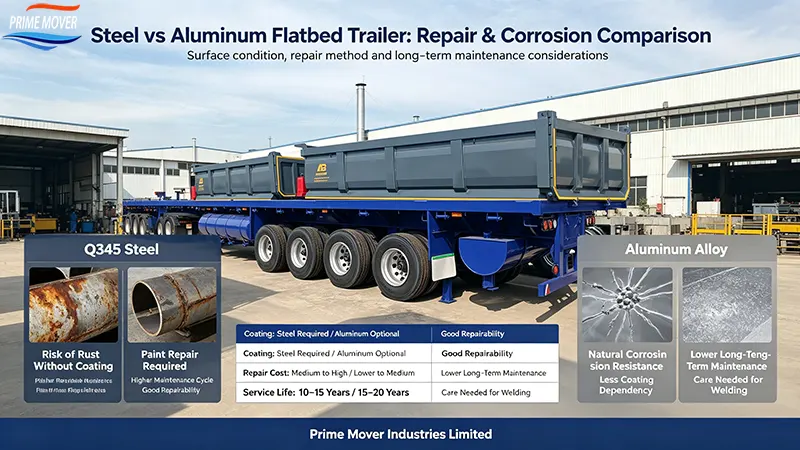
Q345B steel has no inherent corrosion resistance. It requires a protective coating system — typically sandblasting to Sa 2.5, two coats of epoxy anticorrosive primer, and two coats of polyurethane topcoat, totaling 80 to 120 microns dry film thickness. This coating degrades over time, particularly at weld toes, stake pockets, and areas subject to abrasion. A steel flatbed trailer requires touch-up painting annually and a full chassis repaint every 3 to 4 years in aggressive environments.
Aluminum alloy forms a natural oxide layer on exposure to air, which passivates the surface and prevents further corrosion. No coating is required for corrosion resistance. Aluminum flatbed trailers do not rust, do not require repainting for corrosion protection, and maintain structural integrity in salt-spray and high-humidity environments far longer than steel.
| Corrosion factor | Q345B Steel | Aluminum Alloy |
|---|---|---|
| Inherent corrosion resistance | None; requires coating | Natural oxide layer |
| Coating maintenance | Annual touch-up; repaint every 3–4 years | Not required for corrosion |
| Typical service life | 8–12 years | 15–20 years |
| Corrosion risk at welds | High; coating fails first at weld toes | Low; weld heat-affected zone remains passive |
| Coastal / road salt suitability | Requires frequent inspection and repair | Excellent |
The service life difference is significant: a steel flatbed trailer in a corrosive environment may require structural repair or replacement at 8 to 12 years, while an aluminum trailer of the same duty cycle can deliver 15 to 20 years. Over a 20-year horizon, that difference can eliminate one complete replacement cycle.
Comparison 3: Payload and Legal Weight Impact
Payload is where the material choice becomes a direct financial variable. Every kilogram of tare weight is a kilogram of legal payload that cannot be sold.
| Configuration | Tare weight | Payload within 80,000 lb GVWR | Payload difference |
|---|---|---|---|
| All-steel flatbed (48–53 ft) | 12,000–13,500 lbs | ~48,000 lbs | Baseline |
| Combo (steel beam + aluminum components) | 10,500–12,000 lbs | ~46,000–48,000 lbs | +1,000–2,500 lbs |
| All-aluminum flatbed (48–53 ft) | 9,000–10,500 lbs | ~47,000–48,000 lbs | +2,000–3,500 lbs |
The payload advantage of aluminum is most valuable when the trailer operates near the legal gross weight limit. For a fleet hauling dense cargo — steel, concrete, machinery — the additional 2,000 to 3,500 lbs of payload per trip translates into fewer trips for the same total tonnage, or higher revenue per trip for the same number of trips.
The advantage diminishes for light, bulky cargo where the trailer reaches volume capacity before weight capacity. In that scenario, the aluminum trailer’s weight savings do not convert into additional revenue, and the higher purchase price is harder to justify.
Comparison 4: Repairability and Maintenance
Repairability is the dimension where steel retains a decisive advantage, particularly in remote operating environments.
Q345B steel can be welded with standard MIG, MAG, or stick welding equipment by any competent trailer repair shop. A cracked cross-member or damaged side rail can be repaired in the field with a portable welder and reinforcement plate. The material is forgiving, the procedures are well understood, and spare steel is available in virtually every market.
Aluminum requires TIG or specialized MIG welding with a qualified procedure and a skilled welder. The heat-affected zone is weaker than the base metal unless the alloy is heat-treated after welding, and improper repair can create a stress concentration that leads to premature failure. In remote areas without aluminum welding capability, a damaged aluminum flatbed trailer may sit idle for days waiting for a specialist.
| Repair factor | Q345B Steel | Aluminum Alloy |
|---|---|---|
| Field repair capability | Any competent trailer shop | Requires aluminum-certified welder |
| Welding process | MIG / MAG / stick | TIG / specialized MIG with procedure |
| Heat-affected zone strength | Predictable; standard procedures | Reduced unless post-weld heat treated |
| Spare material availability | Universal | Less common in remote markets |
| Typical repair turnaround | Hours to 1–2 days | Days to weeks depending on location |
For fleets operating in areas with limited specialist repair capability, steel’s repairability is a risk-management advantage that can outweigh aluminum’s payload benefit. For fleets with established maintenance infrastructure and predictable routes, aluminum’s repairability limitation is manageable.
Comparison 5: Total Cost of Ownership
Purchase price is the least useful metric for comparing flatbed trailer materials because it ignores payload revenue, fuel consumption, maintenance cost, and resale value. Total cost of ownership over a five- or ten-year horizon tells a different story.
| Cost component | Q345B Steel Flatbed | Aluminum Flatbed |
|---|---|---|
| Purchase price (48–53 ft) | USD 40,000–50,000 (US/EU); USD 10,000–18,000 FOB China | USD 55,000–65,000 (US/EU); USD 18,000–25,000 FOB China |
| Annual corrosion maintenance | USD 300–800 | USD 0–200 |
| Annual fuel cost (lighter tare) | Baseline | 3–5% lower |
| Additional payload revenue per trip | Baseline | +2,000–3,500 lbs |
| Expected service life | 8–12 years | 15–20 years |
| Resale value at 10 years | Moderate | High |
A simplified five-year comparison for a fleet running 100,000 miles per year illustrates the trade-off. The aluminum trailer carries a purchase premium of roughly USD 15,000 in Western markets or USD 7,000 to 8,000 FOB China. Against that premium, the aluminum trailer delivers additional payload revenue of approximately USD 8,000 to 12,000 per year (assuming 200 loads at a conservative USD 40 to 60 per 1,000 lbs of additional payload), fuel savings of USD 1,500 to 2,500 per year, and maintenance savings of USD 300 to 600 per year.
The aluminum trailer’s payback period in a high-mileage, weight-sensitive operation is typically 12 to 24 months. Over a ten-year horizon, the aluminum trailer delivers a net advantage of USD 40,000 to 70,000 compared to the steel alternative — before accounting for the higher resale value.
Material Selection Matrix: When to Choose Which
| Operating condition | Recommended material | Reasoning |
|---|---|---|
| High-mileage, weight-sensitive, paved highways | Aluminum | Payload and fuel savings recover premium within 12–24 months |
| Coastal, northern, or tropical corrosive environments | Aluminum | Inherent corrosion resistance eliminates coating maintenance |
| Remote operations with limited repair infrastructure | Q345B Steel | Field-repairable anywhere; no specialist welding required |
| Concentrated point loads (coils, tracked equipment) | Q345B Steel | Higher stiffness and absolute strength resist localized stress |
| Rough, unpaved, or construction-site routes | Q345B Steel | Impact resistance and repairability outweigh weight penalty |
| Mixed-use fleet with varied cargo | Combo (steel beam + aluminum components) | Balances structural strength with 1,000–2,500 lbs weight savings |
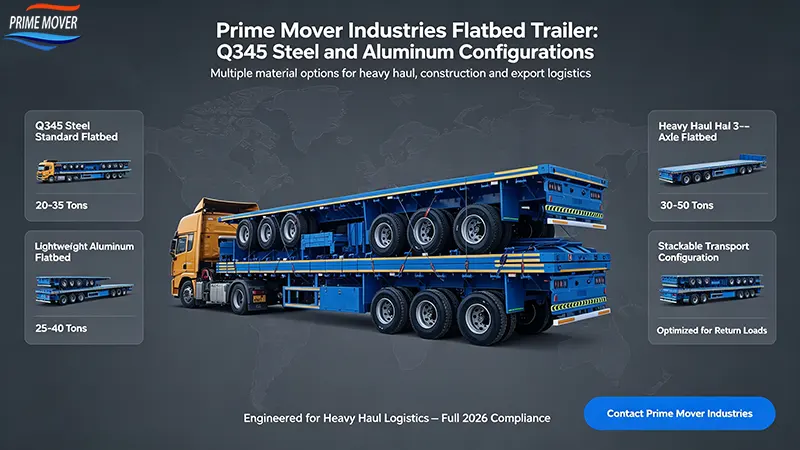
Prime Mover Industries: Q345 Steel and Aluminum Flatbed Trailer Configurations
Prime Mover Industries is a Hong Kong-based semi-trailer manufacturer and global exporter established in 2014. Its flatbed trailer line offers both Q345B steel and aluminum alloy configurations, allowing buyers to match material to cargo profile, route conditions, and maintenance capability rather than accepting a single default specification.
| Component | Q345B Steel Configuration | Aluminum Configuration |
|---|---|---|
| Main beam | Q345B, 500×14/16/8 mm; 20/24 mm heavy-duty option | 5083 / 6061 alloy structural members |
| Cross members | Q235B steel, welded | Aluminum, bolted or welded |
| Deck | 3 mm diamond plate | Aluminum deck plate |
| Side rails | Steel | Aluminum |
| Tare weight (48–53 ft) | 12,000–13,500 lbs | 9,000–10,500 lbs |
| Coating | Sandblast + 2 primer + 2 topcoats | Mill finish; no corrosion coating required |
| Axles | 3 × 13T FUWA / BPW; 16T/20T optional | Same |
| Brakes | WABCO ABS; EBS + RSS optional | Same |
For buyers comparing flatbed trailer materials for heavy haul in 2026, Prime Mover Industries provides factory-direct pricing, third-party inspection through SGS or BV, full export documentation, and the specification flexibility to choose Q345B steel, aluminum, or a combo configuration matched to the actual operating profile.
Conclusion
The choice between Q345 steel and aluminum for a heavy haul flatbed trailer is not a question of which material is better. It is a question of which material matches the operating reality. Q345B steel wins on absolute strength, stiffness, field repairability, and purchase price. Aluminum wins on strength-to-weight ratio, corrosion resistance, payload capacity, fuel efficiency, and resale value.
For high-mileage fleets operating on paved highways with weight-sensitive cargo, aluminum’s payload and operating cost advantages typically recover the purchase premium within 12 to 24 months. For fleets operating in remote areas, on rough terrain, or with concentrated point loads, Q345B steel’s repairability and stiffness remain decisive.
The combo configuration — steel main beam with aluminum cross-members, deck, and side rails — captures much of aluminum’s weight savings while retaining steel’s structural and repair advantages. For many mixed-use fleets, it is the pragmatic middle path.
For buyers in 2026, the correct approach is to define the cargo, route, annual mileage, and maintenance capability first, then select the material that fits. The flatbed trailer that delivers the best total cost of ownership is the one whose material matches the job, not the one with the lowest sticker price or the lightest tare weight.
Written by
Prime Mover Industries
Editor Wang
WhatsApp:+86-189 5386 6163
Email:wlei66@126.com
- Top 10 Fuel Tanker Trailer Manufacturers for Global Export in 2026
- Top 5 3-Axle Flatbed Trailers in 2026: Cost, Payload & Durability Compared
- Top 3 Heavy Haul Trailers Compared: Flatbed vs. Step-Deck vs. Lowboy – Which Delivers the Best ROI in 2026?
- Telematics and Smart Fleet Management – The New Era of Semi Trailers
PRIME MOVER
INDUSTRIES LIMITED