
PRIME MOVER
INDUSTRIES LIMITED
Top 3 Heavy Haul Trailers Compared: Flatbed vs. Step-Deck vs. Lowboy – Which Delivers the Best ROI in 2026?
For fleet operators and owner-operators, the choice between a flatbed, step-deck, and lowboy trailer is one of the most consequential financial decisions you will make. These are not “low-end versus high-end” options — they are parallel engineering solutions built around fundamentally different cargo geometry, route profiles, and structural load paths. The golden procurement rule is simple: define cargo first, lock the chassis second, and compare prices last.
This article provides a comprehensive ROI comparison of the Top 3 heavy haul trailers — flatbed, step-deck, and lowboy — examining acquisition costs, revenue potential, operating expenses, and total cost of ownership to help you determine which trailer type delivers the best return on investment in 2026.
1. Flatbed Trailer – The Versatile Workhorse
Flatbed trailers feature a straight-beam chassis with a fully flat deck approximately 1,450–1,550 mm (57–61 inches) from the ground. They are the most common open-deck trailer, typically 48 to 53 feet long and 8.5 feet wide.
Key Specifications:
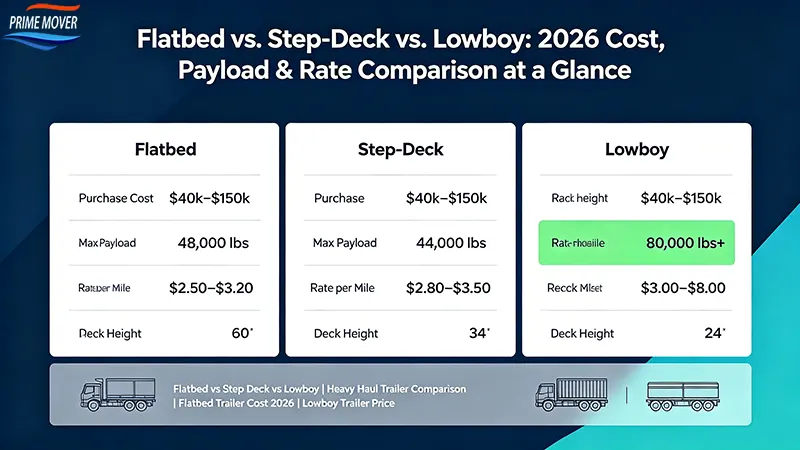
| Metric | Value |
| Deck Height | ~60 inches (5 feet) from ground |
| Deck Length | 48–53 feet (full usable) |
| Standard Width | 8.5 feet |
| Max Payload | 48,000 lbs (standard); up to 80,000 lbs gross |
| Max Legal Cargo Height | ~13.5 feet total (deck + cargo) |
| Tare Weight | 7,000–10,500 kg (15,400–23,100 lbs) |
Best-Fit Freight: Lumber, steel coils, pipes, building materials, palletized goods, containers, and medium-sized machinery that does not exceed legal height limits.
2026 Cost & Revenue Profile:
- New Trailer Cost: $40,000–$65,000
- Average Freight Rate: $2.50–$3.20 per mile
- Load Availability: Highest among open-deck trailers — flatbed loads outnumber step-deck loads 3-to-1 on major load boards
- Maintenance: Lowest among the three due to simpler construction — fewer moving parts, no drop-deck mechanisms
ROI Strengths:
- Lowest upfront investment
- Widest freight availability — less deadhead between loads
- Simplest loading/unloading — side-loading with forklifts or overhead cranes is straightforward
- Easiest tarping on a level surface
- Strong resale value — flatbeds hold value well due to fewer components to fail
ROI Weaknesses:
- Height limitation — cargo exceeding ~8.5–9 feet on the deck will exceed legal height limits
- Lower per-mile rates compared to specialized equipment
2. Step-Deck Trailer – The Height-Clearance Specialist
Step-deck trailers (also called drop-deck trailers) feature a two-level design — a shorter upper deck (10–11 feet) over the fifth wheel and a longer, lower main deck (37–43 feet) that sits 10–14 inches lower than the upper deck. This design provides additional height clearance for loads too tall for a standard flatbed but not requiring the ultra-low profile of a lowboy.
Key Specifications:
| Metric | Value |
| Upper Deck Height | 48–60 inches from ground |
| Lower Deck Height | 34–36 inches from ground |
| Total Length | 48–53 feet (upper 10–11 ft; lower 37–43 ft) |
| Standard Width | 8.5 feet |
| Max Payload | 42,000–48,000 lbs (lower deck rated higher) |
| Max Legal Cargo Height (lower deck) | Up to 10 feet in most states |
| Tare Weight | 9,575–9,885 lbs (steel-aluminum combo) |
Best-Fit Freight: Forklifts (8,000–50,000 lbs), mini excavators, skid steers, backhoes, tractors, agricultural equipment, manufactured housing components, large-diameter pipe, industrial machinery, and generators.
2026 Cost & Revenue Profile:
- New Trailer Cost: $45,000–$80,000 — roughly $5,000–$10,000 more than a comparable flatbed
- Average Freight Rate: $2.80–$3.50 per mile — approximately 10–20% premium over flatbed rates
- Load Availability: Moderate — specialized niche with fewer competing carriers
- Maintenance: Slightly higher than flatbed due to dual-deck design
ROI Strengths:
- Eliminates oversize permits for tall cargo — the extra 18–22 inches of height clearance means machinery that would require permits on a flatbed moves legally on a step deck
- Higher per-mile rates than flatbed
- Reduced permit costs and fewer escort requirements compared to lowboy
- Rear loading ramps for wheeled equipment
ROI Weaknesses:
- Higher upfront cost
- More complex tarping on uneven deck surfaces
- Lower payload capacity than flatbed (43,000–44,000 lbs vs. 48,000 lbs)
- Smaller pool of available freight
3. Lowboy Trailer – The Heavy Haul Specialist
Lowboy trailers (also called lowbed trailers) feature a deeply recessed deck just 18–24 inches from the ground. This ultra-low profile provides the maximum legal height clearance for transporting extraordinarily tall and heavy machinery.
Key Specifications:
| Metric | Value |
| Deck Height | 18–24 inches from ground |
| Deck Length | 24–53 feet (extendable to 65+ feet) |
| Standard Width | 8.5 feet (oversize to 14+ feet with permit) |
| Max Payload | 40,000–80,000 lbs standard; multi-axle to 150,000+ lbs |
| Max Legal Cargo Height | Up to 11.5–11.6 feet on deck (varies by state) |
| Tare Weight | 9,000–19,000 kg (20,000–42,000 lbs) depending on configuration |
Best-Fit Freight: Excavators (20,000–80,000 lbs), hydraulic cranes, bulldozers (D6–D11 class, 40,000–110,000 lbs), motor graders, wheel loaders, mining haul trucks, scrapers, compactors, military vehicles, transformers, and wind-power equipment.
2026 Cost & Revenue Profile:
- New Trailer Cost: $70,000–$150,000+
- Average Freight Rate: $3.00–$8.00 per mile (permitted loads); legal loads under 80,000 lbs run $3.50–$4.50 per mile
- Load Availability: Lowest among the three — specialized, niche market
- Maintenance: Highest — more axles, hydraulic systems, and complex gooseneck mechanisms
ROI Strengths:
- Highest per-mile rates in the industry — step decks and lowboys offer the highest rates but require specialized knowledge
- Can legally transport cargo that no other trailer type can accommodate
- Essential for construction, mining, and energy sector contracts
- Detachable-neck designs allow drive-on loading of tracked equipment
ROI Weaknesses:
- Highest upfront investment — 2–3x the cost of a flatbed
- Most lowboy loads require oversize permits — adding time, cost, and administrative burden
- Restricted routes — lowboys cannot travel on many roads without special permits, increasing transit time
- Highest maintenance costs — more axles and systems mean more repairs
- Higher insurance premiums due to higher replacement value
- Steep learning curve — requires specialized knowledge to operate
ROI Comparison: The Numbers That Matter
| Metric | Flatbed | Step-Deck | Lowboy |
| New Trailer Cost | $40,000–$65,000 | $45,000–$80,000 | $70,000–$150,000+ |
| Average Rate/Mile | $2.50–$3.20 | $2.80–$3.50 | $3.00–$8.00 |
| Rate Premium vs. Flatbed | Baseline | +10–20% | +20–150%+ |
| Max Payload | 48,000 lbs | 43,000–44,000 lbs | 40,000–150,000+ lbs |
| Load Availability | Highest (3× step-deck) | Moderate | Lowest |
| Permit Requirements | Minimal | Minimal to moderate | Almost always required |
| Maintenance Cost | Lowest | Moderate | Highest |
| Tarping Difficulty | Low | High | Moderate to high |
| Best For | High-volume, standard freight | Tall but moderate-weight cargo | Extreme height/weight cargo |
ROI Calculation: Flatbed vs. Step-Deck (Illustrative Example)
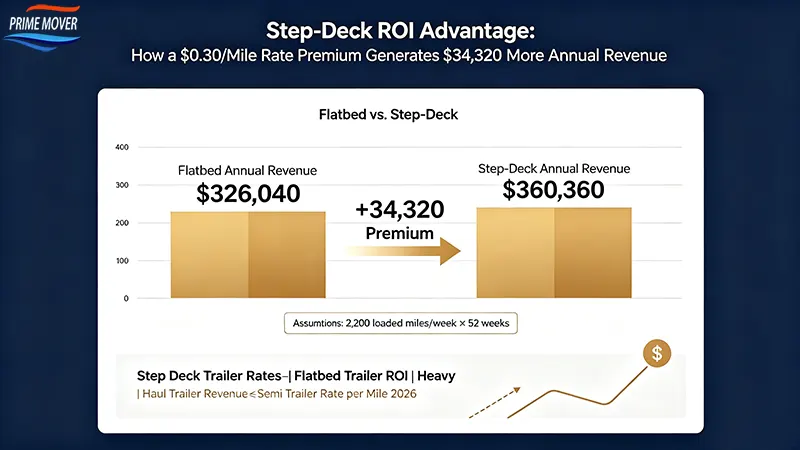
Let us compare a flatbed and a step-deck over one year of operation, assuming 2,200 loaded miles per week (approximately 114,400 miles annually).
| Metric | Flatbed | Step-Deck |
| Trailer Cost | $50,000 (average) | $62,500 (average) |
| Rate/Mile | $2.85 (mid-range) | $3.15 (mid-range) |
| Annual Revenue | $326,040 | $360,360 |
| Annual Revenue Premium | — | +$34,320 |
At a $0.30/mile rate premium, the step-deck generates an additional $34,320 in annual revenue. Even after accounting for a $12,500 higher upfront cost and slightly higher maintenance, the step-deck can pay for its premium within the first year. This explains why many owner-operators specializing in machinery transport prefer step-decks despite the higher initial investment.
Lowboy ROI: A Different Calculation
Lowboy ROI cannot be evaluated on a per-mile basis alone. Lowboy operators typically:
- Haul fewer loads per year due to specialized nature and route restrictions
- Charge significantly higher rates ($3.50–$8.00/mile) to compensate
- Incur substantial permit costs — most lowboy loads require at least one oversize permit
- Face higher operating costs — heavier trailers consume more fuel; more axles increase toll and permit costs
For contractors with consistent heavy equipment transport needs — such as construction companies moving excavators and bulldozers between job sites — the lowboy is not optional. It is the only compliant way to move certain cargo. In these cases, ROI is measured not by rate per mile but by ability to win and execute contracts that would be impossible with any other trailer type.
Which Trailer Delivers the Best ROI in 2026?
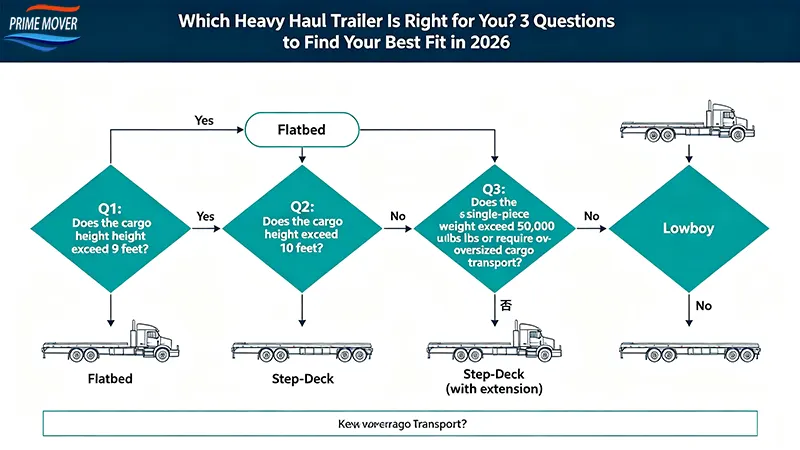
The answer depends entirely on your cargo profile, operating region, and business model.
Choose Flatbed when:
- You haul standard-height freight (lumber, steel, building materials, palletized goods)
- You want maximum load availability and minimum deadhead
- Lowest upfront cost and simplest maintenance are priorities
- You are starting an open-deck trucking business with limited capital
Choose Step-Deck when:
- Your freight is too tall for a flatbed but under 10 feet on the lower deck
- You want to capture the 10–20% rate premium without the complexity of lowboy operations
- You transport machinery, vehicles, or agricultural equipment
- You want to avoid oversize permits that would be required on a flatbed
Choose Lowboy when:
- Your cargo height or single-item weight makes a standard deck illegal or operationally impractical
- You specialize in construction, mining, or energy sector heavy haul
- You have consistent contracts for moving excavators, bulldozers, cranes, or transformers
- You are prepared for the higher investment, permit requirements, and specialized knowledge
Prime Mover Industries: Your Partner in Heavy Haul Solutions
As a Hong Kong-based enterprise established in 2014, Prime Mover Industries has positioned itself as a specialized manufacturer and global exporter of semi-trailers, serving the diverse transportation needs of construction, logistics, agriculture, and heavy industry sectors worldwide.
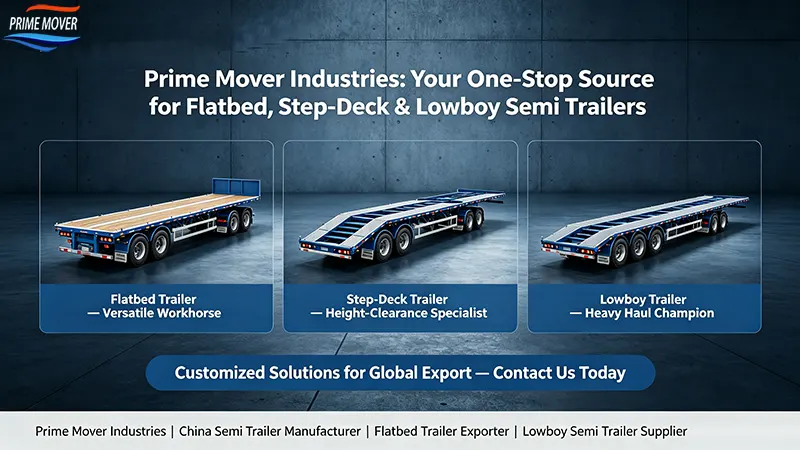
The company's product portfolio spans all three trailer types discussed in this article:
- Flatbed Trailers — engineered with high-strength steel and aluminum-composite hybrid designs for maximum payload and durability
- Step-Deck Trailers — designed for tall machinery and equipment transport with optimal height clearance
- Lowboy Trailers — built for extreme heavy haul applications, including construction machinery, mining equipment, and wind-power components
With a strategic headquarters in one of the world's busiest logistics hubs, Prime Mover Industries offers international clients access to Asia-Pacific's dynamic growth markets while facilitating efficient global exports. The company's commitment to quality control, customer-specific customization, and cost-competitive manufacturing enables fleets worldwide to maximize ROI — whether they need the versatility of a flatbed, the height clearance of a step-deck, or the heavy-haul capability of a lowboy.
The right trailer for your fleet is the one that matches your cargo. Define your cargo first, choose the chassis second, and let Prime Mover Industries deliver a tailored solution that maximizes your return on investment in 2026 and beyond.
Written by
Prime Mover Industries
Editor Wang
WhatsApp:+86-189 5386 6163
Email:wlei66@126.com
- Flatbed Trailer Market 2026-2033: USD 10.54 Billion Forecast & Key Growth Drivers
- How to Choose the Right Semi-Trailer for Your Business
- Electric Semi Trailers: The Future of Green Freight Transport
- Top 5 Lightweight Materials for Flatbed Trailers in 2026: How High-Strength Steel & Aluminum Boost Payload by 18%
PRIME MOVER
INDUSTRIES LIMITED