
PRIME MOVER
INDUSTRIES LIMITED
Best GPS Tracking Solutions for Flatbed Trailers: 7 Must-Have Telematics Features for 2026
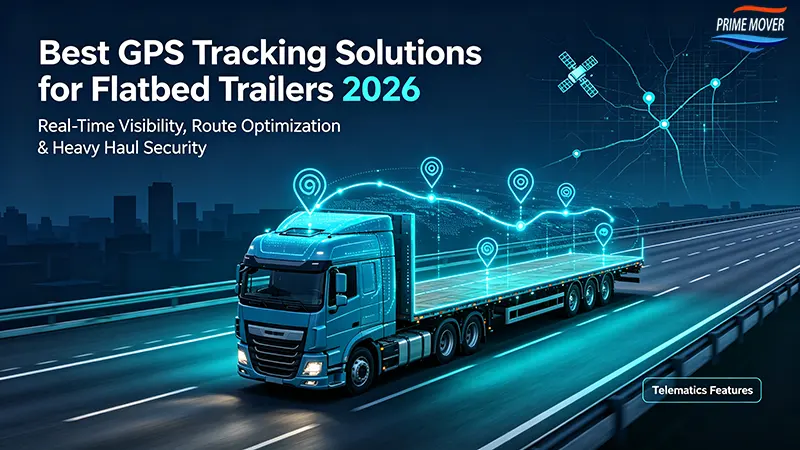
Flatbed trailers are among the most valuable assets in any fleet — and among the hardest to track. Unlike powered vehicles, trailers do not generate their own location data, which often makes them invisible to dispatchers. That gap in visibility results in lost or misplaced trailers, underused assets, and costly operational inefficiencies.
The trailer telematics market is responding to this challenge at breakneck speed. The global trailer telematics market was valued at USD 2.54 billion in 2025 and is projected to grow from USD 3.02 billion in 2026 to USD 7.04 billion by 2034, at a CAGR of 11.2%. Other industry estimates place the 2026 market at $3.85 billion with a 14% CAGR. North America currently dominates with a 38.19% market share, while Asia Pacific is projected to be the fastest-growing region.
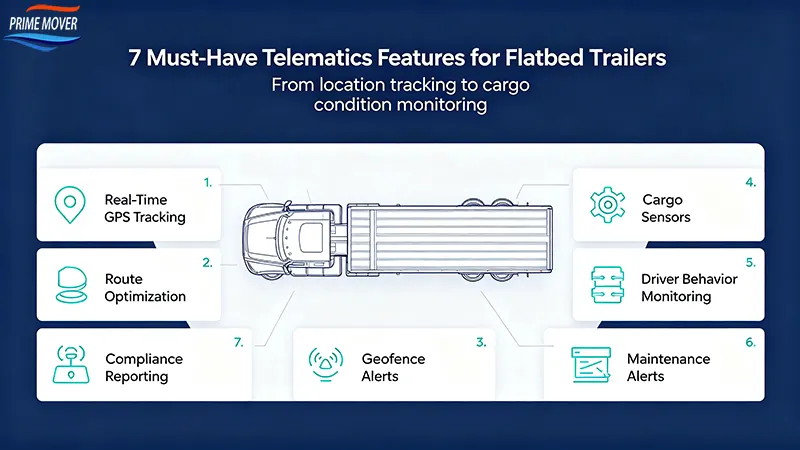
But not all telematics solutions are created equal. For flatbed fleets — which operate in harsh outdoor environments, carry diverse cargo, and face unique security and maintenance challenges — the right system must deliver more than just a dot on a map. Here are the 7 must-have telematics features for flatbed trailers in 2026.
1. Real-Time GPS Tracking with Event-Based Reporting
Basic GPS tracking is the starting point, but modern flatbed fleets need more than periodic location pings. A self-powered GPS trailer tracker — built for long battery life, low-maintenance deployment, and rugged outdoor service — is the most common starting point. However, the real value lies in smart event-based reporting: instead of constant pings, the device reports on movement, stop duration, geofence entry, unauthorized motion, coupling changes, or scheduled intervals that match business needs.
Why it matters for flatbeds: Flatbed trailers transporting equipment or materials between worksites benefit immensely from GPS tracking. Location data alone is valuable for security, dispatch, and utilization tracking. When a flatbed trailer carrying $60,000 worth of cargo goes missing, knowing its exact location within hours — not days — can make the difference between recovery and total loss.
The Data: Assets equipped with GPS tracking recover at rates above 90%, compared to less than 60% for those without. Trailers without GPS are recovered only 7% of the time after theft.
2. Dwell Time Analytics & Utilization Monitoring
Dwell time — the amount of time a trailer remains idle at a location — is one of the highest-value metrics in trailer telematics because it exposes underused assets, bottlenecks at customer sites, and trailers that should be reallocated.
For flatbed fleets, dwell time analytics can transform operations. Sibley Transportation, a company with over a century of experience, implemented FleetPulse trailer telematics and achieved remarkable results:
- $134,100+ in annual savings
- 17% increase in trailer utilization
- 28,560 empty miles eliminated
The 17% boost in trailer utilization alone translated to $88,700 in additional annual revenue. By using live GPS tracking and utilization insights, Sibley proactively repositioned underused trailers, reducing empty miles by 2,380 miles per month — resulting in $30,400 in yearly savings through reduced fuel consumption.
Why it matters for flatbeds: Flatbed trailers often sit idle at construction sites, warehouses, or customer yards. Without visibility into dwell time, fleets cannot distinguish between a trailer that is "being loaded" and one that is "being forgotten."
3. Tire Pressure Monitoring System (TPMS)
Few components affect safety, uptime, and fuel costs like trailer tires. And flatbeds, with their exposed setups and varied loads, are particularly vulnerable to tire issues.
Brad Windy, Great Dane's Director of Application Engineering, emphasizes: *"TPMS is just as helpful on flatbeds as anywhere else. In fact, with certain GAWR limits, having underinflated tires can put you out of compliance."* Underinflated tires generate more heat and more rolling resistance, which increases the risk of blowouts and fuel consumption.
The Data:
- Proactive tire management can reduce emergency roadside tire-related events by as much as 80%
- Proper tire pressure monitoring can increase tire lifespan up to 9% in cases where chronic under-inflation was corrected
- Fuel efficiency can be boosted by up to 4% when recommended pressures are maintained
- Even a 10% deviation in tire pressure from the prescribed value increases fuel consumption by more than 250 liters over an annual distance of 120,000 kilometers
- Fleets that move to a "preventative health" model have slashed maintenance costs by an average of 24%
Why it matters for flatbeds: Flatbed trailers haul heavy, concentrated loads — steel coils, machinery, lumber — that place immense stress on tires. A blowout on a flatbed carrying heavy cargo is not just a delay; it is a safety hazard.
4. ABS Fault Code Alerts & Remote Diagnostics
Anti-lock braking system (ABS) faults are a leading cause of roadside inspection violations and unplanned downtime. Telematics systems that capture and transmit ABS fault codes enable fleets to resolve issues before inspections — not during them.
The Data: Roadside breakdowns cost $500–$1,000 on average. Fleets that do predictive maintenance based on data can reduce maintenance costs between 25–40%. In one case, a fleet saved over $1.3 million in a single year across a 3,000-trailer fleet by shifting to data-driven maintenance.
Why it matters for flatbeds: Flatbed trailers are frequently subject to DOT inspections due to their open-deck design and visible cargo. An ABS fault detected at an inspection means an out-of-service order, a delayed load, and a dissatisfied customer.
5. Geofencing & Theft Prevention
Flatbed trailers are prime targets for theft due to their high value and the ease with which they can be moved. Geofencing allows fleet managers to define virtual boundaries around yards, customer sites, cross-docks, or restricted areas. When a trailer crosses these boundaries without authorization, instant alerts are triggered.
The Data:
- Cargo and trailer theft losses hit an estimated $725 million in 2025, up 60% from the previous year
- 204 semi-trailers were stolen in Q1 2025 alone — a 39% year-over-year increase
- A Samsara survey showed that tracked assets cut theft losses by 76% and insurance premiums by 31%
- Within weeks of implementing telematics, Sibley Transportation recovered a $60,000 trailer stolen from their yard, delivering immediate ROI through theft prevention
Why it matters for flatbeds: Flatbed trailers are often parked at unsecured construction sites, remote job sites, or overnight truck stops. Their open design makes cargo visible — and theft tempting.
6. Load Monitoring & Weight Compliance
Modern telematics systems can integrate load sensors that monitor whether a flatbed trailer is loaded, empty, or overloaded. This capability supports safety, weight compliance, and utilization optimization.
Why it matters for flatbeds: Flatbed trailers frequently haul cargo that pushes legal weight limits — steel coils, heavy machinery, construction materials. Overloading not only invites fines but also accelerates wear on suspension, axles, and tires. Load monitoring provides real-time visibility into weight distribution, helping dispatchers assign the right trailer to the right load.
7. Integrated Fleet Management Platform Compatibility
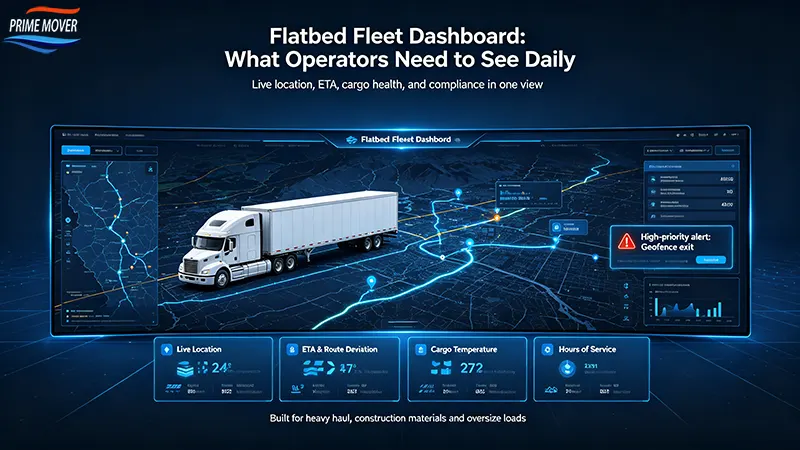
A telematics system is only as valuable as its data integration. The best GPS tracking solutions for flatbed trailers offer open APIs and seamless integration with existing fleet management platforms, dispatch systems, and maintenance workflows.
Leading providers like Great Dane now offer factory-installed, hard-wired telematics platforms that deliver real-time asset, safety, and cargo insights through open APIs and easy-to-use mobile and web dashboards. Phillips Connect has integrated smart trailer data into McLeod TMS workflows, allowing fleets to view trailer health, location, and cargo status inside the same systems used for planning, dispatch, and execution.
Why it matters for flatbeds: Flatbed fleets often operate with mixed trailer ages and types. A platform that works across the entire fleet — rather than creating data silos — delivers the greatest ROI.
The ROI Picture: What Fleets Can Expect
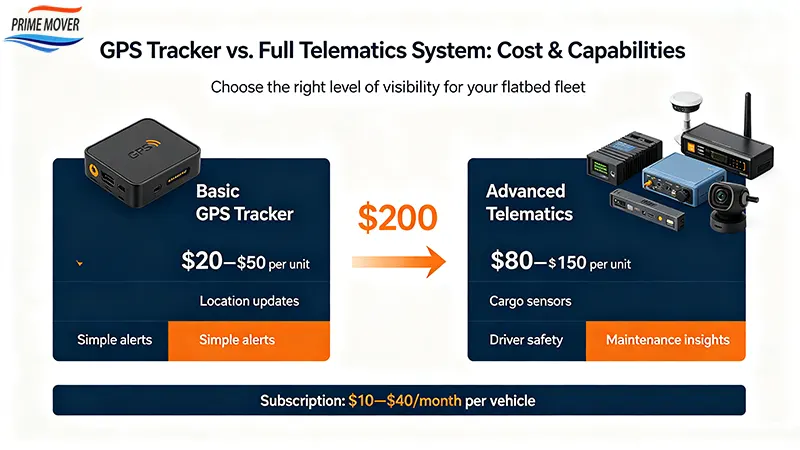
Organizations deploying predictive telematics report annual savings of $8,000 to $15,000 per trailer. Verizon Connect reports that 70% of fleets utilize GPS tracking, with 41% experiencing a positive ROI within a year.
The trailer telematics retrofit kit market — which enables fleets to upgrade existing trailers rather than buying new ones — is itself growing rapidly, from $1.52 billion in 2025 to $1.73 billion in 2026 at a CAGR of 13.8%. This reflects a broader industry recognition that telematics is not a luxury — it is a competitive necessity.
Prime Mover Industries: Your Partner in Connected Flatbed Solutions
As a Hong Kong-based enterprise established in 2014, Prime Mover Industries has positioned itself as a specialized manufacturer and global exporter of semi-trailers, serving the diverse transportation needs of construction, logistics, agriculture, and heavy industry sectors worldwide.
The company's flatbed trailer product line is engineered with the latest advancements in lightweight materials — from high-strength steel to aluminum-composite hybrid designs — and is fully compatible with modern telematics and GPS tracking systems. Whether you are retrofitting an existing fleet or spec'ing new trailers with factory-installed telematics, Prime Mover Industries delivers cost-competitive, customizable solutions that maximize payload, reduce fuel consumption, and improve overall operational efficiency.
With a strategic headquarters in one of the world's busiest logistics hubs, Prime Mover Industries offers international clients access to Asia-Pacific's dynamic growth markets while facilitating efficient global exports. The company's commitment to quality control and customer-specific customization enables fleets worldwide to harness the power of telematics — and achieve the 5X return on investment that smart trailer technology can deliver.
Conclusion
The trailer telematics market is projected to grow from $3.02 billion in 2026 to $7.04 billion by 2034. Flatbed fleets that invest in the right telematics features today — real-time GPS tracking, dwell time analytics, tire pressure monitoring, ABS alerts, geofencing, load monitoring, and platform integration — will be the ones that capture the efficiency gains, cost savings, and competitive advantages of tomorrow.
As Great Dane's Brad Windy puts it: The ROI comes from eliminating surprises. That's what telematics delivers. For flatbed fleets in 2026, there has never been a better time to spec smart.
Written by
Prime Mover Industries
Editor Wang
WhatsApp:+86-189 5386 6163
Email:wlei66@126.com
PRIME MOVER
INDUSTRIES LIMITED