
PRIME MOVER
INDUSTRIES LIMITED
Top 7 Buying Tips for Flatbed Trailer, Fuel Tanker Trailer and Bulk Cement Tank Trailer in 2026
The global semi-trailer market is undergoing a significant transformation in 2026. The flatbed semi-trailer market alone is projected to grow by over 40,000 units between 2021 and 2026, achieving a CAGR of approximately 3.98%, with Asia-Pacific driving roughly half of that expansion. Meanwhile, the Suez Canal's partial reopening in 2026 is releasing an estimated 2 million TEUs of container capacity back into global trade lanes, creating significant downstream demand for trailers at ports and logistics hubs worldwide.
For procurement managers and fleet operators, 2026 is a critical year to make informed purchasing decisions. Whether you are expanding your fleet or replacing aging equipment, this guide covers the Top 7 buying tips for three of the most essential trailer types — Flatbed, Fuel Tanker, and Bulk Cement Tank — to help you maximize ROI and avoid costly mistakes.
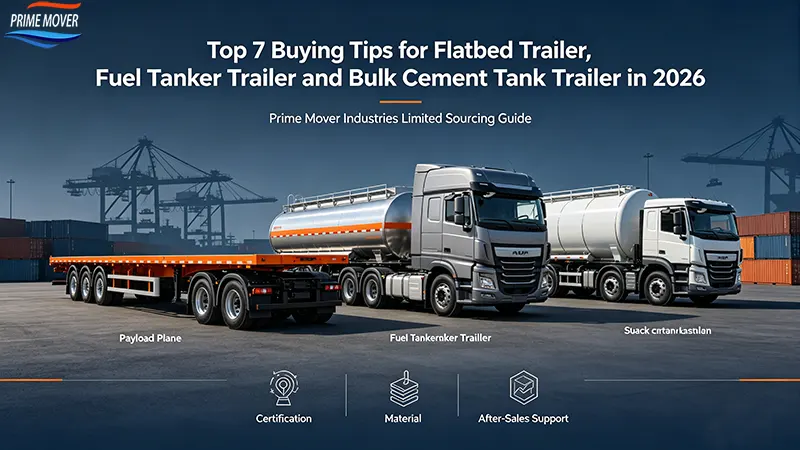
1. Define Your Cargo First — Then Choose the Trailer
One of the biggest mistakes fleets make is selecting a trailer that doesn't properly match their freight operations. The selection logic should always follow the same sequence: cargo type → trailer type → specifications.
| Cargo Type | Recommended Trailer |
| Steel coils, lumber, pipes, machinery, containers | Flatbed Trailer |
| Crude oil, gasoline, diesel, aviation fuel | Fuel Tanker Trailer |
| Cement powder, fly ash, lime powder, mineral powder | Bulk Cement Tank Trailer |
For Flatbed Buyers: Use a flatbed when your cargo is heavy machinery, structural steel, prefab concrete, pipes, coils, agricultural equipment, timber logs, or any item that is oversized, irregularly shaped, or needs crane loading. If your cargo needs weather protection, a flatbed is the wrong tool.
For Fuel Tanker Buyers: Different tankers serve different fuels. Crude oil tankers must meet DOT and operator specifications; produced water and saltwater tankers often require insulated or corrosion-resistant designs; chemical tankers require hazmat-rated materials and certifications.
For Bulk Cement Buyers: The exact material matters — particle size, density, moisture, abrasiveness, and contamination risk all affect the design. Before production, buyers should provide material name, bulk density, moisture content, particle size, and unloading requirements.
2. Master the Material Trade-Off — Weight vs. Cost vs. Durability
Material selection is one of the most consequential decisions you will make. Each trailer type presents distinct material trade-offs:
| Material | Flatbed | Fuel Tanker | Bulk Cement Tank |
| Carbon / High-Strength Steel | Cheapest, most durable, heaviest (12,000–13,500 lbs empty) | $14,000–$18,000 | Heavier but lower cost; standard for V-type designs |
| Aluminum Alloy | Lightest (9,000–10,500 lbs empty), higher cost | $20,000–$28,000 | 30–40% lighter than steel, corrosion-resistant |
| Combo / Hybrid | $45,000–$55,000, balances weight and cost | N/A | N/A |
For Flatbed Buyers: Standard steel flatbeds weigh the most, cutting into payload. All-aluminum flatbeds add payload for weight-critical freight but cost more and are harder to repair. Combo (steel/aluminum) trailers offer a practical middle ground — lighter than steel, more affordable than full aluminum.
For Fuel Tanker Buyers: Premium aluminum tankers use 5083 or 5454 aluminum alloys — approximately 3–4 tons lighter than carbon steel, with natural corrosion resistance. A 3-axle 40,000L carbon steel tanker starts around $16,900 — roughly 35% less than an equivalent aluminum build. If your routes cover thousands of kilometers in high-salinity or high-humidity regions, prioritize aluminum alloy.
For Bulk Cement Buyers: Aluminum alloy 5083 tanks are 30–40% lighter than carbon steel. That extra payload capacity directly increases revenue per trip, especially in markets with strict axle weight laws. Aluminum also resists corrosion from moisture in cement and fly ash.
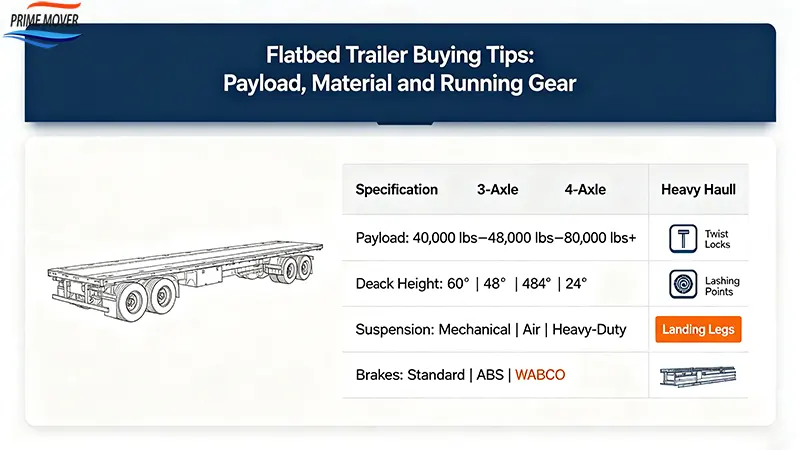
3. Think Total Cost of Ownership (TCO) — Not Just Purchase Price
Industry experts recommend choosing trailers based on total cost of ownership (TCO), not just purchase price. A trailer with a higher initial price tag may generate greater value over its lifespan.
2026 Price Ranges (New):
| Trailer Type | Price Range (New) | Used Price Range |
| Flatbed (48'-53') | $35,000–$60,000 | $15,000–$35,000 |
| Fuel Tanker (Aluminum) | $20,000–$32,000 | Varies by condition |
| Fuel Tanker (Carbon Steel) | $14,000–$18,000 | Varies by condition |
| Bulk Cement Tank | $12,000–$25,000+ (China ex-works) | Varies by condition |
Key TCO Factors to Consider:
- Maintenance costs: Proactive maintenance based on data can reduce costs by 25–40%
- Depreciation and resale value: All-aluminum trailers hold value better in markets that prize payload and corrosion resistance
- Fuel efficiency: Lighter trailers consume less fuel over hundreds of thousands of miles
- Warranty coverage: New trailers offer full warranty protection
- Financing options: Leasing runs $800–$1,500 per month for flatbeds
4. Verify Safety Compliance and Regulatory Requirements
2026 brings updated safety regulations across multiple jurisdictions that directly impact your purchasing decisions.
For Fuel Tanker Buyers (Critical):
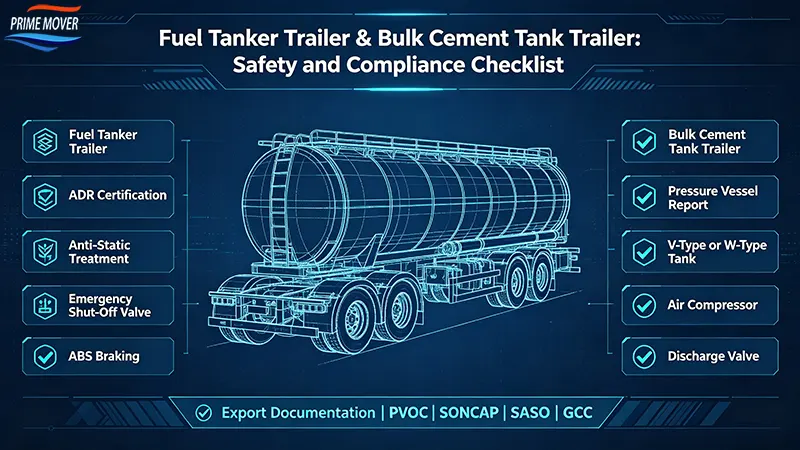
- China: GB/T 47181-2026 took effect on June 1, 2026. Tankers must comply with GB 18564.1 and GB 18564.2 technical requirements.
- ADR 2026 Amendments: Stricter requirements for emergency shut-off valves and grounding systems.
- GCC Standardization: Mandatory fire suppression systems for tankers over 30m³ capacity.
- FMCSA: Amended fuel tank requirements with new exceptions for auxiliary pumps.
Key safety features to demand:
- For Fuel Tankers: Emergency shut-off foot valves (automatically close in collisions to prevent leakage); vapor recovery systems (standard on premium 2026 models); static electricity conducting system; explosion-proof manhole covers with pressure relief.
- For Flatbeds: Dual-line air brakes with WABCO or equivalent relay valves, ABS (Anti-lock Braking System), and load-sensing brake proportioning.
- For Bulk Cement Tankers: Safety valves, pressure relief systems, and proper discharge pipeline design.
5. Match Specifications to Your Operating Environment
Your routes, terrain, and local regulations should dictate your trailer specifications — not the other way around.
For Flatbed Buyers:
- Deck length: Standard 40ft (13m) for general cargo; extendable (13–20+m) for pipes and wind turbine blades; 48–53ft for maximum capacity.
- Axle configuration: 2 axles for 30–40 tons; 3 axles for 40–60 tons; 4–6 axles for 60–120 tons.
- Payload capacity ranges: Standard 40ft flatbed handles 40–50 tonnes; multi-axle heavy-duty handles 60–120 tons.
For Fuel Tanker Buyers:
- Capacity: Typical petroleum tankers range from 6,000–9,500 gallons (all compartments combined).
- Compartment configuration: Multiple compartments allow different fuel grades in one trip.
- Low center of gravity design: Gooseneck or Double-D cross-section design keeps the center of gravity close to the ground, significantly reducing rollover risk.
For Bulk Cement Buyers:
- Capacity: Typical range is 30–60 m³; common options include 38CBM, 40CBM, and 50CBM models.
- Tank shape: V-type/single-cone is cheapest, best for standard cement; W-type/double-cone improves fluidization and reduces residual material to under 1%.
- Compressor output: 12–18 m³/min for efficient unloading.
- Discharge rate: High-performance systems achieve fast discharge up to 1.4 tons per minute with minimal residual ash (~0.2%).
6. Choose Between New vs. Used — and Consider Factory-Direct Sourcing
New vs. Used:
| Factor | New | Used |
| Cost | Higher ($35k–$150k+) | Lower ($15k–$35k for good condition flatbed) |
| Warranty | Full coverage | Limited or none |
| Customization | Full control over specs | Limited to existing configuration |
| Service Life | Longer expected service life | Shorter remaining life |
| Depreciation | Higher initial depreciation | Lower depreciation |
For international buyers:
- Factory-direct purchasing can save approximately 15% compared to buying through trading companies.
- Verify the supplier is a manufacturer, not just a trader.
- Chinese manufacturers are increasingly favored worldwide for their quality, customization capabilities, and cost-effectiveness.
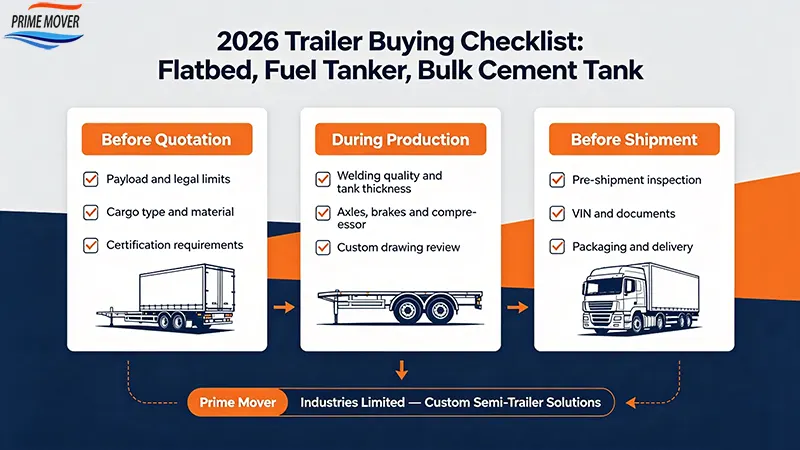
7. Inspect Before You Buy — Critical Checkpoints
Before finalizing any purchase, inspect these critical areas:
For All Trailer Types:
- Chassis condition and structural integrity
- Brake system and suspension components
- Corrosion and structural wear points
- Flooring condition
For Flatbeds Specifically:
- Main beam material (Q345B steel standard; Q460 high-strength for heavy-duty)
- Twist lock functionality for container transport
- Deck flatness and weld quality
For Fuel Tankers Specifically:
- Tank weld integrity and leak testing
- Valve and emergency shut-off system functionality
- Static electricity grounding system
- Vapor recovery system compliance
For Bulk Cement Tankers Specifically:
- Pneumatic discharge system performance
- Compressor and diesel engine condition
- Fluidization system and aeration quality
- Residual material percentage (target: ≤0.2–1%)
Conclusion: Making the Right Purchase in 2026
The semi-trailer market in 2026 offers significant opportunities — but also significant risks for uninformed buyers. Define your cargo first, match materials to your operating environment, and calculate TCO rather than just purchase price. Verify safety compliance for 2026 regulations, inspect thoroughly before purchase, and consider factory-direct sourcing for the best value.
Prime Mover Industries — a Hong Kong-based enterprise established in 2014 — offers a comprehensive portfolio spanning flatbed trailers, fuel tanker trailers, bulk cement tank trailers, and dropside trailers. With a strategic headquarters in one of the world's busiest logistics hubs, the company provides international clients access to Asia-Pacific's dynamic growth markets while facilitating efficient global exports. Prime Mover Industries' commitment to quality control, customer-specific customization, and cost-competitive manufacturing enables fleets worldwide to maximize ROI — whether you need the versatility of a flatbed, the specialized design of a fuel tanker, or the pneumatic efficiency of a bulk cement tanker.
The right trailer for your fleet is the one that matches your cargo, your routes, and your budget. Apply these 7 tips, do your homework, and make 2026 the year your fleet operates at peak efficiency.
Written by
Prime Mover Industries
Editor Wang
WhatsApp:+86-189 5386 6163
Email:wlei66@126.com
PRIME MOVER
INDUSTRIES LIMITED