
PRIME MOVER
INDUSTRIES LIMITED
Top 7 Bulk Cement Tank Trailer Troubleshooting & Daily Inspection Guide
A bulk cement tank trailer is a pressure vessel, a pneumatic conveyor, and a road vehicle operating as a single system. When discharge slows down or residual material rises, the cause is rarely a single failed component. It is usually a chain of small deviations — a partially blocked aeration pad, a compressor running below rated output, a discharge valve not fully open, or a seal that has hardened — that together push discharge time from 30 minutes to two hours.
The economics of getting this wrong are measurable. A pneumatic discharge system operating at design specification moves 1.4 to 1.6 tons per minute and leaves residual material below 0.3%. When performance degrades to 0.8 tons per minute, a 40-ton load takes 50 minutes instead of 28, and the trailer loses one trip per day. At a conservative revenue estimate of $600 per trip, that is roughly $150,000 in annual revenue lost per trailer from a problem that often traces back to a $40 aeration pad or a clogged air filter.
This guide covers the top 7 bulk cement tank trailer troubleshooting scenarios and the daily inspection routine that prevents most of them. Each troubleshooting entry follows the same structure: symptom, likely causes ranked by probability, diagnostic steps, and corrective action. The final section provides a daily and weekly inspection checklist that catches degradation before it becomes a breakdown.
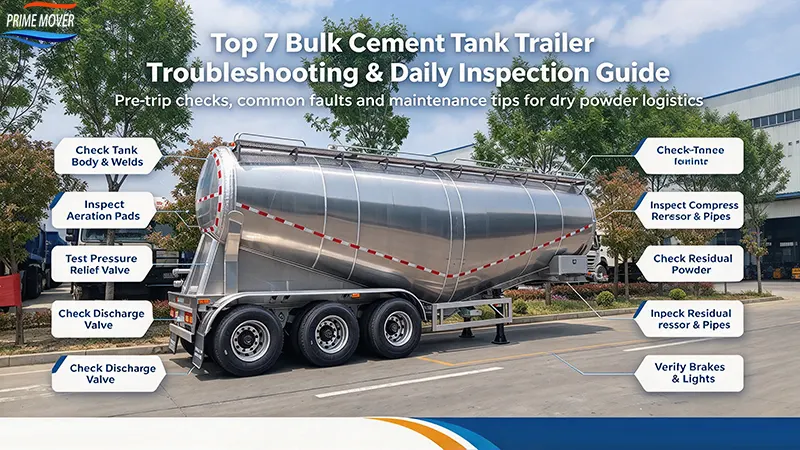
Troubleshooting 1: Slow Discharge Rate
Slow discharge is the most common complaint in bulk cement tank trailer operation and the one with the widest range of root causes. Design discharge for a standard 40-ton configuration is 1.4 to 1.6 tons per minute, or roughly 25 to 30 minutes for a full load. If discharge time exceeds 45 minutes, the system has degraded.
| Likely cause | Probability | Diagnostic step |
|---|---|---|
| Discharge valve not fully open | High | Verify valve position indicator; physically confirm full travel |
| Compressor output below rated capacity | High | Check pressure gauge at tank; compare to 0.2–0.35 MPa working pressure |
| Blocked or worn aeration pads | Medium | Inspect fluidization pattern; uneven aeration indicates blockage |
| Discharge hose internal collapse | Medium | Check hose for soft spots or delamination |
| Material bridging in the tank | Low | Check for vibration or hammer-test tank walls |
The diagnostic sequence should start at the discharge end and work backward. Confirm the valve is fully open before suspecting the compressor. Verify tank pressure at the gauge — if it sits below 0.2 MPa, the compressor is the problem, not the tank. If pressure is within range but discharge is slow, inspect the aeration pattern inside the tank through the inspection hatch after the load is discharged.
Corrective action depends on the finding. A partially open valve requires linkage adjustment. Low compressor output usually traces to a clogged air filter, worn compressor vanes, or a slipping drive belt. Blocked aeration pads require removal and cleaning or replacement. Hose collapse requires hose replacement — a 7-metre steel-wire reinforced hose is the standard specification.
Troubleshooting 2: Excessive Residual Material
Residual material above 1% by volume signals that the fluidization system is not moving powder efficiently toward the discharge point. On a 40-ton load, 1% residual equals 400 kg of material left in the tank per trip — material that must be cleaned out and that represents direct revenue loss.
| Likely cause | Probability | Diagnostic step |
|---|---|---|
| Insufficient discharge time / early shutdown | High | Verify operator allows discharge to run until air-only flow |
| Worn or contaminated aeration pads | High | Inspect pad surface for cement buildup or tears |
| Tank design mismatch (V-type vs W-type) | Medium | Confirm tank geometry; W-type should achieve <1% residual |
| Improper tank inclination during discharge | Medium | Check whether trailer is level or slightly inclined toward discharge |
| Low compressor pressure at end of cycle | Low | Monitor pressure through the full discharge cycle, not just at start |
Operator behavior is the most common cause. Many drivers shut down discharge when the material flow visually stops, but the pneumatic system continues to move material for another 3 to 5 minutes with air-only flow. Training operators to run the full cycle is the lowest-cost correction.
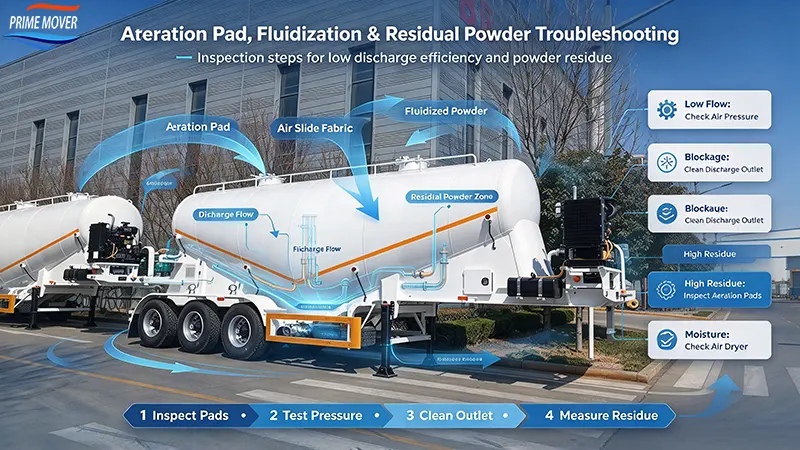
If operator behavior is correct and residual remains above 1%, the aeration pads are the next suspect. Cement builds up on pad surfaces over time, reducing airflow through the fluidization medium. Pads should be inspected every 6 months and replaced when airflow is visibly restricted. A W-type double-cone tank design should achieve residual below 1% when the fluidization system is functioning correctly.
Troubleshooting 3: Compressor Failure or Low Output
The air compressor is the heart of the pneumatic discharge system. A 12 m³/min compressor is standard for 3-axle configurations, with 16 to 18 m³/min specified for high-altitude operations or long discharge distances. When compressor output drops, every downstream function degrades.
| Symptom | Likely cause | Corrective action |
|---|---|---|
| Compressor runs but pressure stays low | Clogged air intake filter | Clean or replace filter element |
| Pressure builds slowly | Worn compressor vanes or piston rings | Compressor overhaul or replacement |
| Unusual noise or vibration | Bearing failure or loose mounting | Stop operation; inspect bearings and mounting bolts |
| Compressor overheats | Low oil level, blocked cooling, or continuous overload | Check oil, clean cooling fins, verify duty cycle |
| No output at all | Drive belt failure or clutch failure | Inspect belt tension and clutch engagement |
The compressor air filter is the most frequently neglected maintenance item on a bulk cement tank trailer. In dusty operating environments, the filter can clog within weeks, reducing output by 20% to 30% before any other symptom appears. Filter inspection should be part of the weekly routine, not the annual service.
Compressor oil level should be checked daily. Low oil causes overheating and accelerated vane or ring wear. The oil should be changed at the interval specified by the compressor manufacturer — typically every 500 to 1,000 operating hours depending on duty cycle and ambient conditions.
Troubleshooting 4: Aeration Pad Blockage
Aeration pads, also called fluidization pads or air slides, are porous media that distribute compressed air evenly through the powder bed. When they block, the powder does not fluidize properly, and discharge becomes uneven or stalls entirely.
Symptoms of aeration pad blockage include uneven discharge from different compartments, visible dead zones inside the tank, and discharge that starts fast then slows abruptly. Cement contamination on the pad surface, tears in the fabric or sintered metal, and moisture ingress are the three primary causes.
The corrective procedure requires the tank to be empty and depressurized. Remove the inspection hatch, access the aeration pads, and inspect each pad surface. Dry cement buildup can often be removed with a soft brush and compressed air. Torn or permanently clogged pads must be replaced. Moisture ingress requires identifying and sealing the source — typically a failed gasket or a damaged hatch seal — before replacing the pads.
Troubleshooting 5: Valve Leakage and Seal Failure
Discharge valves, pressure relief valves, and manhole seals are the pressure boundary of the tank. Leakage at any of these points reduces discharge efficiency, creates material loss, and in the case of pressure relief valve failure, creates a safety hazard.
| Valve / seal | Common failure | Diagnostic | Action |
|---|---|---|---|
| Discharge butterfly valve | Worn seat, hardened seal | Leak test with tank pressurized | Replace seat or seal |
| Pressure relief valve | Set pressure drift, seat contamination | Bench test at specified set pressure | Clean, recalibrate, or replace |
| Manhole cover gasket | Compression set, cracking | Visual inspection; leak test | Replace gasket |
| Discharge hose coupling | Gasket wear, clamp looseness | Pressure test at coupling | Replace gasket; retorque clamp |
| Emergency shut-off valve | Seal degradation | Functional test per schedule | Seal kit replacement |
The pressure relief valve deserves specific attention because its failure mode is silent. A relief valve that drifts open at a lower pressure than specified will vent air continuously during discharge, reducing system pressure and slowing the entire operation. It will not produce an obvious symptom other than poor performance. Bench testing at the specified set pressure every 12 months is the only reliable verification.
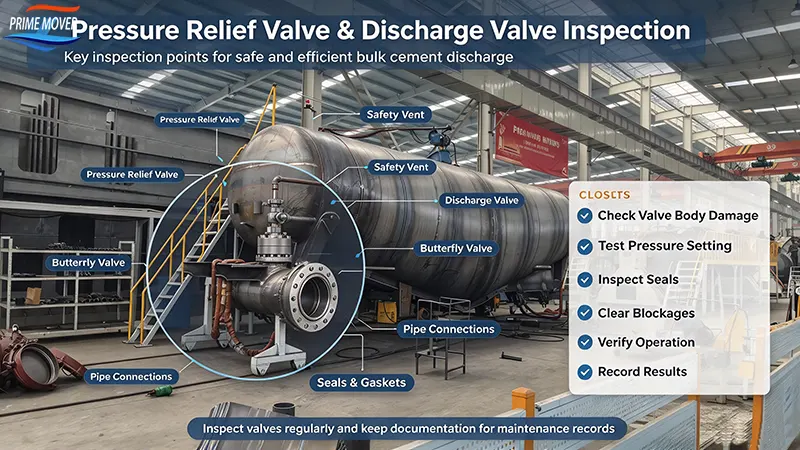
Troubleshooting 6: Pressure Fluctuation and Over-Pressurization
Tank pressure should remain stable within the 0.2 to 0.35 MPa working range during discharge. Fluctuating pressure indicates a control problem; over-pressurization indicates a safety system failure.
Fluctuating pressure commonly traces to a partially blocked air line, a failing pressure regulator, or a compressor cycling erratically. Over-pressurization — pressure rising above 0.35 MPa — is more serious. It indicates that the pressure relief valve is not functioning or that the operator has continued to feed air after the tank is full and the discharge line is blocked.
The immediate response to over-pressurization is to stop the compressor and open the discharge valve to relieve pressure through the normal path. Never attempt to relieve pressure by loosening a manhole cover or fitting. After the event, the pressure relief valve must be removed and bench-tested, and the cause of the blockage in the discharge line must be identified before the trailer returns to service.
Troubleshooting 7: Structural and Chassis Issues
Bulk cement tank trailers carry a heavy, dense load concentrated in the lower portion of the tank. Over time, this load pattern stresses the tank mounting points, the subframe, and the chassis. Structural issues are less frequent than pneumatic problems but far more expensive when they occur.
| Component | Inspection point | Frequency |
|---|---|---|
| Tank mounting brackets | Cracks at weld toes, loose bolts | Monthly |
| Subframe | Deformation, corrosion, weld integrity | Monthly |
| Main beam | Cracks, corrosion, deflection | Quarterly |
| Tank shell | Dents, corrosion, weld cracks | Quarterly |
| Manhole and hatch rings | Distortion, seal surface condition | Quarterly |
Tank mounting bracket cracks are the most common structural finding. The brackets transfer the dynamic load of the tank to the chassis, and the weld toes at the bracket-to-subframe connection are the highest-stress points. A crack found early can be repaired with a reinforcement plate at modest cost. A crack allowed to propagate can require subframe section replacement.
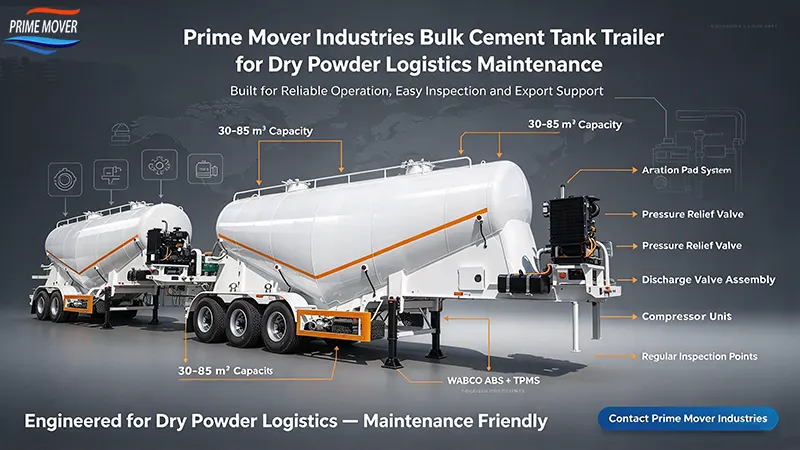
Daily and Weekly Inspection Checklist
Most troubleshooting scenarios in this guide are preventable through a disciplined daily and weekly inspection routine. The checklist below is structured so that a driver can complete the daily items in under 10 minutes and a technician can complete the weekly items in under 45 minutes.
Daily pre-trip inspection
| Item | Check | Pass criteria |
|---|---|---|
| Compressor oil level | Dipstick or sight glass | Between min and max marks |
| Compressor air filter | Visual condition | No visible dust accumulation or damage |
| Tank pressure gauge | Zero reading when idle | Reads zero before start |
| Discharge valve | Full open/close travel | Smooth travel; position indicator matches |
| Discharge hose | Visual inspection | No soft spots, cuts, or delamination |
| Manhole covers | Seated and latched | All covers fully closed |
| Pressure relief valve | Visual, unobstructed | No cement buildup on valve outlet |
| Grounding cable | Continuity and clamp condition | No broken strands; clamp clean |
| Tires and lights | Standard road check | Per roadworthiness requirements |
Weekly inspection
| Item | Check | Action threshold |
|---|---|---|
| Air dryer / desiccant | Condition and saturation | Replace if saturated or discolored |
| Compressor belt tension | Deflection test | Adjust or replace per manufacturer spec |
| Aeration pad surface | Visual through inspection hatch | Clean if cement buildup visible |
| Valve seals | Leak check with tank pressurized | Replace any leaking seal |
| Tank mounting bolts | Torque check | Retorque to specification |
| Discharge hose couplings | Gasket and clamp condition | Replace worn gaskets |
Prime Mover Industries: Bulk Cement Tank Trailers Designed for Maintainability
Prime Mover Industries is a Hong Kong-based manufacturer and global exporter established in 2014. Its bulk cement tank trailer line is engineered with maintenance access and component standardization as design priorities, not afterthoughts.
| Maintenance-relevant feature | Specification |
|---|---|
| Tank design | V-type single cone or W-type double cone for residual <1% |
| Aeration system | Accessible pads through inspection hatches; replaceable media |
| Air compressor | 12 m³/min standard; 16–18 m³/min optional |
| Pressure relief | Bench-testable relief valve, 0.2–0.35 MPa working range |
| Discharge hose | 6–7 m steel-wire reinforced, standardized couplings |
| Axles and brakes | FUWA / BPW 13T–20T; WABCO ABS standard |
| Documentation | Maintenance manual, parts catalog, compressor service guide |
For fleet operators requiring bulk cement tank trailers that are straightforward to troubleshoot and maintain in export markets, Prime Mover Industries provides factory-direct pricing, third-party inspection through SGS or BV, globally standardized components, and specification flexibility matched to the material type and route conditions.
Conclusion
The top 7 bulk cement tank trailer troubleshooting scenarios — slow discharge, excessive residual material, compressor failure, aeration pad blockage, valve leakage, pressure fluctuation, and structural issues — account for the overwhelming majority of unplanned downtime in dry powder logistics. Nearly all of them are detectable before they become failures, provided the daily and weekly inspection routine is followed.
The pattern across all seven scenarios is the same: degradation is gradual, symptoms are subtle at first, and the cost of correction rises steeply with delay. A clogged air filter that costs $30 to replace becomes a $1,500 compressor overhaul. A slow discharge that adds 20 minutes per load becomes a lost trip per day. A hairline crack at a tank mounting bracket becomes a subframe replacement.
For fleet operators, the practical conclusion is that bulk cement tank trailer reliability is a maintenance discipline, not a manufacturer specification. The best trailer in the world will degrade on the same schedule as a mediocre one if the daily inspection is skipped. The right trailer, maintained correctly, will deliver 12 to 15 years of service. That is the return on investment that matters.
Written by
Prime Mover Industries
Editor Wang
WhatsApp:+86-189 5386 6163
Email:wlei66@126.com
PRIME MOVER
INDUSTRIES LIMITED