
PRIME MOVER
INDUSTRIES LIMITED
Top 6 Flatbed Trailer Types & Payload Capacity Comparison Chart
The global flatbed trailer market was valued at USD 9.1 billion in 2026 and is projected to reach USD 11.0 billion by 2033, growing at a 2.7% CAGR. Within that market, the 25.1–50 ton capacity segment accounts for 35% of total demand, and the 3-axle configuration alone holds 42% market share. These figures matter because they define the center of gravity for flatbed trailer procurement — but they do not tell the full story.
Flatbed trailers are not a single product category. They are a family of open-deck configurations, each engineered around a different cargo geometry, deck height, and payload requirement. Choosing the wrong flatbed trailer type for a given freight profile does not just reduce efficiency — it can make a load illegal, require costly permits, or damage cargo that cannot tolerate the wrong loading angle.
This guide compares the top 6 flatbed trailer types by payload capacity, deck dimensions, tare weight, and application fit. It includes a complete flatbed trailer payload capacity comparison chart and practical guidance for matching trailer type to cargo profile.
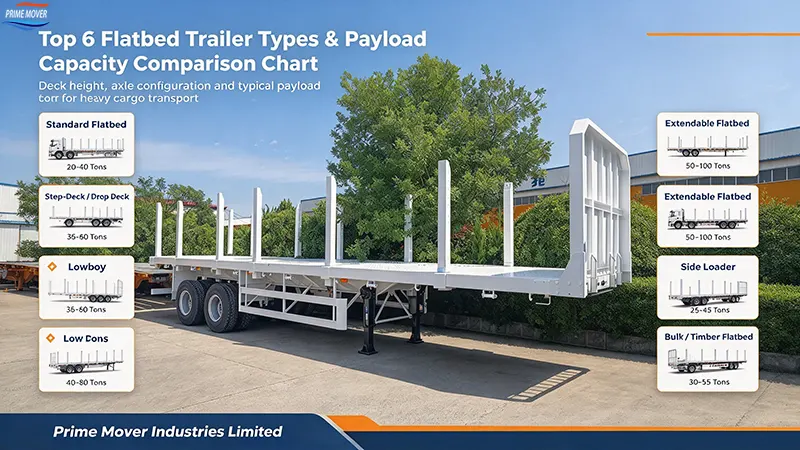
1. Standard Flatbed Trailer — The General-Purpose Workhorse
The standard flatbed trailer is the most common open-deck configuration in global freight. It features a straight-beam chassis with a single level deck, typically 48 to 53 feet long and 8.5 feet wide, sitting approximately 48 to 60 inches above the ground.
Payload and specifications
| Specification | Typical Range |
|---|---|
| Deck length | 48–53 ft (14.6–16.2 m) |
| Deck width | 8.5 ft (102 in / 2.59 m) |
| Deck height | 48–60 in (1,220–1,525 mm) |
| Axle configuration | 3 axles (standard) |
| Payload capacity | 40–48 tons (standard) |
| Tare weight | 7.1–7.5 tons (steel) |
| Max legal cargo height | ~8.5 ft on deck |
The standard flatbed carries lumber, steel coils, pipes, building materials, palletized goods, containers, and medium-sized machinery. Its open deck allows crane, forklift, and side loading from any direction. The 3-axle configuration dominates because it balances payload capacity against axle-load regulations in most markets.
The limitation is height. Cargo taller than approximately 8.5 feet on the deck will exceed legal overall height limits in most jurisdictions, requiring permits or a different trailer type. For freight that fits within standard dimensions, the standard flatbed trailer offers the lowest cost per ton of payload and the widest load availability.
2. Step-Deck Flatbed Trailer — Height Clearance Without Permits
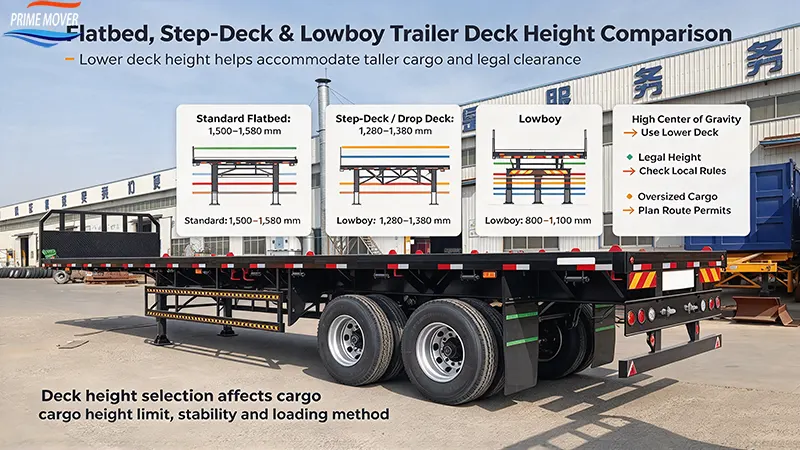
The step-deck flatbed trailer (also called a drop-deck trailer) uses a two-level design. A shorter upper deck sits over the fifth wheel, and a longer lower main deck drops 10 to 14 inches below the upper deck level. This design provides additional height clearance for cargo that is too tall for a standard flatbed but does not require the ultra-low profile of a lowboy.
Payload and specifications
| Specification | Typical Range |
|---|---|
| Upper deck length | 10–11 ft |
| Lower deck length | 37–43 ft |
| Upper deck height | 48–60 in |
| Lower deck height | 34–36 in (860–915 mm) |
| Axle configuration | 3 axles (standard) |
| Payload capacity | 42,000–48,000 lbs (19–22 tons) |
| Max legal cargo height (lower deck) | Up to 10 ft |
The step-deck trailer is the standard choice for forklifts, mini excavators, skid steers, backhoes, tractors, agricultural equipment, and large-diameter pipe. The extra 18 to 22 inches of height clearance on the lower deck means machinery that would require oversize permits on a standard flatbed can move legally on a step-deck.
The trade-off is payload. The dual-deck structure adds weight, and the step-deck typically carries 42,000 to 48,000 lbs — slightly less than a comparable standard flatbed. The higher per-mile rate for step-deck freight (approximately 10–20% above flatbed rates) compensates for the lower payload and smaller load pool.
3. Double Drop / Lowboy Flatbed Trailer — Extreme Height and Weight
The double drop or lowboy trailer features a deeply recessed deck positioned just 18 to 24 inches above the ground. This ultra-low profile provides maximum legal height clearance for transporting extraordinarily tall and heavy machinery.
Payload and specifications
| Specification | Typical Range |
|---|---|
| Deck height | 18–24 in (460–610 mm) |
| Deck length | 24–53 ft (extendable to 65+ ft) |
| Axle configuration | 2–5+ axles |
| Payload capacity | 40–80 tons standard; 150+ tons with multi-axle |
| Tare weight | 9–19 tons depending on configuration |
| Max legal cargo height | Up to 11.5–11.6 ft on deck |
Lowboy trailers carry excavators, bulldozers, cranes, motor graders, mining haul trucks, transformers, and wind-power components. The detachable-neck design allows drive-on loading of tracked equipment, which is essential for machinery that cannot be lifted by crane.
The cost structure is significantly higher. A new lowboy runs USD 70,000 to 150,000+, with higher maintenance costs due to more axles and hydraulic systems. Most lowboy loads require oversize permits, and route restrictions increase transit time. For operators with consistent heavy-equipment transport contracts, the lowboy is not optional — it is the only compliant way to move certain cargo.
4. Extendable Flatbed Trailer — Long Cargo Specialist
The extendable flatbed trailer telescopes from a standard platform to carry pipes, wind turbine blades, girders, and other cargo that exceeds standard trailer length. Extension ranges typically run from 13 meters to 20 meters, with premium models reaching 21 meters.
Payload and specifications
| Specification | Typical Range |
|---|---|
| Base length | 12,500–13,000 mm |
| Extended length | 20,000–21,000 mm |
| Extension range | 7–8 meters |
| Axle configuration | 3 axles (standard) |
| Payload capacity | 40–50 tons (reduced when fully extended) |
| Tare weight penalty | +800–1,200 kg vs fixed-length |
The extendable flatbed is the fastest-growing flatbed sub-category at 3.9% CAGR, driven by wind energy components, large-diameter pipe, and infrastructure beams. The telescoping mechanism introduces wear points that fixed trailers do not have — sliding rails, locking pins, and hydraulic systems require quarterly inspection and annual lubrication.
Payload capacity typically drops when the trailer is extended beyond 75% of its maximum length. Manufacturers specify a reduced rating in the extended position to prevent beam over-stress. The extendable flatbed is a specialist tool for fleets with consistent long-cargo contracts, not a general freight solution.
5. Combo (Steel-Aluminum) Flatbed Trailer — Balanced Payload and Durability
The combo flatbed trailer pairs a steel main beam for structural strength with aluminum floor, cross-members, and side rails for weight savings. It occupies the practical middle ground between all-steel and all-aluminum configurations.
Payload and specifications
| Specification | Standard Steel | Combo | All-Aluminum |
|---|---|---|---|
| Tare weight (48–53 ft) | 12,000–13,500 lbs | 10,500–12,000 lbs | 9,000–10,500 lbs |
| Payload (within 80k GVWR) | ~48,000 lbs | ~46,000–48,000 lbs | ~47,000–48,000 lbs |
| Corrosion resistance | Low (requires coating) | Moderate | High (inherent) |
| Repair difficulty | Easy (weldable) | Moderate | Difficult (specialized) |
| Cost (US/EU) | USD 40,000–50,000 | USD 45,000–55,000 | USD 55,000–65,000 |
The weight savings of 1,000 to 2,500 lbs versus all-steel translate directly into additional payload on every trip. For a fleet running near the 80,000-lb GVWR limit, that weight difference can determine whether a load moves legally or requires a permit.
The steel main beam provides the same structural integrity as an all-steel trailer. The aluminum components resist corrosion naturally, which is an advantage in coastal operations and northern climates with road salt. The trade-off is repair complexity — aluminum components require a shop with aluminum welding capability.
6. Multi-Axle Heavy-Duty Flatbed Trailer — Maximum Payload
The multi-axle heavy-duty flatbed trailer uses 4 to 6+ axles to distribute extreme loads across more contact points, enabling payload capacities that standard configurations cannot achieve.
Payload and specifications
| Specification | Typical Range |
|---|---|
| Axle configuration | 4–6+ axles |
| Axle ratings | 13T, 16T, or 20T per axle |
| Payload capacity | 60–100 tons standard; 150 tons with permits |
| Main beam | Q345B steel, 500 mm height, 20 mm top / 24 mm bottom plate |
| Suspension | Bogie or heavy-duty leaf spring |
| Typical use | Construction, mining, energy, infrastructure |
Multi-axle flatbeds are specified for steel coils, heavy machinery, prefabricated concrete, transformers, and infrastructure components that exceed standard payload limits. The additional axles reduce individual axle stress, improve braking stability, and distribute weight more evenly across bridge structures.
The cost premium is substantial — a 4-axle heavy-duty flatbed typically runs USD 20,000 to 35,000 FOB China, versus USD 10,000 to 18,000 for a standard 3-axle model. The heavier configuration also consumes more fuel and requires more maintenance. For fleets that regularly operate at the upper legal weight limit, the additional capacity justifies the premium.
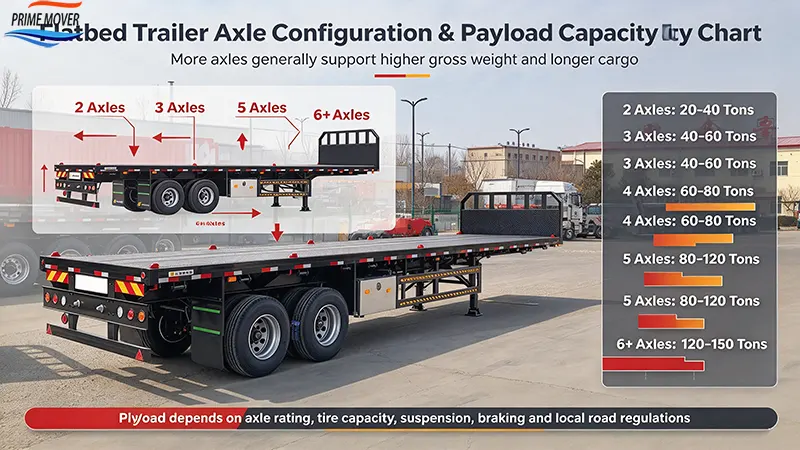
Flatbed Trailer Payload Capacity Comparison Chart
| Trailer Type | Deck Height | Typical Length | Axle Config | Payload Capacity | Tare Weight | FOB Price (China) | Best For |
|---|---|---|---|---|---|---|---|
| Standard Flatbed | 48–60 in | 48–53 ft | 3 axles | 40–48 tons | 7.1–7.5 t | USD 10k–18k | General freight, containers, steel, lumber |
| Step-Deck | 34–36 in (lower) | 48–53 ft | 3 axles | 19–22 tons | 9.5–10 t | USD 15k–25k | Forklifts, excavators, agricultural equipment |
| Double Drop / Lowboy | 18–24 in | 24–53 ft | 2–5+ axles | 40–80+ tons | 9–19 t | USD 70k–150k+ | Excavators, cranes, transformers, mining equipment |
| Extendable Flatbed | 48–60 in | 13–21 m | 3 axles | 40–50 tons | 8.0–9.0 t | USD 15k–30k | Pipes, wind blades, girders, long structural steel |
| Combo Flatbed | 48–60 in | 48–53 ft | 3 axles | 46,000–48,000 lbs | 10.5–12k lbs | USD 18k–25k | Mixed freight, weight-sensitive long-haul |
| Multi-Axle Heavy-Duty | 48–60 in | 40–53 ft | 4–6+ axles | 60–100+ tons | 10–15+ t | USD 20k–35k | Construction, mining, infrastructure, steel coils |
Matching Flatbed Trailer Type to Cargo Profile
The correct flatbed trailer type follows directly from the cargo, not from price or availability. The decision sequence should be: cargo dimensions first, deck height second, axle configuration third, material fourth, and price last.
Decision framework
| If your cargo is... | Choose... | Why |
|---|---|---|
| Standard containers, steel, lumber, palletized goods | Standard Flatbed | Lowest cost per ton, side loading, no height issue |
| Tall machinery under 10 ft on lower deck | Step-Deck | Extra height clearance without oversize permits |
| Very tall or very heavy equipment (excavators, cranes) | Double Drop / Lowboy | Ultra-low deck, drive-on loading, extreme payload |
| Pipes, beams, wind blades over 53 ft | Extendable Flatbed | Telescoping deck up to 21 m |
| Mixed freight with weight sensitivity | Combo Flatbed | 1,000–2,500 lbs weight savings vs all-steel |
| Regular loads above 60 tons | Multi-Axle Heavy-Duty | Payload capacity up to 100+ tons with legal distribution |
Two practical rules apply across all types. First, the simplest trailer that safely fits the load is usually the fastest to book and the easiest to load and unload. Second, an under-specified trailer will be overweight at every checkpoint, which means permits, delays, and fines that erase any purchase-price savings.
Payload Capacity and Legal Weight: The Distinction That Matters
Payload capacity is the weight of cargo a flatbed trailer is structurally rated to carry. Legal payload is the weight of cargo that can be carried without exceeding gross vehicle weight, axle load, or bridge formula limits on a specific route. These are not the same number.
In the United States, the federal gross vehicle weight limit is 80,000 lbs, with single-axle limits around 20,000 lbs and tandem-axle limits around 34,000 lbs. A flatbed trailer structurally rated for 48,000 lbs of payload may only be able to carry 44,000 lbs legally once the tractor weight is subtracted. In other jurisdictions, the limits differ — and cross-border operations must satisfy the strictest applicable rule.
This is why the flatbed trailer payload capacity comparison chart should be treated as a starting point for specification discussions, not as a final compliance document. The manufacturer can build to a capacity; the operator must confirm what is legal on the route.
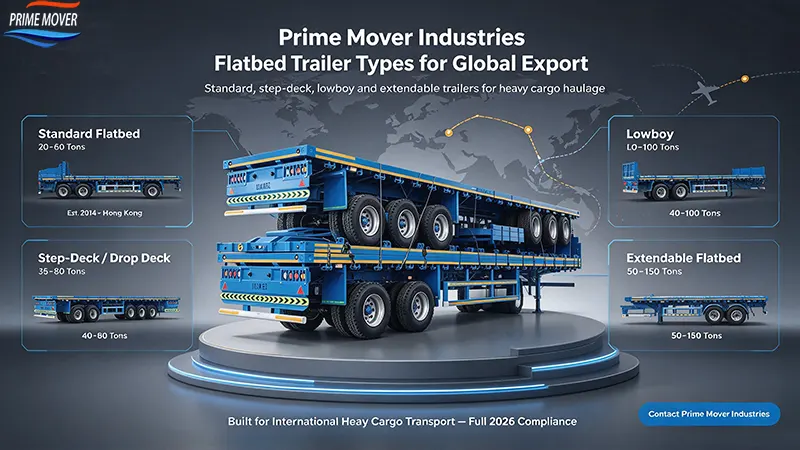
Prime Mover Industries: Flatbed Trailer Configurations for Every Cargo Profile
Prime Mover Industries is a Hong Kong-based semi-trailer manufacturer and global exporter established in 2014. Its flatbed trailer line covers the full range of configurations described in this comparison — from standard 3-axle workhorses to multi-axle heavy-duty platforms — with specifications matched to export market route conditions and regulatory requirements.
Standard specifications across the Prime Mover flatbed trailer line:
| Component | Standard | Optional Upgrade |
|---|---|---|
| Main beam | Q345B steel, 500×14/16/8 mm | Q460 high-strength steel, 20/24 mm plates |
| Axles | 2–5 axles, 13T FUWA / BPW | 16T or 20T axle ratings |
| Suspension | Mechanical leaf spring | Air suspension / ECAS |
| Brake system | WABCO ABS, dual-line pneumatic | EBS 2S/2M + RSS |
| Floor | 3 mm diamond plate | 4 mm checkered plate |
| Twist locks | 12 sets | Custom configuration |
| Coating | Sandblast + 2 primer + 2 topcoats | Hot-dip galvanizing (stake pockets) |
| Deck configurations | Standard, step-deck, extendable, heavy-duty | Custom dimensions on request |
For fleet operators comparing flatbed trailer types and payload capacities in 2026, Prime Mover Industries offers factory-direct pricing, third-party inspection through SGS or BV, full export documentation, and specification flexibility matched to the actual cargo and route rather than a fixed catalog.
Conclusion
The top 6 flatbed trailer types serve distinct cargo profiles, and the payload capacity comparison chart makes the trade-offs visible: standard flatbeds optimize cost per ton, step-decks trade payload for height clearance, lowboys deliver extreme capacity at premium cost, extendable flatbeds handle length that no fixed trailer can, combo flatbeds balance weight and durability, and multi-axle heavy-duty models push payload beyond 100 tons.
The right choice is not the cheapest trailer or the highest-capacity trailer. It is the trailer whose deck dimensions, deck height, axle configuration, and payload rating match the cargo the fleet actually moves on the routes it actually operates. For buyers in 2026, that match — not the headline payload number — is what determines return on investment.
Written by
Prime Mover Industries
Editor Wang
WhatsApp:+86-189 5386 6163
Email:wlei66@126.com
PRIME MOVER
INDUSTRIES LIMITED