
PRIME MOVER
INDUSTRIES LIMITED
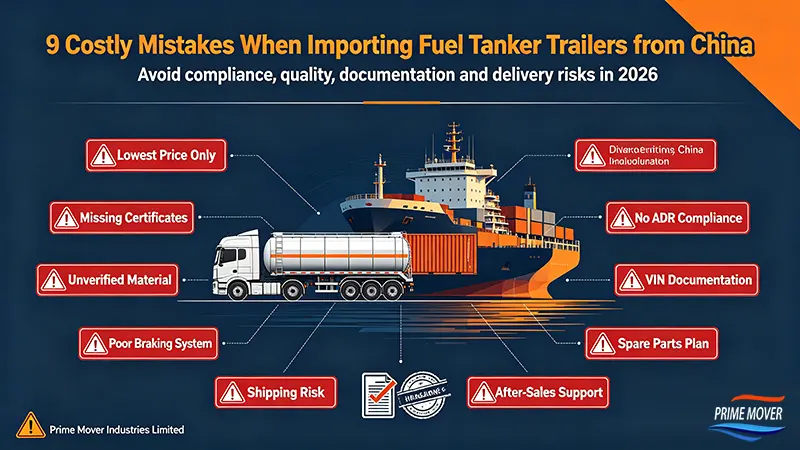
9 Costly Mistakes When Importing Fuel Tanker Trailers from China
Importing a fuel tanker trailer from China can save your fleet 30–40% compared to sourcing from Europe or North America. A 45,000-liter carbon steel tanker can cost as little as $15,000 FOB, while an aluminum equivalent runs around $26,000. But those savings vanish quickly when you make the wrong choices.
Many buyers face the same costly pitfalls: unreliable factories, hidden costs, customs delays, and poor-quality units that can't handle rough local road conditions. One missed weld defect or a seal that holds during a quick shop test but fails on the road can turn into leaked fuel, road closures, and liability claims that cost more than the trailer itself.
This guide covers the 9 most expensive mistakes importers make when buying fuel tanker trailers from Chinese manufacturers — and how to avoid every single one.
Mistake #1: Contacting Factories Before Defining Your Requirements
The biggest mistake new buyers make is contacting factories before locking in their specific needs. Without clear parameters, you risk ending up with a fuel tank trailer that doesn't fit local regulations, road conditions, or transport volumes.
How to avoid it: Before you reach out to any supplier, confirm these core details:
- Capacity & Axle Configuration: Choose the right volume and axle count — from a compact 2-axle for short-haul to a heavy-duty 40-ton for long-distance transport.
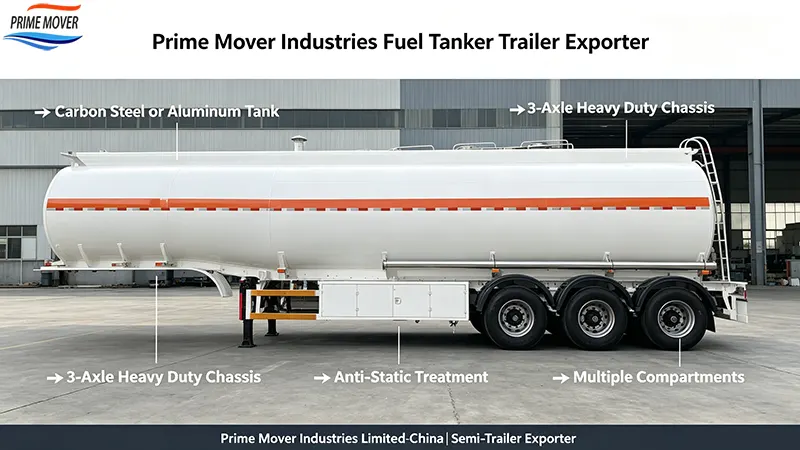
- Material & Build: High-strength carbon steel (cost-effective, durable) or aluminum alloy (lightweight, corrosion-resistant).
- Local Compliance: Verify your country's import regulations, including required certifications, axle limits, and emission standards.
- Additional Features: Compartment divisions, pumping systems, emergency shut-off valves.
Once you have these details finalized, you'll be able to get accurate quotes and compare factory offers on an equal footing.
Mistake #2: Choosing Price Over Quality
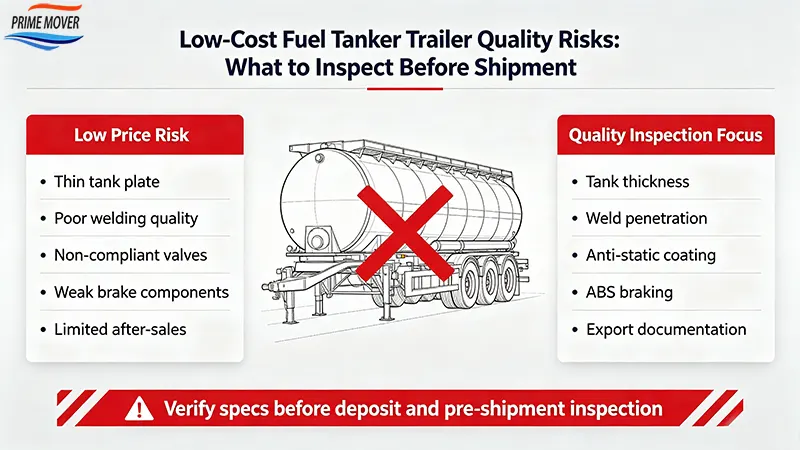
One of the biggest mistakes is selecting the lowest-priced tanker trailer without evaluating its manufacturing quality. Low-cost trailers often use thinner steel plates, simplified welding processes, or low-grade valves. Over time, this may result in leakage, deformation, or structural fatigue.
Two trailers can look similar in photos but have very different costs. For example, a 40-foot flatbed trailer price changes with main beam height, steel thickness, axle brand, tire brand, suspension type, and painting standard. A trailer may look strong from outside, but if the beam structure is weak, it may crack when carrying heavy loads.
How to avoid it: Compare configuration, not just price. Ask for documented proof of hydrostatic testing, weld procedure specifications (WPS), and non-destructive testing (NDT) reports.
Mistake #3: Failing to Verify the Manufacturer Before Payment
With hundreds of semi-trailer suppliers in China, it's critical to separate legitimate manufacturers from low-quality trading companies — or worse, fake factories. Buyers may meet fake factories, weak traders, unclear quotations, changed bank accounts, or trailers that do not match the confirmed specification.
The safest way is to verify the supplier first, confirm every technical detail, inspect before balance payment, and release payment only after documents and photos are checked.
How to verify a Chinese trailer supplier:
- Check the company name consistency — quotation, invoice, contract, bank account, email signature, and website should not conflict.
- Request a live video call from the factory — not only edited photos. Check workshop, welding area, painting area, finished trailers, and office sign.
- Ask for the business license and WMI Code — every legitimate manufacturer has one.
- Ask whether they have exported trailers to your country before.
- Confirm whether they can provide inspection before shipment.
A genuine manufacturer should be comfortable showing its workshop, production equipment, and trailers currently being built. If the factory can't name their steel supplier, or if the "BPW axles" in their product photos don't have BPW branding on the hub caps, walk away.
Mistake #4: Ignoring Tank Material Selection
Different cargo types require different tank materials. Using the wrong material can lead to corrosion, contamination, or shortened service life.
| Material | Best For | Cost | Weight |
| Carbon Steel | Diesel, gasoline, crude oil | Lowest ($14k–$18k) | Heaviest |
| Aluminum Alloy | Fuel, corrosion-resistant applications | Higher ($20k–$28k) | 30–40% lighter |
| Stainless Steel | Chemicals, food-grade liquids | Highest | Medium |
Pick the wrong tank material and corrosion eats through the wall in a few years. For fuel transport, aluminum alloy 5083 or 5454 offers the best balance of weight savings and corrosion resistance.
Mistake #5: Overlooking Safety Systems and 2026 Regulations
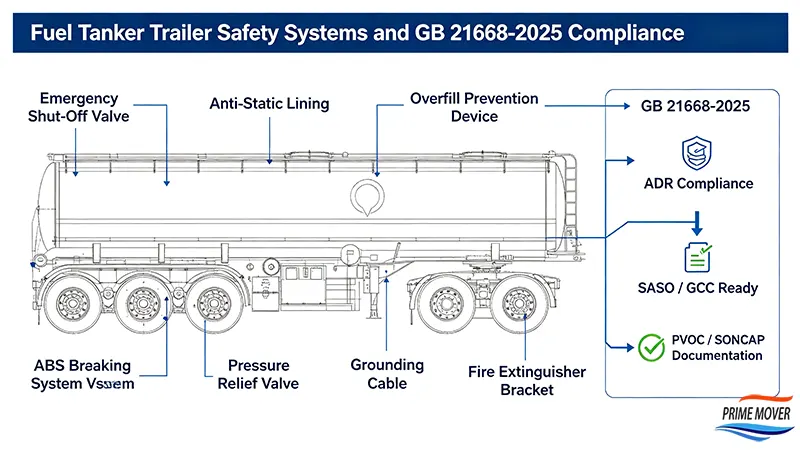
Safety should never be treated as optional. Many buyers underestimate the importance of:
- ABS or EBS braking systems
- Emergency shut-off valves
- Fire-resistant manholes
- Anti-surge baffles inside the tank
Critical 2026 regulatory update: China's mandatory national standard GB 21668-2025 — was published on October 5, 2025, and takes effect on July 1, 2026. It applies to N-class vehicles and O-class semi-trailers transporting dangerous goods. The new standard:
- Replaces three previous standards (GB 21668-2008 and others)
- Adds new requirements for dangerous goods container transport vehicles
- Expands hazard identification markings to include UN numbers, hazard classifications, and emergency response methods
Failing to comply with GB 21668-2025 means your trailer cannot be legally registered or operated in China — and may face rejection at customs in destination markets that recognize Chinese safety standards.
Mistake #6: Not Considering Local Import Regulations and HS Code Classification
Each market has its own regulations regarding tanker trailer imports, registration, and operation. Failing to understand these rules before purchasing can cause customs delays or rework costs.
Critical HS Code information: Fuel tanker trailers fall under HS Code 8716311000 — "Oil tanker trailers and semi-trailers". Import duties vary significantly:
| Duty Type | Rate |
| MFN (Most-Favored Nation) Duty | 10% |
| General Duty (Non-MFN) | 20% |
| Import VAT | 13% |
How to avoid it: Always confirm axle limits, braking requirements, and safety equipment standards with your local transport authority before production begins. Work with a licensed customs broker at your destination port.
Mistake #7: Skipping Quality Inspection Before Shipment
One missed weld defect or a seal that holds during a quick shop test but fails on the road turns into leaked fuel, road closures, and liability claims that cost more than the trailer itself.
A proper fuel tanker trailer inspection should include:
- Visual inspection — paint loss, surface cracks, deformation, weld spatter
- Air tightness test — tank sealed and pressurized to 36 kPa, held for 30 minutes
- Hydrostatic (water filling) test — the single most important test for tank integrity
- Bottom valve inspection — cycled through at least 10 full open-close operations under pressure
- Safety valve testing — correct trip pressure and fast reset
- NDT (non-destructive testing) on critical weld joints
- Axle alignment — checked with laser measuring tools
Never skip inspection before paying the balance. Hire an independent third-party inspector like SGS or Bureau Veritas to verify weld quality and structural integrity before loading.
Mistake #8: Not Controlling Payment Risk
A small mistake in payment can cause a large loss. Common payment pitfalls include:
- Price is much lower than other offers
- Quotation does not mention steel thickness or axle brand
- Supplier uses vague words such as "standard quality" or "best quality"
- Supplier avoids written technical confirmation
- Supplier later adds extra charges for documents, packing, or accessories
How to protect yourself:
- Confirm full trailer specifications in the proforma invoice or contract
- Check whether the bank beneficiary matches the supplier company
- If the seller company and bank beneficiary are different, ask for a formal explanation before payment
- Use Trade Assurance or a letter of credit for large orders
- Request production photos and final inspection photos
- Arrange factory inspection before paying the balance
- Review the bill of lading draft and other export documents
Never make a deposit without confirming certification capability. Avoid ambiguous trade terms.
Mistake #9: Skipping After-Sales Support Evaluation
A tanker trailer is not a one-time purchase. Long-term operation depends on spare parts availability, technical support, and maintenance guidance.
Before placing an order, it is important to confirm whether the manufacturer can provide:
- Long-term service support — warranty coverage, technical documentation
- Spare parts availability — can you get replacement valves, seals, and components quickly?
- Technical support — do they offer remote troubleshooting or on-site assistance?
A reputable manufacturer should be able to provide verifiable client feedback and recent order records. For example, leading manufacturers export over 4,000 units to African markets every year, with a presence in more than 50 countries globally. Look for factories with a proven history of exporting to your target market.
Final Thoughts: Import Smarter, Not Harder
Importing a fuel tanker trailer from China can be one of the smartest investments your fleet makes — or one of the most expensive mistakes. The difference comes down to preparation, verification, and due diligence.
Remember the 9 costly mistakes:
- Contacting factories before defining your requirements
- Choosing price over quality
- Failing to verify the manufacturer before payment
- Ignoring tank material selection
- Overlooking safety systems and 2026 regulations (GB 21668-2025)
- Not considering local import regulations and HS Code classification
- Skipping quality inspection before shipment
- Not controlling payment risk
- Skipping after-sales support evaluation
Define your cargo first, verify the supplier thoroughly, inspect before you pay, and choose a manufacturer that stands behind its product.
Written by
Prime Mover Industries
Editor Wang
WhatsApp:+86-189 5386 6163
Email:wlei66@126.com
PRIME MOVER
INDUSTRIES LIMITED