
PRIME MOVER
INDUSTRIES LIMITED
Best Flatbed Trailer for Oversized Cargo: 8 Critical Selection Factors
Moving oversized cargo is never as simple as booking a truck. The wrong trailer choice can cause delays, fines, or cargo damage, while the right one ensures safe, efficient, and compliant transport. For logistics leaders responsible for coordinating large-scale projects, understanding the equipment options available and when each is used can support better planning, reduce risk, and help keep projects on schedule.
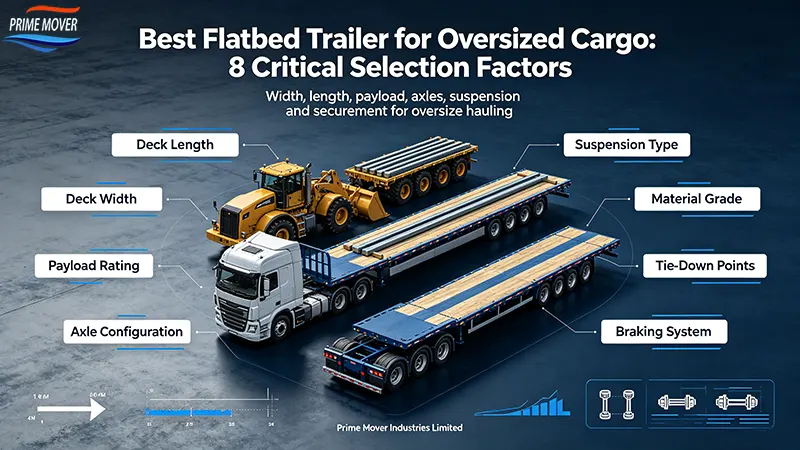
Whether you are hauling steel coils, construction machinery, industrial equipment, or wind turbine components, selecting the right flatbed trailer is one of the most consequential decisions you will make. Here are the 8 critical selection factors to consider when choosing the best flatbed trailer for oversized cargo.
1. Payload Capacity — Matching Weight to Axle Configuration
Payload capacity is the foundation of any flatbed trailer selection. A standard 48–53-foot flatbed can legally haul up to about 48,000 lbs. However, oversized cargo often pushes far beyond these limits.
Key considerations:
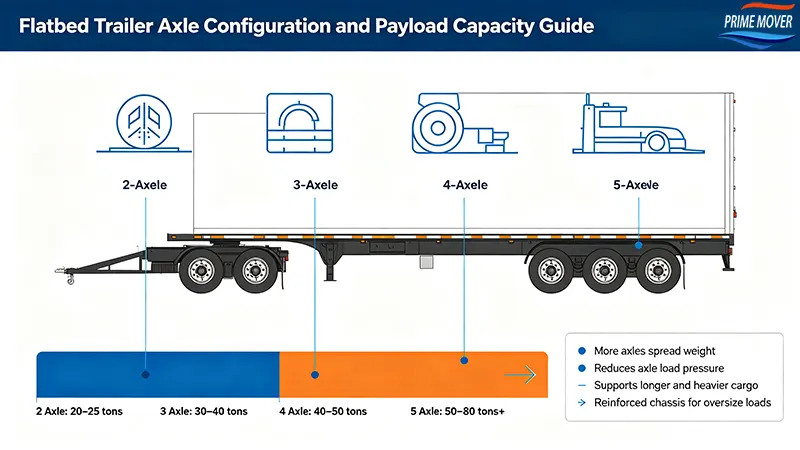
- Standard 3-axle flatbeds typically handle payloads of 40–50 tonnes
- Heavy-duty configurations with 4–5 axles can handle 60–80 tonnes, with specific models capable of accommodating up to 100 tons for extreme heavy-duty applications
- Over-dimensional flatbeds can handle freight up to 160 feet long, 18 feet high, 18 feet wide, and about 200,000 pounds
The more axles there are, the greater the load capacity, ranging from 20 to 150 tons. For oversized cargo, do not underestimate your weight requirements — an under-specified trailer will leave you overweight at every checkpoint.
2. Deck Dimensions — Length, Width, and Height Clearance
The physical footprint of your flatbed determines what cargo it can carry and where it can legally operate.
| Dimension | Standard Range | Oversized Options |
| Deck Length | 48–53 feet (14.6–16.2 m) | Extendable to 65+ feet (20+ m) |
| Deck Width | 8.5 feet (102 inches / 2.59 m) | Up to 18 feet with permits |
| Deck Height | 48–60 inches from ground | Low-deck options down to 31 inches |
Height is usually the first question. A standard flatbed has a single deck at 48–60 inches off the ground. Cargo taller than 8 feet 6 inches cannot legally move on a standard flatbed without permits.
For extremely long cargo, consider extendable flatbeds that telescope from 13 meters to over 20 meters to carry long pipes, wind turbine blades, or girders. Some models can telescope by a full 7.5 meters, reaching a maximum loading area length of 21 meters.
3. Trailer Material — Steel, Aluminum, or Combo
Material selection affects payload capacity, maintenance costs, corrosion resistance, and resale value.
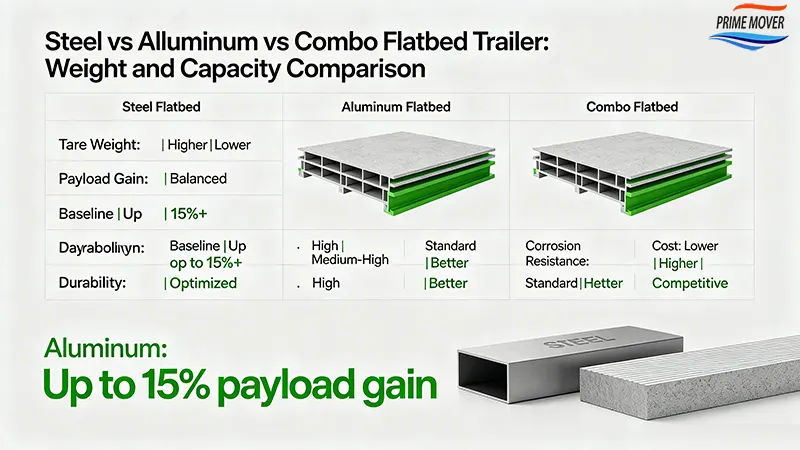
| Material | Weight | Strength | Best For |
| Steel | Heaviest | Maximum durability | Heavy equipment, rough materials, demanding operations |
| Aluminum | Lightest (15–25% lighter) | Good, corrosion-resistant | Long-haul, maximizing payload capacity |
| Combo | Mid-range | Balanced | Mixed cargo, balancing durability and weight savings |
Steel flatbeds are built for demanding operations that require maximum durability and load-bearing capability. However, they weigh the most, cutting into payload.
Aluminum flatbeds are a smart choice when you want to maximize your payload capacity for long-haul operations. The lower weight offers efficiency and improved fuel efficiency on long routes.
Combo trailers deliver a balance of durability and weight savings — strong enough for heavier loads but still light enough to support mixed cargo.
4. Suspension System — Mechanical vs. Air Ride
The suspension system determines ride quality, cargo protection, and maintenance requirements.
| Suspension Type | Characteristics | Best For |
| Mechanical (Leaf Spring) | Simple structure, low maintenance costs | Bumpy road conditions, heavy-duty reliability |
| Air Suspension | Automatic height adjustment, excellent shock absorption | Fragile or precision cargo, long-haul operations |
Mechanical suspension with multi-leaf springs is standard on most heavy-duty configurations, offering reliable performance on rough roads.
Air suspension provides automatic height adjustment for load leveling and excellent shock absorption, reducing damage to fragile or precision cargo. Some high-end models feature ECAS electronically controlled air suspension with lift axles and steering axles for maximum flexibility.
For oversized cargo, air suspension can be particularly valuable when transporting sensitive equipment that cannot tolerate excessive vibration or shock during transit.
5. Axle Configuration and Load Distribution
The number and spacing of axles directly impacts legal payload capacity and weight distribution.
- 2 axles — Light to medium loads (20–40 tons)
- 3 axles — Standard heavy haul (40–60 tons)
- 4–5 axles — Heavy-duty (60–100+ tons)
- 6+ axles — Extreme heavy haul (up to 150 tons)
Critical weight distribution principles:
- Place the heaviest section near the trailer's center
- Spread weight across axles by centering the load front to back
- Avoid stacking weight too high, which raises the center of gravity and increases rollover risk
Legal weight limits are strict: in the U.S., any load exceeding 80,000 pounds gross vehicle weight, 20,000 pounds on a single axle, or 34,000 pounds on a tandem axle crosses into heavy-haul territory and requires permits.
6. Loading and Unloading Capabilities
One of the greatest advantages of a flatbed trailer is its open design — but you must ensure it matches your loading methods.
Flatbeds can be loaded and unloaded from any direction, including by crane or forklift. This flexibility is crucial for oversized cargo that cannot be loaded through a standard dock door.
Key loading considerations:
- Lift points — Confirm where a forklift or crane should touch
- Protection needs — Identify which surfaces need padding
- Equipment compatibility — Does your cargo require ramps for drive-on loading?
- Site access — Does the delivery location have adequate space for crane or forklift positioning?
Pro tip: The simplest trailer that safely fits the load is usually the fastest to book and the easiest to load and unload.
7. Permits and Regulatory Compliance
Oversized cargo almost always requires special permits — and the regulations are getting stricter.
Standard legal limits in the U.S.:
- Width: Up to 8.5 feet (102 inches)
- Height: Up to 13.5 feet overall
- Gross weight: 80,000 pounds total
When permits are required:
- Width exceeding 8.5 feet
- Height exceeding 13.5 feet (varies by state)
- Weight exceeding 80,000 pounds gross
2026 regulatory updates: In California, permits are required for any load over 8.5 feet wide — stricter than the federal standard. Some states demand extra escorts or restrict travel hours.
Permitting adds time and cost to your transport schedule. Factor this into your planning — equipment that doesn't align with a shipment's dimensions or weight can contribute to delays, added costs, or safety concerns.
8. Manufacturer Quality and Customization Capabilities
Not all flatbed trailers are created equal. The manufacturer's quality standards and customization options matter.
What to look for in a manufacturer:
- Quality control — Precision robotic welding, reinforced structural layout
- Material sourcing — High-strength Q345B steel, premium aluminum alloys
- Customization options — Deck length, axle rating, suspension type, braking system
- International compliance — Ability to meet export standards and regional regulations
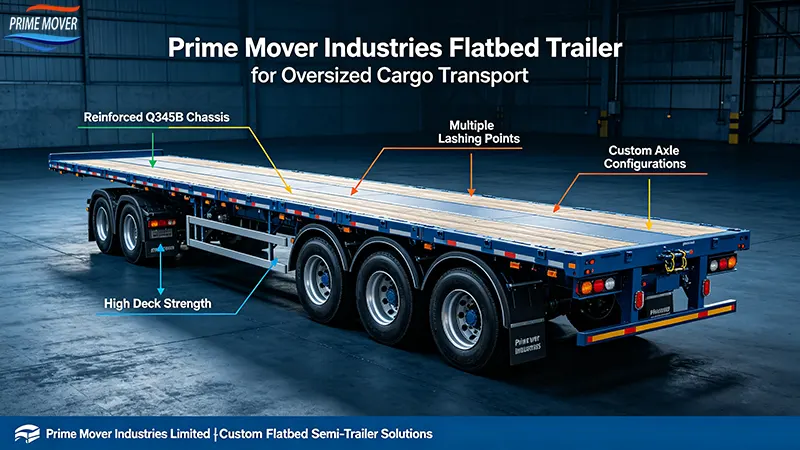
Prime Mover Industries — a Hong Kong-based enterprise established in 2014 — has positioned itself as a specialized manufacturer and global exporter of semi-trailers, serving the diverse transportation needs of construction, logistics, and heavy industry sectors worldwide.
The company's flatbed trailer product line is engineered with:
- High-strength Q345B steel chassis for maximum durability under continuous heavy loads
- Multiple axle configurations from 2 to 5 axles, with payload capacities up to 100 tons
- Customizable dimensions — length, width, and deck height tailored to specific cargo profiles
- Flexible suspension options — mechanical leaf spring (standard) or air suspension (optional)
- International braking systems — WABCO or Haldex brand ABS/EBS for global compliance
With a strategic headquarters in one of the world's busiest logistics hubs, Prime Mover Industries offers international clients access to Asia-Pacific's dynamic growth markets while facilitating efficient global exports. The company's commitment to quality control and customer-specific customization ensures that every flatbed trailer meets the rigorous demands of oversized cargo transport — from steel structures and construction materials to wind turbine components and industrial equipment.
Conclusion: Making the Right Choice for Your Oversized Cargo
Selecting the best flatbed trailer for oversized cargo requires careful evaluation of 8 critical factors:
- Payload Capacity — Match weight to axle configuration
- Deck Dimensions — Length, width, and height clearance
- Trailer Material — Steel, aluminum, or combo
- Suspension System — Mechanical vs. air ride
- Axle Configuration — Load distribution and legal compliance
- Loading Capabilities — Crane, forklift, or ramp access
- Permits and Regulations — Legal limits and permitting requirements
- Manufacturer Quality — Customization and compliance capabilities
The golden rule: Define your cargo first — dimensions, weight, and handling requirements — then choose the trailer that matches. The simplest trailer that safely fits the load is usually the best choice.
For fleet operators and logistics managers moving oversized cargo in 2026, the right flatbed trailer is not just equipment — it is a strategic asset that directly impacts project timelines, operational costs, and profitability.
Written by
Prime Mover Industries
Editor Wang
WhatsApp:+86-189 5386 6163
Email:wlei66@126.com
- Semi Trailer Market Outlook 2026: Trends Shaping the Industry
- Top 7 Benefits of Bulk Cement Tank Trailers in 2026: Why Construction Fleets Choose Pneumatic Tankers for Cement, Fly Ash & Mineral Powder Transport
- Heavy-Duty Trailer Market to Hit $21 Billion by 2032 – Growth Drivers Explained
- Flatbed Trailer Market 2026-2033: USD 10.54 Billion Forecast & Key Growth Drivers
PRIME MOVER
INDUSTRIES LIMITED