
PRIME MOVER
INDUSTRIES LIMITED
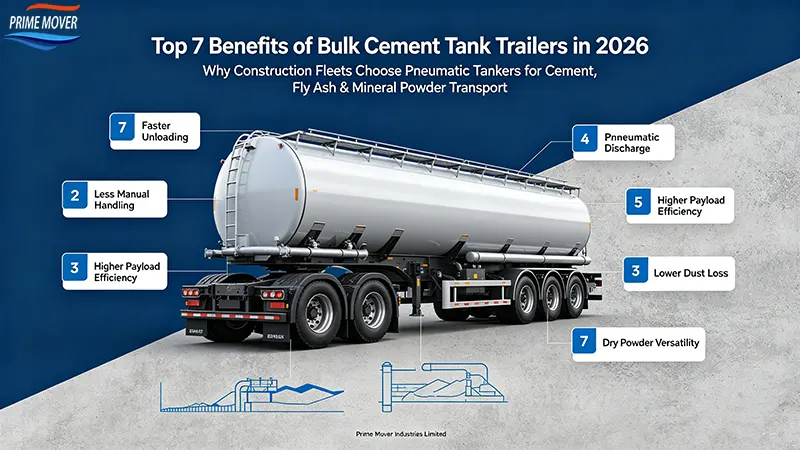
Top 7 Benefits of Bulk Cement Tank Trailers in 2026: Why Construction Fleets Choose Pneumatic Tankers for Cement, Fly Ash & Mineral Powder Transport
The global construction industry is in the midst of an unprecedented expansion. Global infrastructure investment is projected to reach USD 10 trillion through 2030, driving massive demand for cement, fly ash, and mineral powder — the essential raw materials that build roads, bridges, airports, and cities. In 2025, the global bulk cement tanker market surpassed USD 280 million, with global demand reaching 127,000 units — China alone contributed 38% of that volume. The market is projected to grow from USD 2.15 billion in 2025 to USD 3.20 billion by 2035, at a CAGR of approximately 4.0%.
For construction fleet owners and logistics managers, the choice of transport equipment directly impacts project timelines, operational costs, and profitability. Pneumatic bulk cement tank trailers have emerged as the industry standard for dry powder transport — and for good reason. Here are the Top 7 Benefits of bulk cement tank trailers in 2026, and why construction fleets are increasingly choosing pneumatic tankers for cement, fly ash, and mineral powder transport.
1. Unmatched Unloading Speed — Up to 1.5 Tons Per Minute
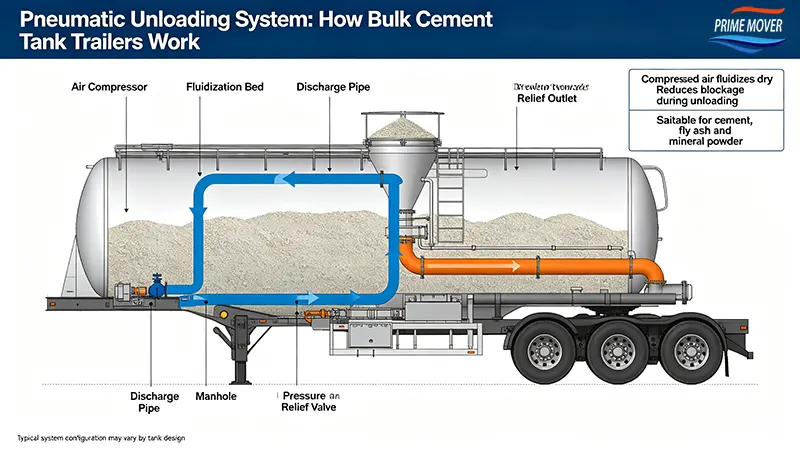
Time is money on construction sites, and nowhere is this truer than at the unloading bay. Traditional gravity-unloading methods are slow, labor-intensive, and prone to delays. Pneumatic bulk cement tank trailers, by contrast, leverage air-assisted fluidization systems that dramatically accelerate the unloading process.
Modern pneumatic systems achieve discharge speeds of 1.4 to 1.6 tons per minute. High-performance models can reach up to 2.0 tons per minute depending on configuration. This translates to unloading a full 40-ton payload in approximately 25 to 30 minutes — compared to 2 hours or more with traditional methods.
The real-world impact: A Nigerian building materials company that switched to pneumatic powder tank semi-trailers saw unloading time drop from 2 hours to just 40 minutes — a 50% increase in transport efficiency. The same fleet was able to complete 3 trips per day instead of 2, dramatically increasing revenue per vehicle.
For construction fleets managing tight project schedules, this speed advantage means fewer trucks needed per job, faster turnaround times, and the ability to respond to urgent material requests without costly delays.
2. Minimal Material Loss — Residual Rates as Low as 0.2%
Every kilogram of cement left in the tank at the end of a trip is revenue lost. Traditional tank designs often leave significant "dead zones" where powder accumulates, resulting in material waste and costly cleaning time.
Advanced pneumatic bulk cement tank trailers feature optimized fluidization structures that minimize residual material. Using gravity-assisted air-slide bags and specialized fluidized bed designs, these trailers ensure that powder materials flow smoothly toward the discharge outlet. The result? Residual rates as low as 0.2% — meaning less than 80 kg of material remains in a 40-ton tanker.
Why this matters: A fleet operating 10 tankers making 200 trips per year could save over 160 tons of material annually simply by switching to low-residue pneumatic designs. For cement costing $50–80 per ton, that translates to $8,000–$12,800 in annual savings — before considering the labor costs saved from reduced cleaning time.
3. Significant Cost Reduction — 30% to 40% Lower Transport Costs
The combination of faster unloading, minimal material loss, and bulk transport capability translates into substantial cost savings. The numbers are compelling:
- Transportation cost reduction: Bulk cement tank trailers can reduce the transportation cost of powdered materials by 30–80 yuan (approximately $4–11 USD) per ton, with overall costs reduced by approximately 30% to 40% compared to traditional bagged transport methods.
- Elimination of packaging costs: Unlike bagged cement transport, bulk pneumatic tankers require no packaging bags — eliminating the cost of bags, bagging labor, and disposal.
- Lower operating costs: One fleet reported 25% lower operating costs after switching to pneumatic tankers, with fuel use falling by 15% and breakdowns dropping by 60%.
For construction companies operating on thin margins, these cost reductions can be the difference between a profitable project and a loss.
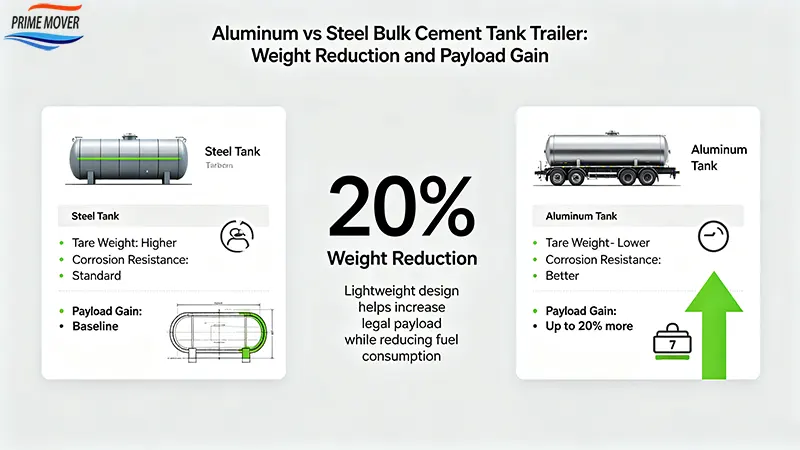
4. Lightweight Aluminum Construction — 15–20% Weight Reduction for Higher Payload
Every kilogram of trailer weight is a kilogram of payload lost. Bulk cement tank trailers increasingly feature aluminum alloy construction, delivering significant weight advantages over traditional carbon steel designs.
The numbers:
- Aluminum alloy tanks reduce overall trailer weight by 15% to 20% compared to carbon steel
- A 30 CBM aluminum tanker can achieve a self-weight of just 4.88 tons — enabling an extra ton of cargo per trip compared to steel equivalents
- High-capacity models (up to 85 CBM) can achieve payloads of up to 80 tons while remaining within gross vehicle weight limits
Why this matters: The tare weight advantage of aluminum means more cargo per trip, fewer trips required, and lower fuel consumption when empty. For long-haul operations covering thousands of kilometers, the cumulative effect of these weight savings can be transformative for fleet profitability.
Aluminum also offers superior corrosion resistance against moisture in cement and fly ash, extending trailer service life and reducing maintenance costs.
5. Environmental Benefits — Reduced Dust, Spillage, and Carbon Footprint
Construction companies face increasing pressure to reduce their environmental impact. Pneumatic bulk cement tank trailers offer several environmental advantages:
- Low-dust unloading: Controlled pneumatic discharge systems with butterfly valve designs minimize dust emissions, protecting both worker health and the surrounding environment.
- Reduced spillage: The enclosed pneumatic system eliminates the spillage common with open or bagged transport methods.
- Lower carbon footprint: By enabling higher payloads per trip and reducing the number of journeys required, bulk tankers reduce overall fuel consumption and CO₂ emissions.
- Material conservation: With residual rates below 0.3%, virtually all transported material reaches its destination — reducing waste and conserving resources.
For construction fleets bidding on environmentally sensitive projects or operating in regions with strict emission regulations, these environmental benefits can provide a competitive edge.
6. Versatility — One Trailer, Multiple Materials
Construction sites rarely handle just one type of powder. A well-designed bulk cement tank trailer can transport cement, fly ash, lime powder, mineral powder, and other fine dry materials. This versatility allows fleets to:
- Maximize asset utilization — the same trailer can serve different customers and material types
- Reduce fleet complexity — fewer specialized trailers needed
- Respond to market demand — pivot between materials as project requirements change
Multi-compartment designs (such as 4-compartment configurations) allow simultaneous transport of different materials in a single trip, further improving logistics efficiency.
7. Enhanced Operational Efficiency — More Trips, Less Downtime
The cumulative effect of the benefits above is a step-change in operational efficiency:
| Metric | Traditional Method | Pneumatic Tank Trailer | Improvement |
| Unloading Time | 2+ hours | 25–40 minutes | 50–75% faster |
| Material Loss | 1–3% | ≤0.2–0.3% | 90%+ reduction |
| Trips Per Day | 2 | 3 | 50% more |
| Transport Cost/Ton | Baseline | 30–40% lower | Significant savings |
| Fuel Consumption | Baseline | Up to 15% lower | Measurable reduction |
The bottom line: A fleet of 10 pneumatic tankers making 3 trips per day instead of 2 can deliver 30 trips daily instead of 20 — a 50% increase in delivery capacity without adding a single vehicle. For construction projects racing against deadlines, this capacity advantage is invaluable.
Prime Mover Industries: Your Partner in Bulk Powder Transport Solutions
As a Hong Kong-based enterprise established in 2014, Prime Mover Industries has positioned itself as a specialized manufacturer and global exporter of semi-trailers, serving the diverse transportation needs of construction, logistics, and heavy industry sectors worldwide.
The company's bulk cement tank trailer product line is engineered with:
- Pneumatic unloading systems with fluidized bed technology for discharge speeds of 1.4–1.5 tons per minute
- Ultra-low residual rates of ≤0.2–0.3% to eliminate material waste
- Lightweight aluminum alloy construction reducing tare weight by 15–20% for higher payload capacity
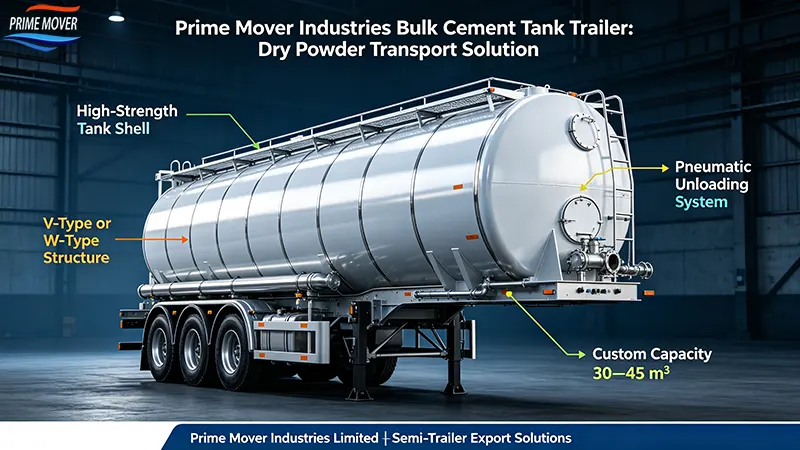
- V-type and W-type tank configurations optimized for different powder characteristics
- Capacities ranging from 30 CBM to 85 CBM to suit diverse operational requirements
With a strategic headquarters in one of the world's busiest logistics hubs, Prime Mover Industries offers international clients access to Asia-Pacific's dynamic growth markets while facilitating efficient global exports. The company's commitment to quality control, customer-specific customization, and cost-competitive manufacturing ensures that every bulk cement tank trailer delivers the speed, efficiency, and reliability that construction fleets demand in 2026 and beyond.
The right trailer for your fleet is the one that moves more material, faster, at lower cost. Prime Mover Industries delivers exactly that.
Written by
Prime Mover Industries
Editor Wang
WhatsApp:+86-189 5386 6163
Email:wlei66@126.com
- Best Flatbed Trailer for Oversized Cargo: 8 Critical Selection Factors
- Top 7 Buying Tips for Flatbed Trailer, Fuel Tanker Trailer and Bulk Cement Tank Trailer in 2026
- Flatbed Trailer Market 2026-2033: USD 10.54 Billion Forecast & Key Growth Drivers
- How to Choose the Right Semi-Trailer for Your Business
PRIME MOVER
INDUSTRIES LIMITED