
PRIME MOVER
INDUSTRIES LIMITED
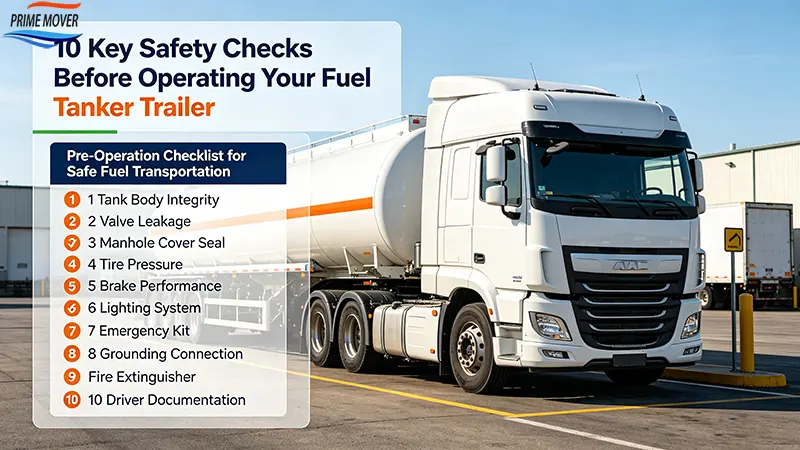
10 Key Safety Checks Before Operating Your Fuel Tanker Trailer
Operating a fuel tanker trailer is fundamentally different from pulling a dry van or a flatbed. When your cargo is thousands of gallons of gasoline, diesel, or aviation fuel, every valve, seam, and seal becomes a potential environmental incident, a fire hazard, or a catastrophic failure waiting to happen. A dry van driver can pull away with a minor air leak and fix it at the next stop. A tanker driver does not have that luxury.
The stakes are stark. Between 2020 and early 2025, tanker-related road crashes claimed at least 555 lives across Nigeria alone. In 2025, China recorded 163 hazardous materials road transport accidents — a 26.9% decline from 2024, but still a sobering reminder that most incidents are not caused by a single failure, but by chain reactions of human, vehicle, road, cargo, environmental, and management factors. In Ghana, the National Road Safety Authority reported 2,949 road crash deaths in 2025 — the highest toll in 35 years — with heavy-duty vehicles like fuel tankers sitting at the center of the crisis.
The good news? Systematic pre-trip inspections work. The implementation of structured safety initiatives has contributed to a 61.29% reduction in tanker fatalities and a 15.53% decline in crash severity. A pre-trip inspection may take only a few minutes, but it can prevent major losses later.
Below are the 10 key safety checks every driver and fleet operator must complete before operating a fuel tanker trailer in 2026.
1. Tank Body & Structural Integrity
The foundation of all tanker safety starts with the vessel itself.
Before loading or departure, walk the entire length of the trailer and inspect the tank shell and heads for dents, cuts, gouges, bulges, corroded or abraded areas, weld defects, or any condition that might render it unsafe for hazardous materials service. Under Chinese regulatory standards, the tank body must have no cracks, no dents deeper than 5 mm, and no corrosion with remaining thickness less than 1 mm. Any paint peeling or rust spots should be repaired immediately to stop corrosion from spreading.
Why this matters: A seemingly minor dent or rust spot can compromise the tank's structural integrity under the stress of liquid surge during braking or cornering. The 2025 rear-end collision involving a tanker truck on the Qinhuangdao section of the Beijing-Harbin Expressway resulted in fuel leakage and multiple fires — a direct consequence of tank breach.
Pro Tip: Use a flashlight for supplemental lighting during the inspection. Don't just look — touch and feel for irregularities.
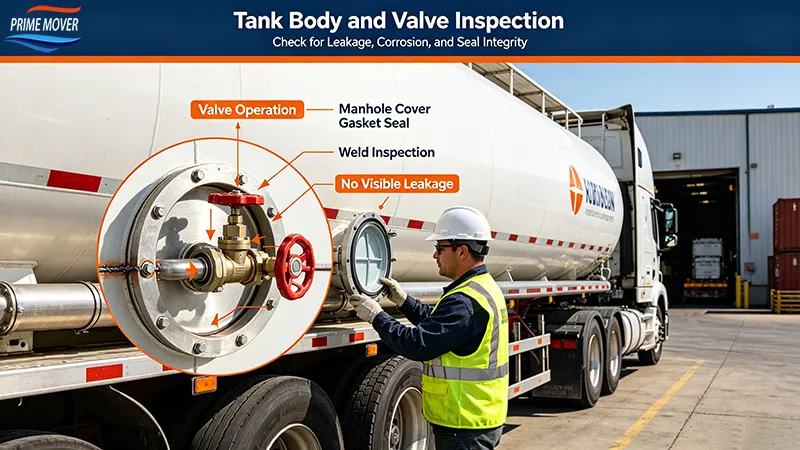
2. Valves, Manhole Covers & Seals
If the tank body is the vessel, valves and seals are its lifelines — and its most common failure points.
Inspect all sealing components before loading or putting the road:
- Bottom unloading valves — check for leakage and proper closure
- Emergency shut-off valves — physically test from remote locations
- API couplings and gaskets — inspect for cracks, dry rot, or compression set
- Manhole covers (top hatches) — verify they are closed, latched, and sealed
- Pipe connections — check for tightness and gasket condition
Never overlook even the smallest leak. Dry or cracked rubber seals are the top cause of fluid spills. What appears insignificant in the yard can quickly become an environmental issue — or worse, a serious fire hazard. A dried-out gasket on a gasoline hose can turn a routine drop into a vapor cloud and a citation.
The data: Under GB 21668-2025, The new mandatory national standard will take effect in July 2026, atmospheric pressure tankers must be equipped with temperature and pressure dual-control emergency shut-off devices. The emergency shut-off valve must open pneumatically within 3 seconds and return to closure without leakage.
Pro Tip: Squeeze hoses along their entire length. A soft spot or slight bulge under the outer cover means the inner lining is failing, even if there's no visible leak yet.
3. Static Electricity Grounding System
Static electricity is not theoretical when you're hauling petroleum products — it's a genuine ignition source that has destroyed trucks and injured operators.
Before the loading arm even touches your tanker, the ground clamp needs to be connected to a verified ground point — not just clipped to any exposed metal. Test grounding straps and earthing connections. Unwind the grounding cable fully and check for broken strands or corrosion where the clamp meets the cable.
Critical specifications:
- Grounding resistance must be <= 10 ohm
- For vehicles transporting explosives: at least 2 grounding devices with resistance <= 4 ohm
- Static drag chain must be at least 30 cm long and free of broken strands or corroded connections
Why this matters: A frayed grounding cable with only a few strands left might still show continuity on a tester but fail under a real static discharge situation. Static protection is mandatory when transporting flammable fuel. Replace ground clamps that show pitting or arc marks immediately — no debate.
Pro Tip: Wiggle the clamp after attaching it and watch for any indicator light change. One driver caught a loose connection twice in his career using this five-second habit.
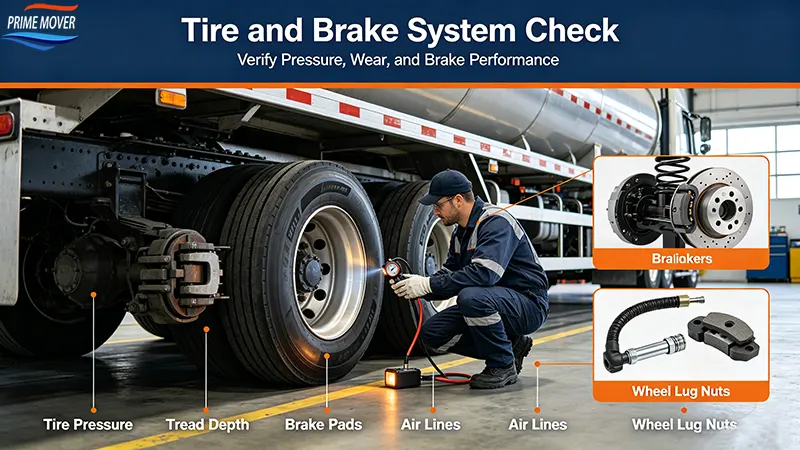
4. Tires & Wheel Fasteners
Your tanker's only contact with the road deserves more than a glance. Check:
- Tire pressure — underinflated tires generate excessive heat
- Tread depth — must be >= 1.6 mm under Chinese standards
- Bulges, cuts, or sidewall damage
- Wheel nuts — confirm all are tight
- Uneven wear patterns — signals axle misalignment
The data: Under the new GB 21668-2025 standard, vehicles with a total mass of 12,000 kg or more must be equipped with Tire Pressure Monitoring Systems (TPMS). Leaking brakes have been identified as one of the most overlooked causes of road crashes involving heavy-duty trucks like tankers.
Pro Tip: Uneven tire wear isn't just a tire problem — it's a warning that your suspension or axles need attention.
5. Brake System & Air Lines
For a tanker, brakes aren't just about stopping — they're about controlling surge.
Test brake response and inspect:
- Brake chambers — push rod stroke must be <= 40 mm with no air leakage
- Air lines — check for leaks, abrasion, or damage
- Glad hands — inspect seals and connections
- Drain water from air reservoirs to protect pneumatic components
Why this matters: When a tanker driver hits the brakes, thousands of gallons of liquid slam forward, shifting the vehicle's center of gravity and violently pushing the truck forward even after the brakes are applied. Any brake system deficiency is magnified by the dynamics of liquid surge. This is exactly why FMCSA's cargo tank training requirements specifically cover surge behavior, not just general defensive driving.
Pro Tip: Use a soapy water solution to check for air leaks — bubbles will reveal even the smallest breach.
6. Lighting, Reflectors & Markings
Visibility is safety — especially for a vehicle carrying hazardous materials.
Inspect:
- Brake lights, turn signals, and tail lights
- Reflective marking strips and DOT tape
- Hazard warning signs and placards
- Orange reflective tape (required under GB 21668-2025 for certain vehicle types)
- Safety marking plates containing UN number, hazard classification, and emergency response methods
Under FMCSA regulations, tanker trailers hauling hazardous materials must display clear placards and UN identification numbers on all four sides.
Pro Tip: Plug in the trailer and walk around to verify every light is functioning before departure.
7. Coupling & Landing Gear
A tanker that separates from its tractor is a disaster waiting to happen.
Inspect:
- Kingpin and fifth wheel — safe lock engagement, no cracks, no excessive play
- Glad hands and air lines — properly connected and secured
- Landing gear — fully raised and properly mounted
- Safety chains or cables — intact and properly secured
Why this matters: Under DOT regulations, any coupling device defect can result in an out-of-service order. For a tanker carrying thousands of gallons of flammable liquid, a coupling failure is not just a breakdown — it's a potential environmental and safety catastrophe.
Pro Tip: Physically check the fifth-wheel locking mechanism — don't just assume it's engaged.
8. Emergency Equipment
Hope is not a safety plan. Equipment is.
Verify that all emergency equipment is:
- Present, accessible, and in working condition
- Fire extinguishers — properly rated for flammable liquid fires (Class B) and within inspection date
- Spill containment tools
- Warning triangles or flares
- Personal protective equipment (PPE) for the driver and any personnel
Under Chinese regulations, drivers and attendants must check the effectiveness of emergency rescue equipment and personal protective equipment before departure.
Pro Tip: Check fire extinguisher pressure gauges and inspection tags — a non-functional extinguisher is worse than none at all.
9. Loading Level & Ullage Space
Overloading a tanker isn't just a weight violation — it's a pressure bomb.
During loading, operators should always adhere to designed filling limits and leave enough ullage space (empty space) in each compartment. This space allows the fuel to expand naturally when temperatures rise during transportation.
Why this matters: If there's not enough room for expansion, the pressure inside the tank will increase significantly. Furthermore, the risk of spills or leaks increases significantly when liquids move on uneven surfaces. Overloading remains one of the most common causes of fuel spills — but it's entirely avoidable.
Pro Tip: Stay with the truck during loading. Watch the gauges, listen for the tone change of the pump, and be ready to shut off flow immediately. Overfill prevention systems are good, but they're a backup — not a substitute for an attentive operator.
10. Documentation & Compliance Verification
Paperwork isn't bureaucracy — it's proof that safety wasn't skipped.
Before departure, verify:
- Driver qualifications — A2 or A1A2 license with hazardous materials endorsement
- Transport permits — valid and appropriate for the cargo
- Vehicle registration and inspection certificates — current and valid
- Dangerous goods transport permit — check that the tanker's certified cargo list matches the actual product
- Electronic waybill — properly completed
- Shipping papers — accurate and accessible
The regulatory landscape for 2026:
- GB 21668-2025 takes effect July 1, 2026, replacing three previous standards. Violations can result in fines of RMB 100,000–200,000.
- Medium and heavy vehicles (N2/N3 class) must be equipped with Electronic Stability Control (ESC), Automatic Emergency Braking (AEB), and Lane Departure Warning (LDW) under the new standard.
- Maximum speed is electronically limited to 80 km/h.
- Rear impact guards must withstand 20 tons of loading force, with rear safety distance increased from 150 mm to 300 mm.
Pro Tip: Keep inspection records for the period the vehicle is in service plus one year as required by FMCSA regulations.
The Prime Mover Industries Commitment
At Prime Mover Industries, we understand that safety starts long before the wheels turn. As a Hong Kong-based enterprise established in 2014, we manufacture fuel tanker trailers engineered with:
- Automated deep-penetration tank welding — fewer hidden leakage risks
- Multi-layer anti-corrosion paint systems — suitable for tropical, coastal, and mountain transport
- Standardized international valve fittings — convenient global spare parts supply
- Optional SAF/FUWA axles, air suspension, and ADR safety configurations
But even the best-built tanker requires disciplined pre-trip inspections. These 10 checks are not optional — they are the difference between a safe delivery and a catastrophe.
Written by
Prime Mover Industries
Editor Wang
WhatsApp:+86-189 5386 6163
Email:wlei66@126.com
- Best 5 Axle Flatbed Trailer Specifications You Should Know
- Top 5 Lightweight Materials for Flatbed Trailers in 2026: How High-Strength Steel & Aluminum Boost Payload by 18%
- Prime Mover Industries Expands Global Reach – New Markets in 2026
- Lightweight Semi Trailer Design – Boosting Payload and Fuel Efficiency
PRIME MOVER
INDUSTRIES LIMITED