
PRIME MOVER
INDUSTRIES LIMITED
Top 9 Must-Know Advantages of Bulk Cement Tank Trailers for Cement & Dry Powder Logistics
The global bulk cement tank trailer market reached approximately USD 9.74 billion in 2025, growing 6.2% year-on-year, and is projected to exceed USD 10.3 billion in 2026 before reaching USD 13.6 billion by 2030 at a CAGR of roughly 6.8%. That growth is not accidental. It reflects a structural shift in how cement, fly ash, lime powder, and mineral powder move from production sites to construction and industrial destinations.
Bulk cement tank trailers have become the default equipment for dry powder logistics because they solve a set of problems that bagged transport and open-top alternatives cannot. They eliminate packaging waste, reduce material loss, accelerate unloading, and protect both the cargo and the environment. For fleet operators evaluating whether to invest in pneumatic powder tankers, the advantages are measurable and the data is well documented.
This article covers the top 9 must-know advantages of bulk cement tank trailers for cement and dry powder logistics. Each section includes the operational mechanism, the quantified benefit, and the practical implication for fleet economics.
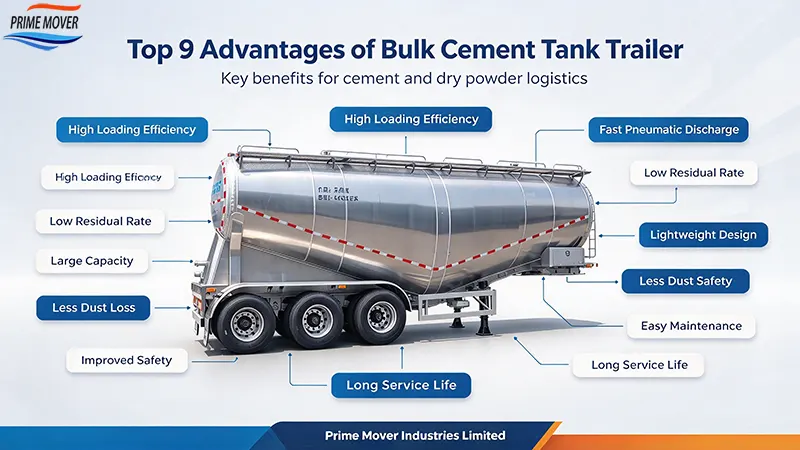
Advantage 1: Unloading Speed Up to 1.6 Tons Per Minute
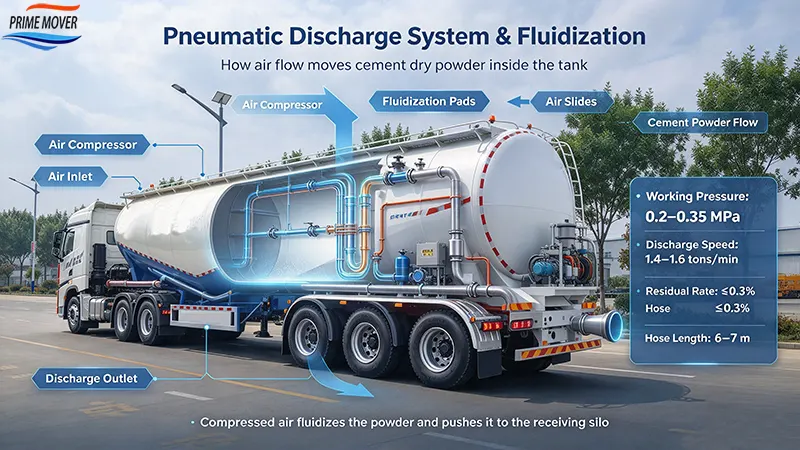
The most visible advantage of a bulk cement tank trailer is discharge speed. Pneumatic fluidization systems use compressed air to aerate the powder until it behaves like a fluid, then push it through a discharge pipeline to the receiving silo. Modern systems achieve 1.4 to 1.6 tons per minute, with high-performance configurations reaching 2.0 tons per minute.
For a standard 40-ton payload, this translates to an unloading cycle of roughly 25 to 30 minutes. Traditional gravity or manual bag-handling methods require two hours or more for the same volume. A Nigerian building materials operator that switched to pneumatic powder tank semi-trailers reported unloading time dropping from 2 hours to 40 minutes — a 50% efficiency gain that allowed the fleet to move from two trips per day to three.
| Metric | Traditional Bagged Method | Bulk Cement Tank Trailer |
|---|---|---|
| Unloading time (40 t) | 120+ minutes | 25–30 minutes |
| Discharge rate | Manual / gravity | 1.4–1.6 t/min |
| Trips per day | 2 | 3 |
| Labor required at discharge | 2–4 workers | 1 operator |
Faster discharge is not just a convenience. It shortens vehicle turnaround, reduces driver hours, and increases the number of revenue-generating trips a single bulk cement tank trailer can complete in a working day.
Advantage 2: Residual Rates as Low as 0.2%
Every kilogram of cement left in the tank at the end of a trip is revenue lost. Older tank designs leave significant material trapped in dead zones, and that residual material must be cleaned out before the next load — consuming labor and creating disposal costs.
Modern bulk cement tank trailers use optimized fluidization structures, including gravity-assisted air-slide bags and carefully positioned aeration pads, to move powder toward the discharge outlet. The result is residual rates as low as 0.2% to 0.3%. In a 40-ton tanker, that means less than 120 kg remains after discharge.
| Residual Rate | Material Left (40 t Load) | Annual Loss (200 Trips) | Cost at $60/ton |
|---|---|---|---|
| 1.0% | 400 kg | 80 tons | $4,800 |
| 0.5% | 200 kg | 40 tons | $2,400 |
| 0.2% | 80 kg | 16 tons | $960 |
For a fleet running ten bulk cement tank trailers at 200 trips per year, moving from a 1% residual design to a 0.2% design saves roughly 64 tons of material annually — before counting the labor saved on cleaning.
Advantage 3: Transport Cost Reduction of 30% to 40%
Bulk transport eliminates the packaging, handling, and disposal costs embedded in bagged cement logistics. Industry data shows that bulk cement tank trailers reduce the transportation cost of powdered materials by 30% to 40% compared with traditional bagged methods.
Where the savings come from
- No packaging bags to purchase, fill, seal, or dispose of
- No bagging labor at the cement plant or batching station
- No pallet or manual handling equipment costs
- Lower material loss during transfer
- Higher payload per trip due to no packaging weight
One fleet reported operating costs dropping by 25% after switching to pneumatic tankers, with fuel use falling 15% and breakdown frequency dropping 60%. For construction companies operating on thin margins, these reductions directly affect project profitability.
Advantage 4: Lightweight Aluminum Construction Adds Payload
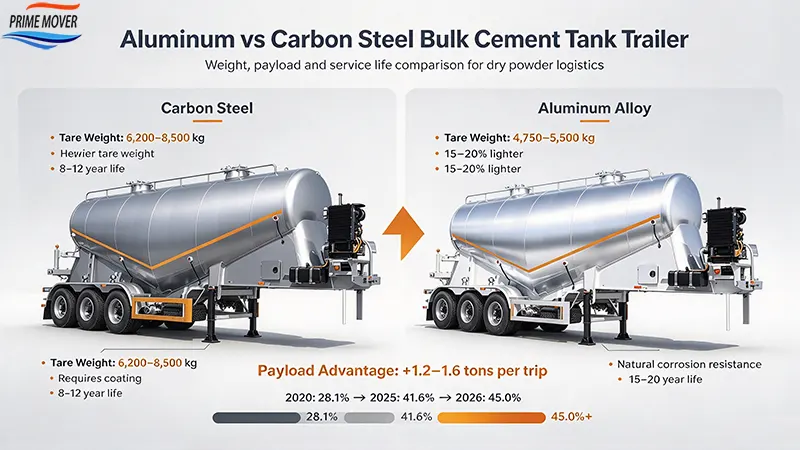
The shift to aluminum alloy tank bodies is one of the most consequential developments in dry powder logistics. Aluminum bulk cement tank trailers are 15% to 20% lighter than carbon steel equivalents of the same volume. In 2020, aluminum alloy tank trailers held 28.1% of the market. By 2025 that share had risen to 41.6%, and it is projected to exceed 45% in 2026.
| Parameter | Carbon Steel Tanker | Aluminum Alloy Tanker |
|---|---|---|
| Tare weight (30 m³) | 6,200–8,500 kg | 4,750–5,500 kg |
| Weight reduction | Baseline | 15–20% |
| Payload gain per trip | Baseline | +1.2–1.6 tons |
| Corrosion resistance | Requires epoxy coating | Natural oxide layer |
| Service life | 8–12 years | 15–20 years |
A 28 m³ aluminum bulk cement tank trailer can achieve a dead weight of just 4.75 tons, reducing tare by 1.2 to 1.6 tons versus a steel tanker of the same capacity. Across 200 trips per year, that is 240 to 320 additional tons of cargo moved without a single extra kilometer driven. The bulk cement tank trailer that carries more per trip is the one that wins on route economics.
Advantage 5: Environmental Benefits — Lower Dust and Zero Packaging Waste
Construction companies face growing pressure to reduce environmental impact. Bulk cement tank trailers address several environmental pain points at once.
- Enclosed pneumatic discharge with butterfly valve control minimizes dust emissions during unloading, protecting worker health and surrounding air quality.
- No packaging waste — bagged cement generates paper or plastic waste that must be collected, transported, and disposed of. Bulk tankers generate none.
- Lower carbon footprint per ton — higher payload per trip and fewer journeys reduce total fuel consumption and CO₂ emissions across the logistics chain.
- Material conservation — with residual rates below 0.3%, virtually all transported material reaches its destination.
For fleets bidding on environmentally sensitive projects or operating in jurisdictions with strict dust and waste regulations, these advantages can be a competitive differentiator rather than a compliance burden.
Advantage 6: Multi-Material Versatility in One Trailer
Construction sites rarely handle a single powder type. A properly specified bulk cement tank trailer can transport cement, fly ash, lime powder, mineral powder, gypsum, and other fine dry materials without modification.
Multi-compartment configurations range from 2 to 6 compartments, each with an independent manhole and discharge system. A 3-compartment 45 m³ trailer can carry cement, fly ash, and gypsum simultaneously, delivering each to a different location along the same route. This flexibility transforms a single-purpose vehicle into a distribution asset and improves asset utilization across a mixed customer base.
| Configuration | Capacity Range | Typical Use |
|---|---|---|
| Single compartment | 30–60 m³ | Dedicated cement transport |
| 2 compartments | 35–50 m³ | Cement + fly ash |
| 3 compartments | 40–60 m³ | Cement + fly ash + gypsum |
| 4+ compartments | 45–70 m³ | Multi-material distribution networks |
For a bulk cement tank trailer fleet serving concrete batching plants, multi-compartment flexibility reduces the number of dedicated vehicles required and improves response time to varied material orders.
Advantage 7: Sealed Transport Protects Cargo and Site Conditions
A bulk cement tank trailer is a sealed pressure vessel during transport. The powder never contacts ambient air, rain, or road dust. This sealing delivers two distinct advantages.
First, cargo quality is preserved. Moisture contamination causes cement to set prematurely and fly ash to lose pozzolanic activity. A sealed tank eliminates that risk. Second, site conditions remain clean. Bagged cement handling generates dust at the unloading point and leaves torn bags and spilled material on site. Pneumatic discharge through a closed pipeline keeps the receiving area clean, which matters for urban job sites, indoor batching plants, and projects with strict housekeeping requirements.
The triple safety design standard on modern bulk cement tank trailers — pressure relief valves, anti-static grounding, and overload sensors — reinforces this sealed-transport advantage by preventing over-pressurization and static discharge incidents.
Advantage 8: Reduced Labor Requirements and Lower Handling Risk
Bagged cement logistics is labor-intensive at every transfer point. Bags must be loaded at the plant, unloaded at the site, moved to the mixing area, opened, and emptied. Each step involves manual handling, which means labor cost and injury risk.
A bulk cement tank trailer reduces the unloading process to a single operator connecting a discharge hose and monitoring pressure. No bag handling, no manual lifting, no bag disposal. The labor savings are direct, and the reduction in manual handling injuries is a secondary benefit that affects insurance and downtime costs.
| Activity | Bagged Cement | Bulk Cement Tank Trailer |
|---|---|---|
| Loading at plant | Manual / forklift | Pneumatic silo loading |
| Unloading at site | 2–4 workers | 1 operator |
| Bag disposal | Required | None |
| Manual handling injury risk | High | Low |
For fleets operating in labor markets with rising wage costs or worker shortage conditions, the labor efficiency of a bulk cement tank trailer becomes an increasingly important economic factor.
Advantage 9: Higher Fleet Utilization and Faster ROI
The cumulative effect of the previous eight advantages is a step-change in fleet utilization. Faster unloading, minimal residual loss, higher payload, and lower maintenance translate into more revenue-generating trips per vehicle per year.
| Metric | Bagged Method | Bulk Cement Tank Trailer | Improvement |
|---|---|---|---|
| Unloading time | 120+ min | 25–40 min | 50–75% faster |
| Material loss | 1–3% | ≤0.3% | 90%+ reduction |
| Trips per day | 2 | 3 | 50% more |
| Transport cost per ton | Baseline | 30–40% lower | Significant savings |
| Fuel consumption | Baseline | Up to 15% lower | Measurable reduction |
A fleet of ten bulk cement tank trailers making three trips per day instead of two delivers 30 daily deliveries instead of 20 — a 50% increase in capacity without adding a single vehicle. For construction projects operating against tight schedules, that capacity advantage directly affects contract win rates and on-time delivery performance.
Prime Mover Industries: Bulk Cement Tank Trailers Built for Dry Powder Logistics
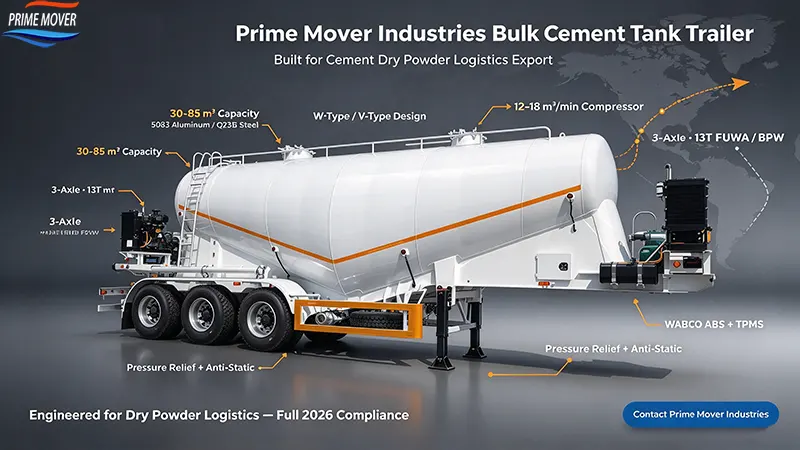
Prime Mover Industries is a Hong Kong-based manufacturer and global exporter established in 2014. Its bulk cement tank trailer line is engineered for cement, fly ash, lime powder, and mineral powder transport, with specifications matched to the route and regulatory conditions of export markets across Africa, Southeast Asia, and the Middle East.
Standard specifications across the Prime Mover bulk cement tank trailer line:
| Component | Standard | Optional Upgrade |
|---|---|---|
| Tank material | Q235B carbon steel | 5083 aluminum alloy |
| Tank capacity | 30–60 m³ | Custom up to 85 m³ |
| Tank design | V-type single cone | W-type double cone |
| Compartments | 1–2 | Up to 4 compartments |
| Air compressor | 12 m³/min | 16–18 m³/min |
| Axles | 3 × 13T FUWA / BPW | 3 × 16T or 4 axles |
| Suspension | Mechanical leaf spring | Air suspension |
| Brake system | WABCO ABS | EBS + TPMS |
| Safety systems | Pressure relief + anti-static | Overload sensors + IoT monitoring |
Key differentiators for international buyers include factory-direct pricing, third-party inspection through SGS or BV, full export documentation, and globally standardized components. For fleet operators evaluating bulk cement tank trailer advantages in 2026, Prime Mover Industries offers a specification matched to actual dry powder logistics requirements rather than a fixed catalog.
Conclusion
The top 9 advantages of bulk cement tank trailers for cement and dry powder logistics come down to one core principle: moving more material, faster, with less waste and lower cost. Pneumatic discharge at 1.4–1.6 tons per minute, residual rates below 0.3%, aluminum lightweighting that adds 1.2–1.6 tons of payload, and transport cost reductions of 30–40% are not marginal improvements. They change the economics of a fleet.
The market data confirms the direction. The global bulk cement tank trailer market is growing at roughly 6.8% CAGR, aluminum alloy penetration is approaching 45%, and the Asia Pacific region is expanding at over 7.2% annually. Fleets that adopt well-specified bulk cement tank trailers in 2026 are positioning themselves for the infrastructure and construction demand that will define the rest of the decade.
For buyers, the practical decision is not whether bulk pneumatic transport is superior to bagged transport — it is which bulk cement tank trailer specification matches your cargo, your routes, and your regulatory environment. That is the question Prime Mover Industries exists to answer.
Written by
Prime Mover Industries
Editor Wang
WhatsApp:+86-189 5386 6163
Email:wlei66@126.com
PRIME MOVER
INDUSTRIES LIMITED