
PRIME MOVER
INDUSTRIES LIMITED
Top 7 Fuel Tanker Trailer Market Trends 2026-2032: $26 Billion Forecast & Outlook
The global fuel tanker trailer market is entering a period of structural transformation. According to industry research, the global Oil Tank Trailer and Semi-Trailer market was valued at US$ 21.58 billion in 2025 and is forecast to reach US$ 27.06 billion by 2032, growing at a CAGR of 3.3% during the review period. A broader QYResearch analysis places the combined oil tanker truck and semi-trailer market at US$ 20.97 billion in 2025, rising to US$ 26.41 billion by 2032 at a 3.4% CAGR.
Behind these headline numbers lies a market undergoing fundamental change. The fuel tanker trailer industry is being reshaped by lightweight material adoption, smart telematics integration, sweeping new safety regulations, and a major shift in regional demand patterns. For fleet operators, procurement managers, and manufacturers, understanding these trends is essential for making informed equipment decisions through 2032.
This analysis examines the Top 7 fuel tanker trailer market trends driving the industry forward — from the $26 billion forecast to the regulatory and technological forces that will define the next seven years.
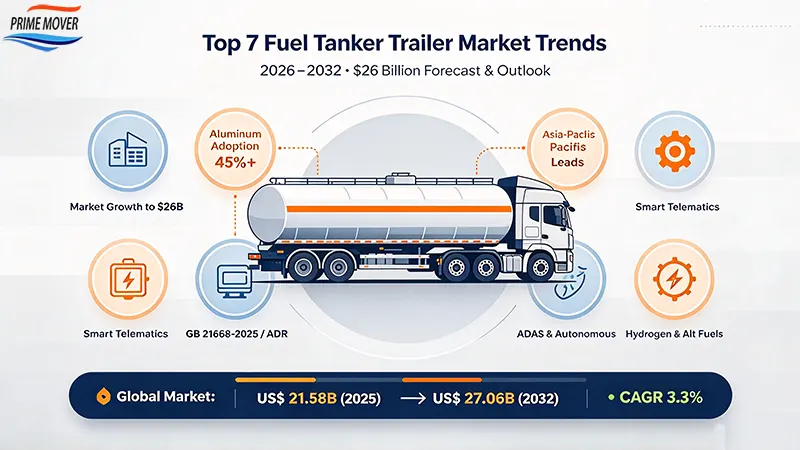
Trend #1: Steady Market Growth to $26 Billion by 2032
The most fundamental trend is the sustained expansion of the fuel tanker trailer market itself. With the market growing at 3.3–3.4% annually, the industry is adding approximately $600–$700 million in incremental value every year through 2032. This is not explosive growth — it is structural, resilient growth driven by the irreplaceable role of tank semi-trailers in global energy logistics.
The semi-trailer market as a whole is projected to grow from $34.53 billion in 2026 to $54.14 billion by 2033 at a 6.6% CAGR, with tanker trailers contributing a disproportionately high value density. Tank semi-trailers have higher technical barriers and command prices concentrated in the mid-to-high-end range, reflecting stronger added value and profit margins.
| Metric | 2025 Value | 2032 Forecast | CAGR |
|---|---|---|---|
| Oil Tank Trailer & Semi-Trailer | US$ 21.58 B | US$ 27.06 B | 3.3% |
| Oil Tanker Truck & Semi-Trailer | US$ 20.97 B | US$ 26.41 B | 3.4% |
| Aluminum Alloy Tank Semi-Trailer | US$ 2.16 B | US$ 3.11 B | 5.28% |
Key drivers supporting this growth include global energy consumption patterns, ongoing fleet replacement cycles, stricter safety and environmental regulations forcing equipment upgrades, and the growing demand for bulk liquid transport in emerging economies. The tanker trailer segment is experiencing steady development opportunities against the backdrop of global energy restructuring and continuous upgrading of logistics systems.
Outlook: Fleet operators should expect steady demand growth but should plan for a market increasingly defined by regulatory compliance and technology differentiation rather than volume expansion alone.
Trend #2: Lightweight Aluminum Adoption Accelerates to 45%+ Market Share
Material selection is undergoing the most visible transformation in the fuel tanker trailer market. Aluminum alloy tank semi-trailers are growing faster than the overall market at a 5.28% CAGR, projected to reach US$ 3.11 billion by 2032. A parallel analysis suggests aluminum alloy tanker trailers could grow at 6.5% CAGR, reaching US$ 1.27 billion by 2032.
In 2020, aluminum alloy tank trailers accounted for 28.1% of the market. By 2025, that share had risen to 41.6%, and it is projected to exceed 45% in 2026. The fundamental economics are straightforward: aluminum alloy tanker trailers are typically 30–40% lighter than carbon steel equivalents of the same volume. This translates directly into higher payload capacity and lower fuel consumption.
| Parameter | Carbon Steel | Aluminum Alloy |
|---|---|---|
| Market Share (2020) | 71.9% | 28.1% |
| Market Share (2026E) | ~55% | 45%+ |
| Tare Weight (45,000L) | 10,000–13,000 lbs | 8,500–9,000 lbs |
| Payload Advantage | Baseline | +2,000–3,000 kg |
| Corrosion Resistance | Requires coating | Natural oxide layer |
| Service Life | 8–12 years | 15–20 years |
Europe is leading this shift. Under the EU Carbon Border Adjustment Mechanism, demand for lightweight aluminum tankers has surged, with the region's aluminum tanker penetration rate exceeding 42% in 2025. Manufacturers are also improving welding quality — modern aluminum tankers use 5182 aluminum alloy for the tank body with 5356 welding material, delivering exceptional strength-to-weight ratios.
Outlook: Aluminum alloy will continue to gain market share through 2032. Fleets operating high-mileage routes should prioritize aluminum specifications; carbon steel remains viable for rough-road and budget-constrained operations.
Trend #3: Regional Demand Shifts — Asia-Pacific Leads, Middle East Accelerates
The geographic center of gravity in the fuel tanker trailer market is shifting eastward. Asia Pacific dominates the tanker trailer market with 42.3% of global revenue share in 2025, and the region's fuel tanker trailer demand is growing at 8.9–9.1% annually — far outpacing the global average.
China, India, and Southeast Asia are the three primary growth engines, driven by petrochemical industry upgrades and expanding energy infrastructure. China alone accounts for more than 50% of regional demand for oil tank trailers.
| Region | Market Position | Growth Rate | Key Drivers |
|---|---|---|---|
| Asia-Pacific | 42.3% revenue share (2025) | 8.9–9.1% | Petrochemical expansion, infrastructure investment, trade corridors |
| North America | Significant share | 5.8% | Shale oil transport network expansion, fleet modernization |
| Middle East & Africa | Growing from small base | 11.3% (import growth) | Oil & gas infrastructure, Vision 2030 projects, refining capacity |
| Europe | Mature market | Moderate | Safety certification, emissions efficiency, lightweight adoption |
The Middle East is emerging as the fastest-growing import market. The region's oil tank semi-trailer imports grew 11.3% year-over-year, driven by new refining and petrochemical projects. Saudi Arabia's Vision 2030 plan and expanding energy infrastructure are generating substantial demand for specialized tanker trailers — and the region is increasingly choosing Chinese-made logistics equipment.
North America and Asia-Pacific together account for over 62% of global market share. North America benefits from shale oil transport network expansion, while Asia-Pacific is driven by petrochemical industry upgrades in China, India, and Southeast Asia.
Outlook: Asia-Pacific will remain the dominant production and consumption region. Middle East and Africa will offer the highest growth rates for exporters. Europe will lead in lightweight and safety technology adoption.
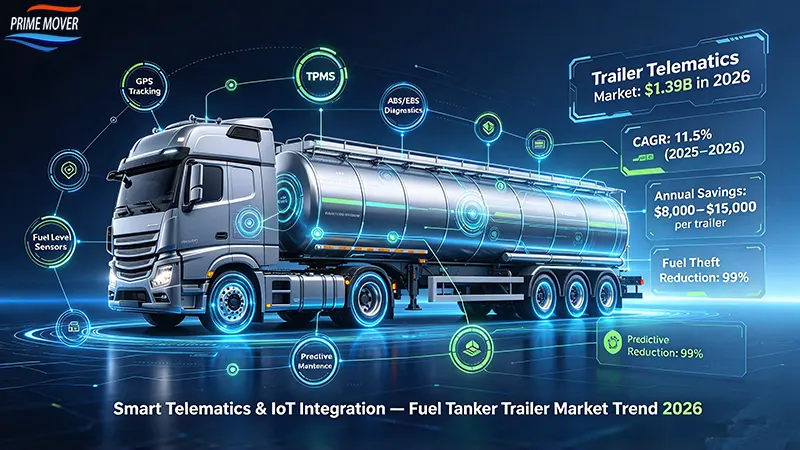
Trend #4: Smart Telematics and IoT Integration Reshapes Fleet Management
Telematics is moving from optional to essential in the fuel tanker trailer market. The trailer roll stability telematics market alone grew from $1.25 billion in 2025 to $1.39 billion in 2026 at a 11.5% CAGR — more than three times the growth rate of the overall tanker trailer market.
At Tank Truck Week 2026, major technology launches signaled the industry's direction. Tremcar unveiled its "TremSmart" technology package, a smart petroleum tank trailer designed to deliver real-time operational data, proactive equipment monitoring, and enhanced safety features. Drōv introduced AirBoxLite, a streamlined telematics system delivering tire pressure, hub temperature, ABS faults, GPS location, and battery status — all integrated into a unified dashboard.
| Capability | Function | Fleet Benefit |
|---|---|---|
| Real-Time GPS Tracking | Live location, route history, geofence alerts | Theft prevention, dispatch optimization |
| Tire Pressure Monitoring | Continuous TPMS data | Reduce blowouts, extend tire life by 9% |
| ABS/EBS Diagnostics | Fault code alerts, brake system health | Prevent roadside breakdowns ($500–$1,000 each) |
| Axle Load Monitoring | Real-time weight distribution | Prevent overload violations |
| Fuel Level Sensors | Per-compartment monitoring | 99% fuel theft elimination |
The economic case is compelling. Fleets deploying telematics report annual savings of $8,000–$15,000 per trailer. The integration of AI-powered predictive maintenance models — combining inspection records, axle and suspension data, braking events, corrosion observations, and route conditions — enables fleets to identify assets requiring intervention before failure.
Outlook: By 2032, telematics will be standard equipment on new fuel tanker trailers. Fleets without telematics will face competitive disadvantage in insurance costs, theft recovery, and maintenance efficiency.
Trend #5: Regulatory Compliance Drives Replacement Cycle — GB 21668-2025 and ADR 2026
Regulation is the most powerful short-term force reshaping the fuel tanker trailer market. China's mandatory national standard GB 21668-2025 — takes effect on July 1, 2026, replacing three previous standards: GB 21668-2008, GB 20300-2018, and GB 36220-2018.
The new standard significantly raises the technical bar for fuel tanker trailers:
| Requirement | GB 21668-2025 Specification |
|---|---|
| Active Safety Devices | ESC, EBS, TPMS, intelligent onboard terminals mandatory |
| Rear Impact Protection | Must withstand 20 tonnes loading force |
| Rear Safety Distance | Doubled from 150 mm to 300 mm |
| Hazard Identification | UN numbers, hazard classifications, emergency response methods |
| Speed Limitation | 80 km/h electronically limited |
| AEBS/ESC | Mandatory for medium and heavy vehicles |
In Europe, ADR 2025–2026 updates harmonize inspection requirements across member states and tighten tank construction, overfill protection, vapour recovery, earthing, and ATEX/EX certification requirements. Delegated Directive (EU) 2025/1801, effective November 2, 2025, harmonises ADR inspections across member states.
The regulatory push is translating directly into market growth. Compliance is becoming a market prerequisite, creating a policy-driven replacement cycle and making advanced safety systems a key competitive advantage. Fleets that delay upgrades face operational restrictions and legal liability.
Outlook: The 2026 regulatory deadline will accelerate fleet replacement through 2027–2028. Operators should factor compliance timelines into procurement planning and verify that new trailers meet destination-market requirements before purchase.
Trend #6: Autonomous Driving and ADAS Move from Concept to Deployment
The long-term transformation of the fuel tanker trailer market will be defined by automation. ZF officially unveiled its scalable 360° safety concept for integrated truck-and-trailer combinations at the 2026 IAA Transportation, introducing a high-speed automotive Ethernet interface — the "Truck-Trailer Link" — connecting trucks and trailers into one perception system. ADAS functions can be upgraded step-by-step, adapting to different markets and vehicle models for future autonomous driving.
In China, the regulatory framework is already enabling this shift. GB 21668-2025 requires ESC, AEBS, and lane departure warning systems on medium and heavy vehicles. The Ministry of Transport has mandated AEBS and LDWS on newly produced dangerous goods transport vehicles.
The autonomous driving pilot market for tank vehicles is expanding rapidly. L4-level autonomous systems in enclosed parks and fixed-route transport applications have been deployed across 12 countries, with the sensor and onboard controller market for these applications reaching $1.7 billion in 2026.
Outlook: Full autonomy for fuel tanker trailers remains years away, but ADAS (ESC, AEBS, LDW) will be standard on all new trailers by 2028. The "Truck-Trailer Link" concept will enable incremental automation upgrades without full vehicle replacement.
Trend #7: Alternative Fuel and Hydrogen Logistics Create New Tanker Demand
The global energy transition is creating entirely new demand categories for fuel tanker trailers. Hydrogen fuel cell trucks are entering commercial deployment. Daimler Truck plans to produce 100 Mercedes-Benz NextGenH2 fuel cell trucks starting late 2026, featuring liquid hydrogen storage enabling 1,000-kilometer range.
The hydrogen logistics infrastructure is already taking shape. WTK Stratmann, a German company specialising in silo tanker and container transport, won the H2 MOBILITY "Hydrogen Power User" award after its MAN hTGX truck took on 86 kilograms of hydrogen in a single day — a record across the H2 MOBILITY network.
This creates demand for specialized cryogenic tanker trailers capable of transporting liquid hydrogen at extreme low temperatures. While this market is nascent today, the trajectory is clear: as hydrogen fuel cell trucks scale from 100-unit pilot programs to mass production, the demand for hydrogen tanker trailers will grow exponentially.
Simultaneously, the growing adoption of LNG, CNG, and electric commercial vehicles is reshaping the traditional diesel and petrol distribution networks that fuel tanker trailers currently serve. This does not reduce overall tanker trailer demand — it diversifies it. Fleets that adapt their product portfolios to serve multiple energy carriers will be best positioned for growth.
Outlook: Hydrogen and alternative fuel logistics will represent a small but fast-growing segment through 2032. The broader energy transition will diversify — not eliminate — fuel tanker trailer demand.
Competitive Landscape: Top 3 Players Hold 40% Market Share
The fuel tanker trailer market remains moderately concentrated. The top three manufacturers account for approximately 40% of global market share. Key players include Schmitz Cargobull (Germany), CIMC (China), Schwarzmüller Group (Austria), Kassbohrer (Germany), Feldbinder (Germany), Wabash National (USA), and Hyundai Translead.
| Company | Headquarters | Strategic Strength |
|---|---|---|
| Schmitz Cargobull | Germany | High-end design, lightweight technology, ADR compliance |
| CIMC | China | Scale, cost advantage, global export network |
| Schwarzmüller Group | Austria | European premium segment, cross-border logistics |
| Wabash National | USA | North American fleet standards, standardized production |
Competition in the tank semi-trailer sector focuses on technological capabilities and safety standards — including tank materials, welding processes, and explosion-proof design. Companies with technological accumulation and certification capabilities are more likely to establish a competitive advantage in the high-end market.
Chinese manufacturers continue to strengthen their position in global production and exports, leveraging well-established manufacturing systems and cost advantages. European companies retain leadership in high-end product design and lightweight technology, while North America prioritizes standardized production and large-fleet demand.
Prime Mover Industries: Specification Flexibility for the Evolving Fuel Tanker Trailer Market
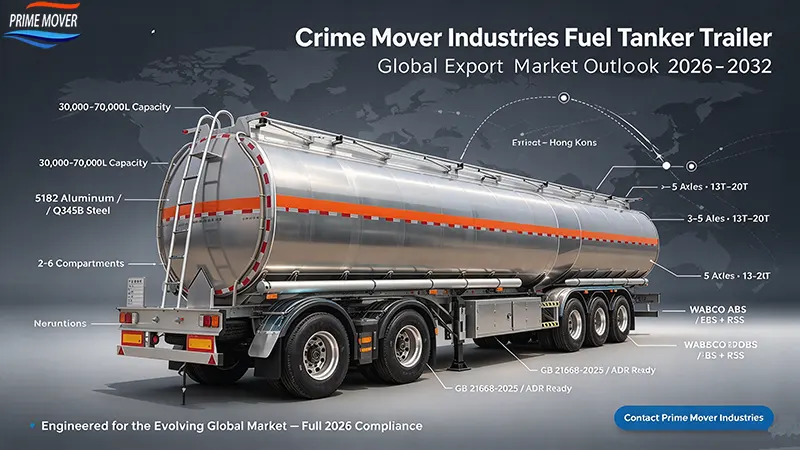
Prime Mover Industries — a Hong Kong-based manufacturer and global exporter established in 2014 — builds fuel tanker trailers engineered to meet the evolving demands of the 2026–2032 market. The company serves construction, logistics, and energy sector clients across Africa, Southeast Asia, the Middle East, and beyond.
Standard specifications across the Prime Mover fuel tanker trailer line:
| Component | Standard | Optional Upgrade |
|---|---|---|
| Tank Material | Q345B carbon steel | 5182 aluminum alloy |
| Tank Capacity | 30,000–60,000L | Custom up to 70,000L+ |
| Compartments | 2–4 | Up to 6, customizable |
| Axles | 3 × 13T FUWA / BPW | 4–5 axles, 16T/20T ratings |
| Brake System | WABCO ABS | EBS 2S/2M + RSS |
| Emergency Valves | Pneumatic bottom valves | Remote-controlled + fusible element |
| Telematics | Optional GPS tracking | Full telematics integration |
| Compliance | GB 21668-2025 ready | ADR / destination-market certification |
Key differentiators for international buyers:
- Factory-direct pricing — no distributor markup
- Full compliance support — GB 21668-2025, ADR, and destination market documentation
- Third-party inspection — SGS, BV, or buyer-nominated inspector
- Capacity range — 30,000L to 70,000L+ with customizable compartment configurations
- After-sales parts — standardized components available globally
For fleet operators navigating the fuel tanker trailer market trends of 2026–2032, Prime Mover Industries delivers a specification matched to your cargo, routes, and regulatory environment.
Market Outlook Summary: What to Expect Through 2032
| Trend | 2026 Status | 2032 Outlook | Impact on Buyers |
|---|---|---|---|
| Market Size | ~$22 B | ~$27 B | Steady 3.3% growth |
| Aluminum Adoption | 45%+ share | 55%+ share | Prioritize aluminum for high-mileage |
| Asia-Pacific Demand | 42.3% share | 45%+ share | Source from Asia for cost advantage |
| Middle East Growth | 11.3% import growth | Fastest-growing region | Opportunity for exporters |
| Telematics | 11.5% CAGR | Standard equipment | Spec telematics-ready trailers |
| Regulatory Compliance | GB 21668-2025 effective | Global harmonization trend | Verify compliance before purchase |
| ADAS/Automation | ESC, AEBS, TPMS mandatory | L4 pilots in 12+ countries | Choose upgradeable platforms |
| Alternative Fuels | 100 H2 trucks entering service | Scaling H2/LNG infrastructure | Diversify tanker portfolios |
Conclusion: Strategic Implications for Fleet Operators and Buyers
The Top 7 fuel tanker trailer market trends for 2026–2032 paint a picture of an industry in transition — not shrinking, but evolving. The $26 billion market forecast represents steady growth, but the composition of that market will look very different by 2032.
Key strategic takeaways:
- Aluminum is the future of tank construction. With 45%+ market share in 2026 and growing, aluminum tankers deliver superior payload, fuel efficiency, and service life for high-mileage operations.
- Regulatory compliance is non-negotiable. GB 21668-2025 and ADR 2026 requirements will drive fleet replacement cycles and create competitive separation between compliant and non-compliant operators.
- Telematics is becoming standard, not optional. The 11.5% CAGR in trailer telematics far outpaces overall market growth. Fleets without telematics will face rising insurance and maintenance costs.
- Regional demand is shifting east and south. Asia-Pacific dominates at 42.3% revenue share; Middle East and Africa offer the highest growth rates for exporters and fleet expansion.
- Buy from manufacturers who can grow with the regulations. Choose partners with proven compliance capability, specification flexibility, and global after-sales support.
The right fuel tanker trailer is not the cheapest one — it is the one that matches your cargo, your routes, your regulatory environment, and your fleet's trajectory through 2032. For fleet operators investing in 2026, these seven market trends provide the strategic framework for equipment decisions that will deliver ROI for years to come.
Written by
Prime Mover Industries
Editor Wang
WhatsApp:+86-189 5386 6163
Email:wlei66@126.com
- Top 5 3-Axle Flatbed Trailers in 2026: Cost, Payload & Durability Compared
- Top 3 Heavy Haul Trailers Compared: Flatbed vs. Step-Deck vs. Lowboy – Which Delivers the Best ROI in 2026?
- Telematics and Smart Fleet Management – The New Era of Semi Trailers
- Top 7 Must-Have Fuel Tanker Trailer Features for Diesel & Petrol Haulage in 2026
PRIME MOVER
INDUSTRIES LIMITED