
PRIME MOVER
INDUSTRIES LIMITED
Top 8 Bulk Cement Tank Trailer Specifications for Dry Powder Logistics
Dry powder logistics is one of the fastest-growing segments in global bulk transport. Cement, fly ash, lime powder, mineral powder, and other fine dry materials move in enormous volumes every day — from cement plants to concrete batching stations, from power plants to construction sites, from ports to industrial processing facilities. And at the center of this supply chain sits one critical piece of equipment: the bulk cement tank trailer.
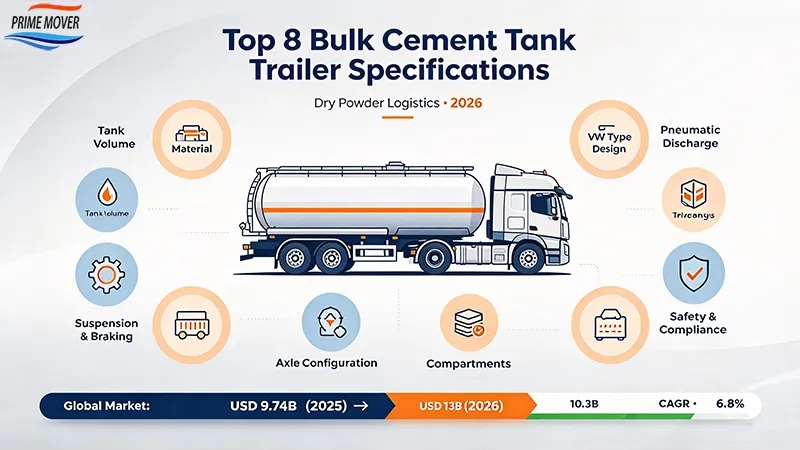
The global bulk cement tank trailer market is expanding rapidly. In 2025, the global market reached approximately USD 9.74 billion, growing 6.2% year-on-year, with China contributing 34.8% of global demand at USD 3.39 billion. The market is projected to exceed USD 10.3 billion in 2026 and reach USD 13.6 billion by 2030, growing at a CAGR of approximately 6.8%. The pneumatic dry bulk trailer segment alone — the core category for cement and powder transport — was valued at $1.5 billion in 2024 and is projected to reach $2.4 billion by 2033, expanding at a CAGR of 5.4%.
For fleet operators and procurement managers, the specification decisions made when purchasing a bulk cement tank trailer for dry powder logistics determine payload capacity, unloading efficiency, maintenance costs, and regulatory compliance for years to come. A poorly specified trailer can reduce payload by 15–20%, extend unloading time from 30 minutes to 2 hours, and create costly compliance issues at border crossings.
This guide covers the Top 8 bulk cement tank trailer specifications that matter most for dry powder logistics in 2026 — with the technical data, market context, and practical guidance to help you specify the right trailer for your operation.
Specification #1: Tank Volume and Capacity Range
The tank volume is the foundation of any bulk cement tank trailer specification. It determines how much powder you can carry per trip, which directly affects revenue per kilometer and fleet utilization. The dry powder logistics industry standard capacity range for bulk cement tank trailers is 30 m³ to 60 m³, with larger models reaching up to 85 m³ for high-volume operations.
| Capacity Range | Typical Application | Recommended Axles |
|---|---|---|
| 24–35 m³ | Urban distribution, short-haul, light powder | 2–3 axles |
| 35–45 m³ | Standard long-haul cement transport | 3 axles |
| 45–60 m³ | High-volume cement, fly ash, industrial powder | 3–4 axles |
| 60–85 m³ | Mining backfill, large-scale infrastructure | 4–5 axles |
The most common configuration for dry powder logistics in 2026 is the 3-axle 40–45 m³ bulk cement tank trailer, which offers the best balance of payload, route flexibility, and regulatory acceptance. For example, a standard 45 m³ 3-axle bulk cement tank semi-trailer uses 3 mm T610L high-strength steel for the tank body and 4 mm T610L steel for the tank heads, with a 12 m³/min air compressor and a 7-meter steel-wire reinforced discharge hose.
Larger capacity does not always mean better economics. The right tank volume depends on:
- Cargo density: Cement at 1,380 kg/m³ requires different volume than fly ash at 700–900 kg/m³
- Route restrictions: Height, weight, and axle load limits vary by country and region
- Loading and unloading infrastructure: Silo heights, discharge hose length, and site access
The verdict: For most dry powder logistics operations, a 40–45 m³ 3-axle configuration delivers the best return on investment. For specialized high-volume routes, larger capacities with additional axles may justify the higher upfront cost.
Specification #2: Tank Material — Aluminum Alloy vs. Carbon Steel
Material selection is the second most consequential bulk cement tank trailer specification. It affects tare weight, payload capacity, corrosion resistance, service life, and resale value. The two primary options are carbon steel and aluminum alloy.
| Parameter | Carbon Steel (Q235B/Q345B) | Aluminum Alloy (5083/5454) |
|---|---|---|
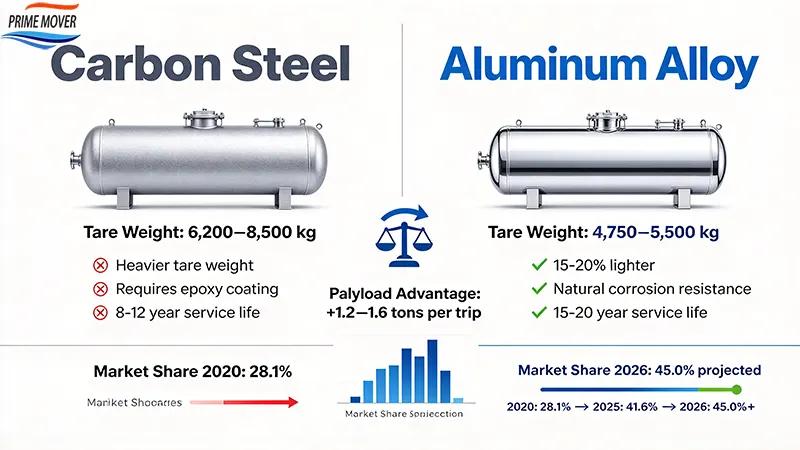
| Tare Weight (30 m³) | 6,200–8,500 kg | 4,750–5,500 kg |
| Weight Reduction | Baseline | 15–20% lighter |
| Payload Advantage | Baseline | +1.2–1.6 tons per trip |
| Corrosion Resistance | Requires epoxy coating | Natural oxide layer |
| Service Life | 8–12 years | 15–20 years |
| Initial Cost | Lower | Higher |
| Scrap Value | Baseline | Higher |
The market share of aluminum alloy cement tankers has grown dramatically. In 2020, aluminum alloy tank trailers accounted for 28.1% of the market. By 2025, that share had risen to 41.6%, and it is projected to exceed 45.0% in 2026. This shift is driven by the fundamental economics of dry powder logistics: every kilogram of tare weight saved is a kilogram of payload gained.
A 28 m³ aluminum cement trailer can achieve a minimum dead weight of just 4.75 tons, reducing dead weight by 1.2–1.6 tons compared to a carbon steel tanker of the same capacity. For a fleet running 200 trips per year, that translates to 240–320 tons of additional cargo moved annually — without a single extra kilometer driven.
Aluminum tankers also require no painting, which reduces production processes and eliminates the environmental burden of paint coatings. The natural corrosion resistance of aluminum is particularly valuable when transporting materials with high moisture content or in humid, coastal environments.
The verdict: For high-mileage dry powder logistics operations on paved highways, aluminum alloy is the must-have material specification. For rough, unpaved routes or budget-constrained operations, carbon steel with proper epoxy coating remains a viable alternative.
Specification #3: Tank Design — V-Type vs. W-Type vs. Multi-Hopper
The internal tank geometry is a critical bulk cement tank trailer specification that directly impacts discharge efficiency and residual material. The three main designs are V-type (single-cone), W-type (double-cone), and multi-hopper configurations.
| Design | Structure | Residual Rate | Best For | Cost |
|---|---|---|---|---|
| V-Type / Single-Cone | One steep cone at bottom | Higher | Standard cement, fly ash, short routes | Lowest |
| W-Type / Double-Cone | Two lower cones, improved fluidization | <1% by volume | Cement, lime, fine industrial powders | Moderate |
| Multi-Hopper | Multiple discharge points, maximum flexibility | Lowest | Mixed cargo, multi-compartment operations | Highest |
The V-type design uses a single steep cone at the bottom of the tank. It is the simplest and most cost-effective design, typically built in carbon steel. These trailers work well for standard Portland cement and fly ash, but the residual material left after discharge is higher than W-type designs. If your routes are short and your material flows easily, a V-type is a cost-effective choice.
The W-type design uses two lower cones, which improves fluidization and reduces leftover material to under 1% by volume. This is the design most buyers choose for cement, lime, and finer industrial powders. The improved fluidization means faster discharge, less cleaning time between loads, and lower risk of cross-contamination when switching materials.
The V-shape design makes the bottom inclined surface angle of the tank larger, and the discharge method often adopts a vibrator, which can increase the fluidity of high-density medium cargo and quickly cover the discharge device to complete quick unloading.
The verdict: For dry powder logistics operations handling cement, lime, and fine industrial powders, the W-type design is the recommended specification. Its lower residual rate and superior fluidization deliver measurable gains in unloading speed and material conservation. For basic cement transport on short routes, V-type remains a cost-effective option.
Specification #4: Pneumatic Discharge System and Compressor
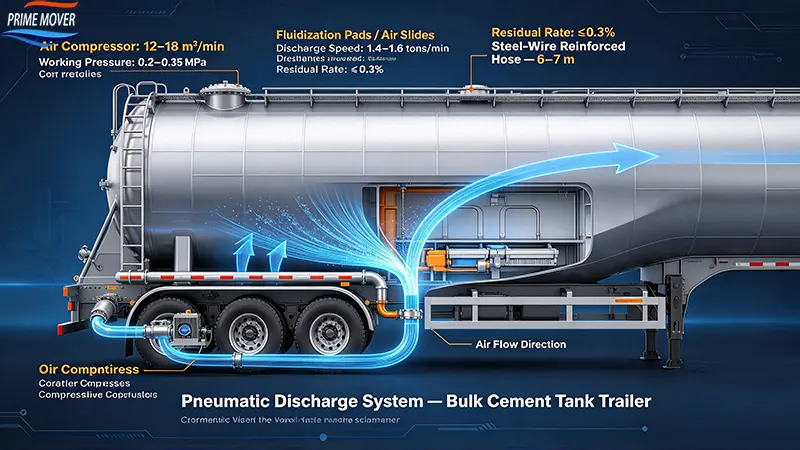
The pneumatic discharge system is the heart of any bulk cement tank trailer. Unlike a dump trailer or flatbed, a powder tank trailer is a sealed system that uses compressed air to fluidize and push the cargo out through discharge pipes. This means no dust loss during transport, no weather damage, and faster turnaround at both the loading silo and the unloading point.
Key Components
| Component | Specification Range | Impact |
|---|---|---|
| Air Compressor | 12–18 m³/min | Determines discharge speed and pressure consistency |
| Working Pressure | 0.2–0.35 MPa | Higher pressure for denser materials and longer hoses |
| Discharge Hose | 6–7 m, steel-wire reinforced | Abrasion resistance and flexibility |
| Fluidization System | Aeration pads / air slides | Ensures even material flow to discharge point |
Modern pneumatic systems achieve discharge speeds of 1.4 to 1.6 tons per minute. For a 30 m³ load at standard cement density, this means unloading can be completed in 2–3 minutes under optimal conditions, with residue reduced to ≤0.3%. A 12 m³/min air compressor is standard for most 3-axle configurations, with larger compressors recommended for high-altitude areas or long discharge distances.
The working pressure of the pneumatic system typically ranges from 0.2 MPa to 0.35 MPa. Higher pressure is required for denser materials (such as cement at 1,380 kg/m³) and for longer discharge hoses. The system must be equipped with pressure relief valves to prevent over-pressurization and ensure safe operation.
The verdict: For dry powder logistics, a 12–18 m³/min air compressor with 0.2–0.35 MPa working pressure is the must-have specification. This ensures fast discharge, minimal residual material, and consistent performance across different powder types.
Specification #5: Axle Configuration and Load Distribution
Axle configuration determines payload capacity, legal compliance, and weight distribution. For bulk cement tank trailers in dry powder logistics, the standard configurations range from 2 to 5 axles, with 3 axles being the industry standard.
| Axle Configuration | Payload Range | Best For | Market Share |
|---|---|---|---|
| 2 Axles | 25–35 tons | Urban distribution, light powder | Low |
| 3 Axles | 35–50 tons | Standard long-haul cement transport | Dominant |
| 4 Axles | 50–65 tons | High-volume, heavy powder transport | Moderate |
| 5 Axles | 65–80+ tons | Mining backfill, large infrastructure | Specialized |
The 3-axle configuration dominates the market because it hits the sweet spot between payload capacity and regulatory compliance. A standard 3-axle bulk cement tank semi-trailer with a 40 m³ tank and 13-ton axles delivers a rated payload of approximately 35–40 tons, which aligns with legal weight limits in most markets.
Axle brands and ratings matter. Common specifications include FUWA, BPW, or Yahua 13-ton axles, with 16-ton or 20-ton axles available for heavy-duty configurations. The suspension system must be matched to the axle configuration — mechanical leaf spring for standard applications, air suspension for improved ride quality and load leveling.
The verdict: For most dry powder logistics operations, the 3-axle configuration with 13-ton axles is the standard specification. For heavier payloads or specialized routes, 4-axle configurations provide better weight distribution and reduce individual axle stress.
Specification #6: Suspension and Braking Systems
The suspension and braking systems are often overlooked bulk cement tank trailer specifications, yet they directly impact safety, maintenance costs, and cargo protection. For dry powder logistics, where trailers operate at or near maximum weight limits, these systems must be specified for heavy-duty performance.
Suspension Options
| Type | Characteristics | Best For | Maintenance |
|---|---|---|---|
| Mechanical Leaf Spring | Simple, durable, cost-effective | Rough roads, heavy-duty operations | Low |
| Air Suspension | Automatic load leveling, superior shock absorption | Highway transport, precision cargo protection | Moderate |
| Bogie Suspension | Even load distribution across axle group | Extreme heavy loads | Moderate |
The standard suspension for bulk cement tank trailers is heavy-duty mechanical leaf spring, typically with 10 leaves per spring pack. This provides reliable performance on the varied road conditions common in dry powder logistics. Air suspension is increasingly specified for high-mileage operations because it reduces vibration, extends tire life, and protects the tank structure from dynamic loads.
Braking System
For a trailer carrying 35–40 tons of powder, the braking system must deliver reliable stopping power under all conditions. Standard specifications include:
- Dual-line pneumatic brake system with WABCO relay valve
- ABS (Anti-lock Braking System) — WABCO 4S/2M configuration is the industry standard
- Brake chambers: 4 double-chamber + 2 single-chamber for balanced braking force
- Parking brake: Spring-loaded on axles 1–3
- Tires: 12R22.5 tubeless, 13 units for a 3-axle configuration
The verdict: For dry powder logistics, specify WABCO ABS with dual-line pneumatic brakes and a suspension system matched to your route conditions. Air suspension is recommended for high-mileage highway operations; mechanical leaf spring for mixed or rough-road conditions.
Specification #7: Compartment Configuration and Multi-Material Capability
Modern dry powder logistics increasingly demands flexibility: delivering multiple powder types in a single trip reduces transport frequency, improves route profitability, and lowers overall operational costs. Multi-compartment bulk cement tank trailers allow operators to transport different materials — cement, fly ash, lime powder, mineral powder — simultaneously without cross-contamination risk.
| Configuration | Capacity Range | Best For |
|---|---|---|
| Single Compartment | 30–60 m³ | Dedicated single-material transport |
| 2 Compartments | 35–50 m³ | Two powder types, cement + fly ash |
| 3 Compartments | 40–60 m³ | Multiple powder types, complex distribution |
| 4+ Compartments | 45–70 m³ | Specialized multi-material logistics |
A well-designed 3-compartment 45 m³ bulk cement tank trailer allows simultaneous transport of cement, fly ash, and gypsum to different locations along the same route. The compartments have independent manholes and discharge systems, ensuring no cross-contamination and allowing partial loads to be delivered at different stops.
Multi-compartment configurations are particularly valuable for fleets serving:
- Concrete batching plants that require cement and fly ash in different proportions
- Construction sites with varied material requirements
- Industrial customers needing lime powder, mineral powder, and other specialized dry materials
The verdict: For fleet operators serving multiple powder types or delivery points, multi-compartment configuration is a must-have specification. It transforms a single-purpose trailer into a flexible distribution asset for dry powder logistics.
Specification #8: Safety Systems and Regulatory Compliance
The final — and most critical — bulk cement tank trailer specification is safety and regulatory compliance. As global regulations tighten around dry bulk transport, trailers must meet increasingly stringent requirements for pressure safety, dust control, and structural integrity.
Safety System Specifications
| System | Specification | Purpose |
|---|---|---|
| Pressure Relief Valves | Set at 0.2–0.35 MPa working pressure | Prevents tank over-pressurization |
| Anti-Static System | Grounding devices, conductive materials | Prevents static discharge and dust explosion |
| Overload Sensors | Axle load monitoring | Prevents overloading and legal violations |
| Emergency Shut-Off | Manual or pneumatic valve | Emergency discharge control |
| Fire Extinguisher | Class B rated | Fire safety compliance |
| Lighting | 24V LED system | Visibility and road safety |
Regulatory Landscape for 2026
China's mandatory national standard GB 21668-2025 — takes effect on July 1, 2026. While primarily targeting dangerous goods transport, the standard's requirements for TPMS (Tire Pressure Monitoring Systems), ESC (Electronic Stability Control), and active safety devices are increasingly being applied to all heavy-duty semi-trailers, including bulk cement tankers.
International markets have their own requirements:
- ADR (Europe): Requirements for pressure relief valves, grounding systems, and fire suppression
- FMCSA (USA): Brake system standards, lighting requirements, and weight compliance
- GCC Standardization: Fire safety and pressure system requirements for powder tankers
The triple-safety design now standard on leading bulk cement tank trailers includes pressure relief valves, anti-static systems, and overload sensors — all three are essential for safe dry powder logistics operations.
The verdict: Never specify a bulk cement tank trailer without pressure relief valves, anti-static grounding, and overload protection. These are non-negotiable safety requirements that protect your fleet, your drivers, and your business.
Head-to-Head Specification Comparison
| Specification | Standard Configuration | Premium Configuration | Impact |
|---|---|---|---|
| Tank Volume | 35–40 m³ | 45–60 m³ | Payload per trip |
| Tank Material | Q235B carbon steel | 5083 aluminum alloy | Payload + corrosion |
| Tank Design | V-type single cone | W-type double cone | Residual rate <1% |
| Compressor | 12 m³/min | 16–18 m³/min | Discharge speed |
| Axles | 3 × 13T | 3 × 16T / 4 axles | Payload capacity |
| Suspension | Mechanical leaf spring | Air suspension | Ride quality & tire life |
| Brakes | WABCO ABS | EBS + TPMS | Safety & compliance |
| Compartments | 1–2 | 3–4 | Multi-material flexibility |
Prime Mover Industries: Specification Flexibility for Dry Powder Logistics
Prime Mover Industries — a Hong Kong-based manufacturer and global exporter established in 2014 — builds bulk cement tank trailers engineered for the most demanding dry powder logistics requirements. The company serves construction, logistics, and industrial clients across Africa, Southeast Asia, the Middle East, and beyond.
Standard specifications across the Prime Mover bulk cement tank trailer line:
| Component | Standard | Optional Upgrade |
|---|---|---|
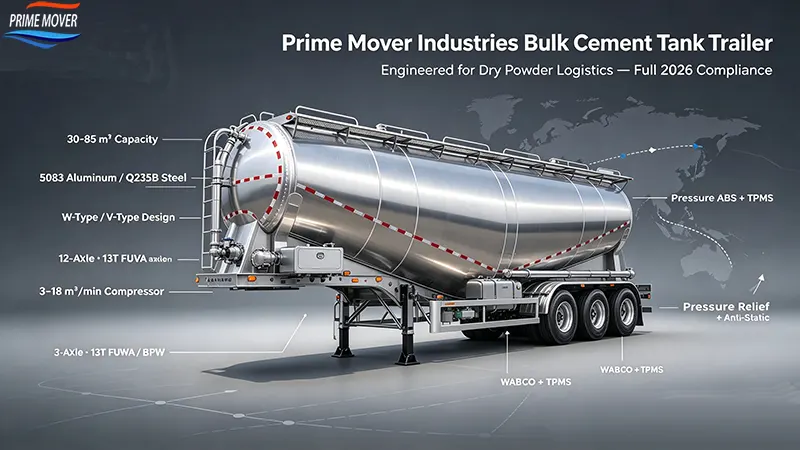
| Tank Material | Q235B carbon steel | 5083 aluminum alloy |
| Tank Capacity | 30–60 m³ | Custom up to 85 m³ |
| Tank Design | V-type / W-type | Multi-hopper configuration |
| Compartments | 1–2 | Up to 4 compartments |
| Air Compressor | 12 m³/min | 16–18 m³/min |
| Axles | 3 × 13T FUWA / BPW | 3 × 16T / 4 axles |
| Suspension | Mechanical leaf spring | Air suspension |
| Brake System | WABCO ABS | EBS + TPMS |
| Safety Systems | Pressure relief + anti-static | Overload sensors + IoT monitoring |
Key differentiators for international buyers:
- Factory-direct pricing — no distributor markup
- Full compliance support — GB 21668-2025, ADR, and destination market documentation
- Third-party inspection — SGS, BV, or buyer-nominated inspector
- Capacity range — 30 m³ to 85 m³ with customizable compartment configurations
- After-sales parts — standardized components available globally
For dry powder logistics operations requiring aluminum construction, W-type tank design, multi-compartment flexibility, and full 2026 regulatory compliance, Prime Mover Industries delivers a bulk cement tank trailer specification matched to your operating profile.
Conclusion
The Top 8 bulk cement tank trailer specifications outlined in this guide — tank volume, material, design, pneumatic discharge, axle configuration, suspension and braking, compartment flexibility, and safety compliance — form the complete specification framework for competitive dry powder logistics in 2026.
The market data supports the urgency of getting these specifications right. The global bulk cement tank trailer market is growing at 6.8% CAGR, with the pneumatic dry bulk trailer segment expanding at 5.4%. Aluminum alloy tankers now account for 41.6% of the market and are projected to exceed 45% in 2026. The Asia Pacific region is the fastest-growing market at over 7.2% CAGR, driven by infrastructure investment and industrialization.
The right bulk cement tank trailer is not the cheapest one — it is the one that matches your cargo, your routes, and your regulatory environment. For fleet operators investing in dry powder logistics in 2026, these eight specifications deliver the payload, efficiency, and compliance that modern bulk powder transport demands.
Written by
Prime Mover Industries
Editor Wang
WhatsApp:+86-189 5386 6163
Email:wlei66@126.com
- Top 7 Fuel Tanker Trailer Market Trends 2026-2032: $26 Billion Forecast & Outlook
- Top 7 Must-Have Fuel Tanker Trailer Features for Diesel & Petrol Bulk Haulage in 2026
- Top 6 Flatbed Trailer Maintenance Tips to Extend Service Life in 2026
- Top 5 3-Axle Flatbed Trailers in 2026: Cost, Payload & Durability Compared
PRIME MOVER
INDUSTRIES LIMITED