
PRIME MOVER
INDUSTRIES LIMITED
Top 7 Must-Have Fuel Tanker Trailer Features for Diesel & Petrol Bulk Haulage in 2026
The global fuel transport industry is entering a critical transformation period. With the global oil tank trailer and semi-trailer market valued at US$ 21.58 billion in 2025 and projected to reach US$ 27.06 billion by 2032 at a 3.3% CAGR, demand for high-performance fuel tanker trailers for diesel and petrol bulk haulage has never been stronger. Semi-trailers combined with tractor units enable medium- and long-distance freight transport, serving as a crucial support for modern supply chain systems. Tank semi-trailers, as a key sub-segment, are specifically designed for transporting liquids, gases, and granular materials, playing an irreplaceable role in petrochemicals, energy supply, and industrial production.
For fleet managers and procurement professionals hauling diesel and petrol, the specification decisions made at the point of purchase determine safety outcomes, operational efficiency, and profitability for years to come. A poorly specified fuel tanker trailer can reduce payload, slow delivery, increase maintenance, and create serious compliance risks.
This article examines the Top 7 Must-Have Features for fuel tanker trailers in 2026 — with the technical specifications, regulatory requirements, and ROI data that support each one. Whether you are sourcing an aluminum fuel tanker trailer or a carbon steel unit, these features are essential for safe and efficient diesel and petrol bulk haulage.
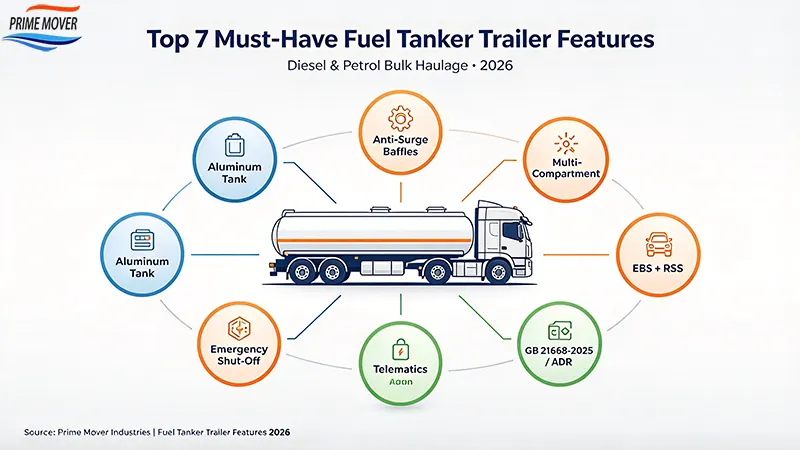
Figure 1: The 7 must-have features for fuel tanker trailers in 2026 — from aluminum construction to regulatory compliance.
Feature #1: Optimized Tank Material Selection — Aluminum Alloy vs. Carbon Steel
The single most consequential specification decision for any fuel tanker trailer for diesel and petrol bulk haulage is the tank body material. This choice affects every downstream metric: payload capacity, fuel efficiency, maintenance costs, service life, and resale value. The construction material is the primary determinant of empty weight — lighter tankers carry more cargo within the 80,000-lb federal GVW limit.
The Weight-Payload Equation
In liquid logistics, weight directly dictates revenue. Every kilogram reduced from the trailer's tare weight translates into an additional kilogram of cargo that can be legally transported. Aluminum alloy fuel tanker trailers are typically 30% to 40% lighter than carbon steel trailers of the same volume. A carbon steel tank adds 2,000–3,000 kg over aluminum at the same capacity — equivalent to 2–3 fewer tonnes of cargo per trip, which adds up fast over 200+ monthly loads.
| Parameter | Carbon Steel Tanker | Aluminum Alloy Tanker |
|---|---|---|
| Tare Weight (45,000L) | 10,000–13,000 lbs | 8,500–9,000 lbs |
| Payload Advantage (80K GVW) | ~49,000 lbs | ~53,000 lbs |
| Corrosion Resistance | Moderate (requires coating) | Superior (natural oxide layer) |
| Service Life | 8–12 years | 15–20 years |
| Initial Purchase Cost | Lower (~$16,900) | Higher (~$26,000) |
| Scrap Value | Baseline | 5–8× higher than carbon steel |
Source: O Trucking spec guide and HUAYU comparative analysis.
The Aluminum Advantage in Detail
Modern aluminum fuel tanker trailers use 5182 aluminum alloy for the tank body with 5356 aluminum alloy welding material. This combination delivers an exceptional strength-to-weight ratio while maintaining weld integrity under continuous dynamic loading. For diesel and petrol bulk haulage, the weight savings translate directly into higher payload and lower fuel consumption.
Aluminum also does not spark on impact. For gasoline and ethanol transport, that's not a minor detail — it's a safety requirement in some markets. And when the trailer reaches end of life, aluminum scrap value runs 5–8x higher than carbon steel scrap.
When Carbon Steel Remains the Right Choice
Aluminum is not universally superior. Carbon steel fuel tanker trailers remain the preferred choice for:
- Rough, unpaved off-road routes — construction sites, mining operations, and remote areas where impact resistance matters more than weight savings
- Budget-constrained operations — where minimizing initial capital expenditure takes priority over long-term operational savings
- High-viscosity or abrasive cargo — where aluminum's softer surface may wear faster
For diesel and petrol bulk haulage on paved highways with high annual mileage, aluminum delivers measurably better total cost of ownership over the trailer's service life.
The verdict: For long-haul diesel and petrol bulk haulage, aluminum alloy is the must-have specification. For regional distribution on mixed road conditions, carbon steel with proper corrosion protection remains a viable, cost-effective alternative.
Feature #2: Advanced Anti-Surge Baffle Design
Liquid surge is one of the most dangerous and least understood phenomena in tanker operations. When a partially filled fuel tanker trailer for diesel and petrol bulk haulage brakes or corners, the liquid inside does not move as a fixed mass — it shifts, builds momentum, and hits the tank walls with real force. That force can destabilize a vehicle within seconds.
How Baffles Work
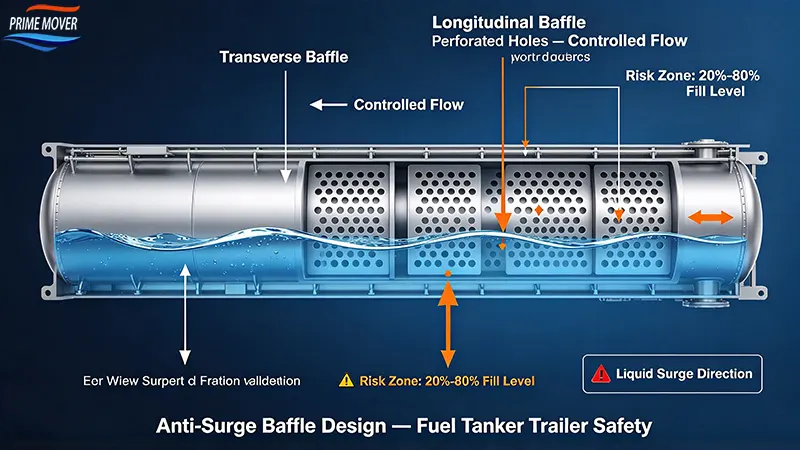
A baffle is an internal partition plate mounted at right angles to the tank's long axis. Engineers perforate it with circular or slotted holes, then weld it to the tank shell at calculated intervals. Those holes let liquid pass through at a controlled rate — the key difference from a solid divider. Surge baffle arrangements typically cover from 40% to 70% of the cross-section of the tank interior, providing resistance to fluid sloshing and improving longitudinal stability.
Baffles do not stop liquid movement. They manage its speed, volume, and direction to prevent destructive wave buildup. For any fuel tanker trailer carrying diesel or petrol, properly designed anti-surge baffles are a must-have safety feature.
The Risk Zone: 20% to 80% Fill Levels
Liquid surge events are most severe at partial fill levels between 20% and 80% of capacity. At that range, liquid has maximum space to build momentum. At full capacity, it has little room to surge. Near empty, the mass is too small to cause danger.
Safety research across the US, EU, and Australia has identified liquid tanker rollover rates as above average for commercial vehicles, with partial-load surge cited as a factor in a significant share of reviewed incidents. A CFD study on the effect of baffles on longitudinal stability found that a 40% height three-baffle model is the proper baffle configuration to resist longitudinal sloshing in partially filled tanker trailers. This makes anti-surge baffle design a critical must-have feature for fuel tanker trailers in diesel and petrol bulk haulage.
Baffle Design Specifications for 2026
Modern fuel tanker trailers typically incorporate:
- Transverse baffles — positioned at calculated intervals along the tank length to break longitudinal surge
- Longitudinal baffles — to attenuate side-to-side liquid movement during cornering
- Dished head baffles — antipodally positioned circular plates that attenuate forward and rearward directed surges
The selection and spacing of baffles must be matched to the trailer's declared operating profile — route characteristics, typical fill levels, and regulatory requirements. The interior is equipped with a thickened baffle plate, which greatly reduces the liquid surge during driving and sudden braking, lowering the vehicle's center of gravity shift and ensuring safety at high speeds and on curves.
The verdict: Anti-surge baffle design is not optional for diesel and petrol bulk haulage. It is a fundamental safety requirement that should be specified based on your actual operating routes and fill patterns.
Feature #3: Multi-Compartment Configuration for Diesel & Petrol
Fuel distribution networks increasingly demand flexibility: delivering multiple fuel grades in a single trip reduces transport frequency, improves route profitability, and lowers overall operational costs. A multi-compartment fuel tanker trailer is a must-have for any fleet serving multiple fuel types.
The Multi-Compartment Advantage
Modern fuel tanker trailers for diesel and petrol bulk haulage offer customizable multi-compartment configurations ranging from 2 to 6 compartments. Each compartment has its own manhole and discharge system, allowing operators to transport different fuel types — diesel, gasoline, kerosene, and lubricants — simultaneously without cross-contamination risk.
Key operational benefits:
- Reduced transport frequency — one trip can deliver multiple fuel grades to different customers or stations
- Improved route profitability — fewer deadhead miles, higher revenue per kilometer
- Enhanced payload utilization — compartments can be filled to varying levels based on demand
- Reduced risk of mixing — isolated compartments prevent cross-contamination between fuel types
Compartment Configurations in Practice
| Configuration | Capacity Range | Best For |
|---|---|---|
| 2–3 compartments | 30,000–45,000L | Single-fuel distribution, long-haul |
| 4–5 compartments | 40,000–50,000L | Multi-grade delivery to retail stations |
| 6+ compartments | 45,000–60,000L | Complex distribution networks, aviation fuel + road fuel |
A well-designed 6-compartment 45,000L fuel tanker trailer allows simultaneous transport of diesel, petrol, and kerosene to different locations along the same route — dramatically improving operational efficiency for fuel logistics companies.
The verdict: For fleet operators serving multiple fuel grades or retail stations, multi-compartment configuration is a must-have feature. It transforms a single-purpose vehicle into a flexible distribution asset for diesel and petrol bulk haulage.
Feature #4: Emergency Shut-Off Valve System
The emergency shut-off valve — also known as the bottom valve — is the single most critical safety component on any fuel tanker trailer. It is the last line of defense against catastrophic fuel loss in the event of a collision, rollover, or tank breach. For diesel and petrol bulk haulage, this is a non-negotiable must-have feature.
How Emergency Shut-Off Valves Work
The emergency shut-off valve is installed at the bottom of each tank compartment. It features a built-in shear groove: in the event of a crash or external impact, the valve body disconnects along the groove, sealing the tank compartment and preventing fuel leakage. The valve's shear structure must ensure that the sealing mechanism inside the tank compartment remains intact during external impact.
Technical Specifications for 2026
| Parameter | Standard Specification |
|---|---|
| Nominal Diameter | 3" (DN80), 4" (DN100) |
| Working Pressure | 0.6 MPa |
| Material | Aluminum alloy or stainless steel |
| Temperature Range | -20°C to +70°C |
| Actuation | Pneumatic or manual |
| Certification | ISO 9001, SGS/BV audited |
Regulatory Requirements
China's T/WZS 0011—2025 standard for emergency shut-off valves on liquid dangerous goods tank vehicles specifies:
- The valve must be capable of remote control connection — when an emergency occurs, the remote control system must be able to close the valve normally
- A fusible element must be integrated: when ambient temperature reaches 75°C ± 5°C, the element must melt within ≤30 minutes, automatically closing the valve with no visible leakage
- The valve's shear structure must ensure that the sealing mechanism inside the tank compartment remains intact during external impact
The verdict: Never purchase a fuel tanker trailer without pneumatic emergency shut-off valves on every compartment. This is a non-negotiable safety requirement that can prevent catastrophic fuel loss and environmental disaster in diesel and petrol bulk haulage.
Feature #5: Advanced Braking System — ABS, EBS & Rollover Protection
A fuel tanker trailer carrying 45,000 liters of flammable liquid demands braking performance far beyond standard commercial vehicle requirements. The combination of high mass, liquid surge dynamics, and hazardous cargo makes advanced braking systems a must-have feature for diesel and petrol bulk haulage.
Braking System Specifications
| Component | Standard | Premium |
|---|---|---|
| Base System | WABCO or Haldex ABS | WABCO or Knorr EBS |
| EBS Function | N/A | EBS 2S/2M with integrated ABS |
| Rollover Protection | Optional | RSS (Roll Stability System) |
| Brake Chambers | 30/30 or 30/24 | 30/30 or 30/24 |
| Parking Brake | Spring-loaded, axles 1–3 | Spring-loaded, all axles |
EBS with RSS provides automatic brake force distribution, shorter stopping distances, and rollover prevention through selective wheel braking. Under ADR 2025–2026 updates, dangerous goods tank trailers carrying bulk loads are required to be fitted with a roll stability function, and the fitting of auto slack adjusters with ABS/EBS forms part of the new ADR38/04 requirement. The RSS function uses selective braking to prevent the tanker from tipping, jack-knifing, or skidding.
Why RSS Matters for Tankers
The Roll Stability System (RSS) continuously checks and updates the lateral acceleration of the vehicle and compares it to a critical threshold where rollover may occur. When the critical threshold is exceeded, the RSS intervenes to slow down the vehicle — often before the driver is aware of the need. For fuel tanker trailers, this is particularly critical: liquid surge during cornering raises the vehicle's center of gravity on the side already under lateral stress, dramatically increasing rollover risk.
The verdict: For 2026 diesel and petrol bulk haulage, EBS with RSS is the minimum standard. ABS alone is no longer sufficient for high-capacity fuel tanker trailers operating in mixed traffic conditions.
Feature #6: Telematics & Real-Time Monitoring Systems
The fuel transport industry is undergoing a digital transformation. Modern fuel tanker trailers increasingly integrate telematics systems that provide real-time visibility into cargo status, vehicle location, and safety parameters. For fleet operators in diesel and petrol bulk haulage, telematics is a must-have feature for theft prevention and operational efficiency.
What Modern Telematics Delivers
| Capability | Function |
|---|---|
| Real-Time GPS Tracking | Live location monitoring when vehicle is running; route tracking and trip history |
| Fuel Level Monitoring | Per-compartment fuel level measurement using sensors; detects theft or unauthorized discharge |
| Bottom Valve Monitoring | Detects unauthorized opening of bottom valves |
| Pressure & Temperature Monitoring | Real-time tank pressure and temperature data for safe loading/unloading |
| Axle Load Sensors | Prevents overloading; ensures legal weight compliance |
| Driver Behavior Monitoring | Harsh braking, cornering, and acceleration alerts |
The Anti-Theft ROI
Fuel theft is a multi-billion-dollar problem for fleet operators worldwide. Telematics systems with per-compartment fuel level sensors can achieve 99% fuel theft elimination by monitoring loading and unloading volumes at every stop. For a fleet of 10 fuel tanker trailers carrying 45,000 liters each, even a 1% monthly theft rate translates to $27,000–$40,000 in annual losses — easily justifying the telematics investment.
2026 Technology Trends
Industry forecasts indicate that 2026 tanker designs are increasingly integrating:
- Electronic rollover stability systems (RSS)
- Digital pressure and temperature monitoring
- Automated bottom-loading and vapor recovery systems
- Lightweight subframe engineering
- Improved anti-surge baffle design
The verdict: Telematics is no longer a luxury specification. For fleets operating more than 3 fuel tanker trailers or transporting high-value cargo in diesel and petrol bulk haulage, real-time monitoring delivers measurable ROI within 12–18 months.
Feature #7: 2026 Regulatory Compliance — GB 21668-2025 & ADR Updates
The regulatory landscape for fuel tanker trailers has changed significantly in 2026. Failing to spec a compliant trailer means customs rejection, registration denial, and legal liability. For any fuel tanker trailer for diesel and petrol bulk haulage, regulatory compliance is a must-have feature.
China: GB 21668-2025
China's mandatory national standard GB 21668-2025 — was issued on October 5, 2025, and takes effect on July 1, 2026. It replaces three previous standards: GB 20300—2018, GB 21668—2008, and GB 36220—2018. The standard applies to Category N vehicles, Category O semi-trailers, and tractor-semi-trailers for the carriage of dangerous goods.
Key requirements of GB 21668-2025:
- Requires ESC, EBS, TPMS, and intelligent onboard terminals on tank vehicles
- Adds requirements for the installation of tyre pressure monitoring systems, electronic stability control systems, and active safety devices
- Expands hazard identification markings to include speed limits, UN numbers of dangerous goods, hazard nature, and emergency response methods
- Rear-upper protection able to withstand 20 tonnes and a doubled rear safety distance of 300 mm
- Maximum speed electronically limited to 80 km/h
Europe: ADR 2025–2026 Updates
European ADR regulations require:
- EBS with rollover protection on tankers carrying dangerous goods
- Spill-prevention technology with enhanced containment systems
- Advanced pressure monitoring sensors for all compartments
- Compliance with EN 12493/ADR standards for tank construction and welding
Practical Compliance Checklist
| Requirement | Specification |
|---|---|
| Emergency Shut-off Valves | Pneumatic, remote-controlled, fusible element (75°C ± 5°C) |
| Braking System | EBS with RSS (ADR); ESC + EBS + TPMS (GB 21668-2025) |
| Hazard Markings | UN number, hazard class, emergency response codes |
| Speed Limiter | 80 km/h electronic limitation |
| Rear Impact Guard | 20-ton load capacity |
| Fire Extinguishers | Class B rated, within inspection date |
The verdict: For any fuel tanker trailer purchased in 2026 for diesel and petrol bulk haulage, GB 21668-2025 and ADR compliance is mandatory. Trailers that do not meet these standards cannot be legally registered or operated in China — and may face rejection at customs in destination markets that recognize Chinese safety standards.
Head-to-Head Feature Comparison Table
| Feature | Standard Specification | Premium Specification | Safety Impact | ROI Impact |
|---|---|---|---|---|
| Tank Material | Carbon steel (Q235B/Q345B) | Aluminum alloy (5182 + 5356 welding) | Medium | High (payload + fuel savings) |
| Anti-Surge Baffles | Transverse baffles, standard spacing | Optimized baffle design per operating profile | Critical | Low (safety investment) |
| Compartments | 2–3 compartments | 4–6 compartments, customizable | Medium | High (route flexibility) |
| Emergency Shut-Off | Manual bottom valve | Pneumatic + remote + fusible element | Critical | Low (compliance) |
| Braking System | WABCO ABS | EBS 2S/2M + RSS | High | Medium (insurance + safety) |
| Telematics | GPS tracking only | Full telematics: fuel level, pressure, temperature, valve monitoring | Medium | High (theft prevention + efficiency) |
| Regulatory Compliance | GB 21668-2025 minimum | GB + ADR + EN 12494 | Critical | High (market access) |
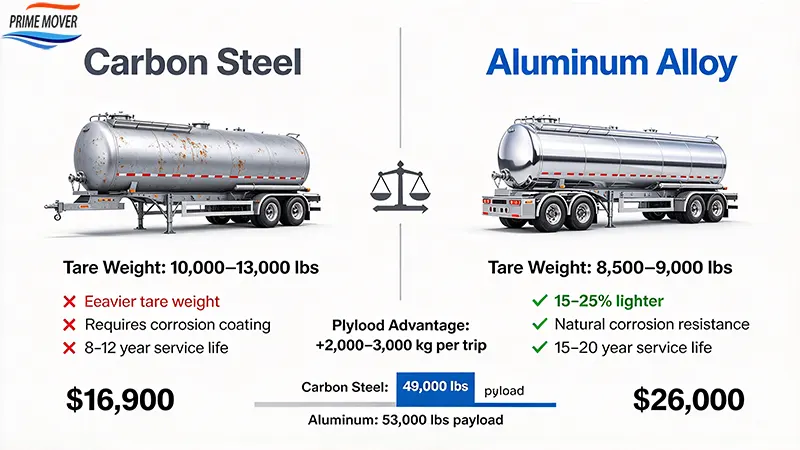
Figure 3: Aluminum vs carbon steel fuel tanker trailer — tare weight and payload comparison within the 80,000-lb GVW limit.
Prime Mover Industries: Specification Flexibility for Every Fuel Haulage Fleet
Prime Mover Industries — a Hong Kong-based manufacturer and global exporter established in 2014 — builds fuel tanker trailers engineered to meet the most demanding diesel and petrol bulk haulage requirements. The company serves construction, logistics, and energy sector clients across Africa, Southeast Asia, the Middle East, and beyond.
Standard specifications across the Prime Mover fuel tanker trailer line:
| Component | Standard | Optional Upgrade |
|---|---|---|
| Tank Material | Q345B carbon steel | 5182 aluminum alloy |
| Tank Capacity | 30,000–60,000L | Custom up to 70,000L+ |
| Compartments | 2–4 | Up to 6, customizable |
| Axles | 3 × 13T FUWA / BPW | 4–5 axles, 16T/20T ratings |
| Suspension | Mechanical leaf spring | Air suspension / ECAS |
| Brake System | WABCO ABS | EBS 2S/2M + RSS |
| Emergency Valves | Pneumatic bottom valves | Remote-controlled + fusible element |
| Baffles | Transverse anti-surge design | Optimized per operating profile |
| Coating | Sandblast + 2 primer + 2 topcoats | Epoxy anti-corrosion system |
| Telematics | Optional GPS tracking | Full telematics integration |
Key differentiators for international buyers:
- Factory-direct pricing — no distributor markup
- Full compliance support — GB 21668-2025, ADR, and destination market documentation
- Third-party inspection — SGS, BV, or buyer-nominated inspector
- Capacity range — 30,000L to 70,000L+ with customizable compartment configurations
- After-sales parts — standardized components available globally
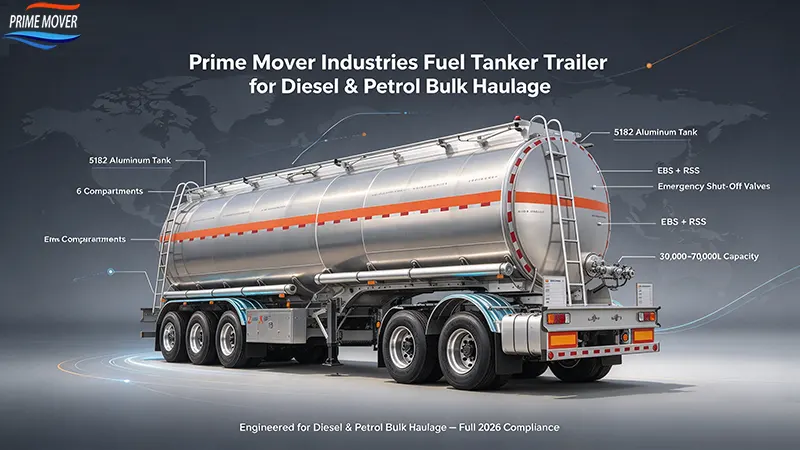
For diesel and petrol bulk haulage operations requiring aluminum construction, multi-compartment flexibility, and full 2026 regulatory compliance, Prime Mover Industries delivers a fuel tanker trailer specification matched to your operating profile.
Conclusion
The diesel and petrol bulk haulage industry is entering a new era of regulatory compliance, operational efficiency, and safety technology. The Top 7 must-have features outlined in this article represent the minimum specification standard for competitive fleet operations in 2026:
- Aluminum alloy tank construction — for maximum payload and fuel efficiency in fuel tanker trailers
- Advanced anti-surge baffle design — for rollover prevention and stability in diesel and petrol bulk haulage
- Multi-compartment configuration — for distribution flexibility
- Pneumatic emergency shut-off valves — for catastrophic failure prevention
- EBS with RSS braking system — for superior stopping power and rollover protection
- Real-time telematics monitoring — for theft prevention and operational visibility
- GB 21668-2025 and ADR compliance — for legal market access
The right fuel tanker trailer is not the cheapest one — it is the one that matches your cargo, your routes, and your regulatory environment. For fleet operators investing in 2026, these seven must-have features deliver the safety, efficiency, and compliance that modern diesel and petrol bulk haulage demands.
Written by
Prime Mover Industries
Editor Wang
WhatsApp:+86-189 5386 6163
Email:wlei66@126.com
- Top 7 Benefits of Bulk Cement Tank Trailers in 2026: Why Construction Fleets Choose Pneumatic Tankers for Cement, Fly Ash & Mineral Powder Transport
- Heavy-Duty Trailer Market to Hit $21 Billion by 2032 – Growth Drivers Explained
- Best Flatbed Trailer for Oversized Cargo: 8 Critical Selection Factors
- Flatbed Trailer Market 2026-2033: USD 10.54 Billion Forecast & Key Growth Drivers