
PRIME MOVER
INDUSTRIES LIMITED
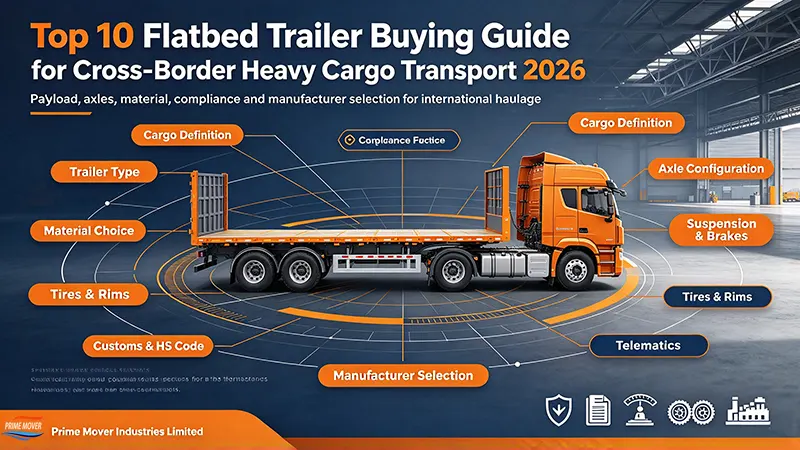
Top 10 Flatbed Trailer Buying Guide for Cross-Border Heavy Cargo Transport 2026
Cross-border heavy cargo transport is one of the most demanding segments in global logistics. It combines oversized and overweight freight, multiple customs jurisdictions, varying road regulations, and long transit routes. For fleet operators, freight forwarders, and project logistics companies, choosing the right flatbed trailer for cross-border heavy cargo transport is not a simple equipment purchase. It is a strategic decision that affects legal compliance, payload economics, delivery reliability, and long-term profitability.
The global flatbed trailer market was valued at USD 7.67 billion in 2024 and is projected to reach USD 10.54 billion by 2033, growing at a 3.6% CAGR. The heavy-haul and cross-border segment is expanding faster than the overall market, driven by infrastructure investment, energy projects, wind turbine components, mining equipment, and large-scale industrial relocation. Global infrastructure investment alone is projected to reach USD 10 trillion through 2030, creating sustained demand for heavy-duty flatbed equipment.
This Top 10 flatbed trailer buying guide for 2026 covers the critical factors that buyers must evaluate before purchasing a trailer for cross-border heavy cargo transport. Whether you are sourcing from China, Europe, or North America, these ten factors will help you avoid costly mistakes and select a trailer that delivers maximum return on investment.
1. Define the Cargo Envelope Before You Choose the Trailer
The most common buying mistake is selecting a trailer before defining the cargo. For cross-border heavy cargo, the cargo envelope includes length, width, height, weight, center of gravity, and loading method. These parameters determine the trailer type, deck height, axle configuration, and permit requirements.
A flatbed trailer is ideal for cargo that can be loaded from the side, top, or rear by crane or forklift. It offers an open deck with no height restriction from the trailer itself, making it suitable for steel structures, machinery, containers, pipes, and prefabricated components. However, if the cargo exceeds legal height limits on a standard flatbed, a step-deck or lowboy trailer may be required.
| Cargo Type | Recommended Trailer | Key Reason |
|---|---|---|
| Steel coils, plates, pipes | Standard flatbed | Side loading with crane or forklift |
| Tall machinery, excavators | Step-deck or lowboy | Extra height clearance |
| Wind turbine blades, long girders | Extendable flatbed | Telescoping deck up to 20 m+ |
| Containers and break-bulk | Flatbed with twist locks | Standard container locking points |
Buying tip: Create a cargo matrix before requesting quotations. Include maximum dimensions, maximum weight, loading method, route restrictions, and destination country regulations. This allows manufacturers to propose the correct specification rather than a generic trailer.
2. Choose the Right Trailer Type for Cross-Border Routes
Cross-border heavy cargo transport often involves multiple road authorities, customs checkpoints, and weight bridges. The trailer type must match both the cargo and the route. The main flatbed configurations are:
- Standard flatbed: Lowest cost, highest availability, best for general heavy cargo within legal dimensions.
- Step-deck flatbed: Lower main deck for taller cargo, reducing permit requirements.
- Lowboy / lowbed: Ultra-low deck for extreme height and weight, often requiring permits and escorts.
- Extendable flatbed: Telescoping deck for long cargo such as pipes, beams, and wind components.
- Combo flatbed: Steel main beam with aluminum components for reduced tare weight and higher payload.
For cross-border operations, standard and combo flatbeds offer the best balance of payload, route flexibility, and permit simplicity. Lowboys are essential for extreme cargo but add permitting complexity, route restrictions, and higher operating costs. Extendable flatbeds are specialized assets best suited to operators with consistent long-cargo contracts.
3. Evaluate Material and Tare Weight Carefully
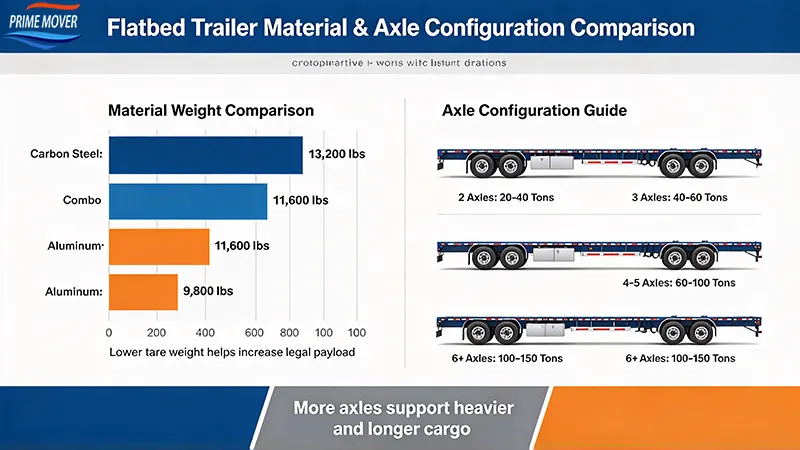
Material selection directly affects payload, fuel efficiency, corrosion resistance, and resale value. The three main options are carbon steel, aluminum alloy, and combo construction.
| Material | Tare Weight | Payload Impact | Best For |
|---|---|---|---|
| Carbon steel | Heaviest | Lowest payload | Rough roads, budget operations |
| Aluminum alloy | 15–25% lighter | Highest payload | Long-haul, weight-sensitive freight |
| Combo steel-aluminum | Mid-range | Balanced payload | Mixed-use cross-border fleets |
A full-steel flatbed can weigh 15–25% more than an aluminum unit of similar length and axle package. For cross-border heavy cargo, where every kilogram affects legal payload and fuel consumption, the weight difference can determine whether a load moves legally or requires permits. Combo trailers are often the smartest choice because they retain steel beam strength while reducing weight through aluminum floors, cross-members, and side rails.
4. Match Axle Configuration to Legal Weight Limits
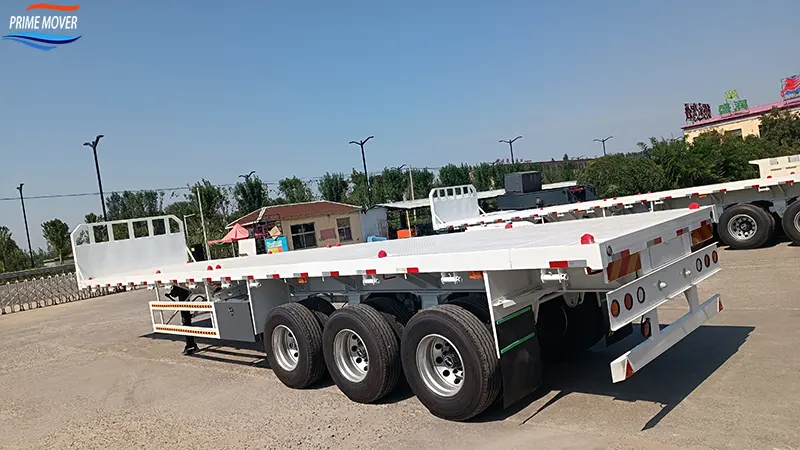
Axle configuration determines payload capacity and legal compliance. Cross-border routes often enforce strict axle load limits, gross vehicle weight limits, and bridge formula requirements. The most common configurations are:
- 2 axles: Light to medium loads, 20–40 tons.
- 3 axles: Standard heavy haul, 40–60 tons, 42% market share.
- 4–5 axles: Heavy-duty, 60–100 tons.
- 6+ axles: Extreme heavy haul, up to 150 tons with permits.
The 3-axle configuration dominates the global flatbed market with approximately 42% market share, reflecting its balance of payload, cost, and regulatory acceptance. For cross-border heavy cargo, a 3-axle flatbed with 13-ton axles is the standard starting point. If your cargo regularly exceeds 60 tons, a 4-axle or 5-axle configuration provides better weight distribution and reduces individual axle stress.
5. Specify Suspension and Braking for Load Stability
Cross-border heavy cargo transport involves long distances, variable road surfaces, and high-speed highways. Suspension and braking systems must be specified for stability, safety, and cargo protection.
| Component | Standard | Premium / Recommended |
|---|---|---|
| Suspension | Mechanical leaf spring | Air suspension / ECAS |
| Braking | Dual-line pneumatic with ABS | EBS 2S/2M with RSS |
| Parking brake | Spring-loaded on axles 1–3 | Spring-loaded on all axles |
| Relay valve | WABCO or equivalent | WABCO / Knorr premium |
Air suspension improves ride quality, reduces cargo damage, and extends tire life. EBS with Roll Stability System (RSS) provides shorter stopping distances and rollover prevention — critical when carrying heavy, high-center-of-gravity cargo. For cross-border operations, these upgrades often pay for themselves through reduced maintenance, lower insurance premiums, and fewer cargo claims.
6. Choose Tires, Rims, and Axles for Global Availability
Cross-border transport means your trailer may operate thousands of kilometers from your home base. Tire, rim, and axle specifications should use globally available standards to simplify roadside repairs and spare parts sourcing.
- Tires: 12R22.5 tubeless is the most widely available heavy-duty size worldwide.
- Rims: 9.0 × 22.5 steel rims are standard and easy to replace.
- Axles: FUWA, BPW, or equivalent brands with 13T, 16T, or 20T ratings.
- Wheel bearings: Standardized tapered roller bearings available in most markets.
Avoid proprietary or uncommon component sizes. A flatbed trailer that cannot be repaired locally may sit idle for days, destroying cross-border delivery schedules. Standardized components also improve resale value because buyers in different countries can maintain them easily.
7. Verify Cross-Border Compliance and Certification
Cross-border heavy cargo transport requires compliance with multiple regulatory frameworks. The exact requirements depend on the origin and destination countries, but common areas include:
- Vehicle type approval: ECE, DOT, or local homologation.
- Braking and lighting: ABS/EBS, LED lighting, reflective markings.
- Dimensions and weights: Width, height, length, axle load, and gross weight limits.
- Hazardous materials: ADR or local dangerous goods regulations if applicable.
- Emissions and noise: For the towing vehicle, not the trailer itself, but relevant to overall compliance.
2026 compliance note: For trailers exported from China to markets recognizing Chinese standards, GB 21668-2025 takes effect on July 1, 2026, for dangerous goods transport vehicles. While flatbed trailers are not tankers, buyers should still verify that the trailer's braking, lighting, and marking systems meet destination-country requirements.
8. Understand Customs, HS Codes, and Import Documentation
Cross-border heavy cargo transport often involves importing the trailer itself or moving it temporarily across borders. The buyer must understand the customs classification and documentation requirements.
| Item | Typical Requirement |
|---|---|
| HS Code | 8716.39 for other trailers and semi-trailers |
| Certificate of Origin | Required for preferential duty treatment |
| Commercial Invoice | Must match contract and bank documents |
| Packing List | Details dimensions, weight, and quantity |
| Bill of Lading | Ocean or road freight document |
| Inspection Certificate | SGS, BV, or buyer-nominated inspector |
Import duties vary by country. For many markets, flatbed trailer imports face 0–20% duty plus VAT. Some countries offer preferential rates for trailers that meet local content or trade agreement rules. Always confirm the HS code and duty rate with a licensed customs broker before purchase.
9. Add Telematics and Tracking for Cross-Border Visibility
Cross-border heavy cargo transport involves multiple borders, long transit times, and high-value cargo. Telematics and GPS tracking provide real-time visibility, theft prevention, and operational efficiency.
- Real-time GPS tracking: Live location, route history, and geofence alerts.
- Door and load sensors: Detect unauthorized access or cargo movement.
- Tire pressure monitoring: Reduce blowouts and fuel consumption.
- Axle load sensors: Prevent overloading before weigh stations.
- Driver behavior monitoring: Harsh braking, cornering, and speeding alerts.
The trailer telematics market is growing rapidly, and fleets deploying these systems report annual savings of USD 8,000–15,000 per trailer. For cross-border operations, the theft prevention and route visibility benefits alone often justify the investment.
10. Select a Manufacturer with Export Experience and After-Sales Support
The final and most important factor is the manufacturer. A low purchase price means nothing if the trailer fails at a border crossing or cannot be repaired locally. Look for a manufacturer with:
- Proven export experience to your region or similar markets.
- Third-party inspection support such as SGS or BV.
- Full export documentation including certificate of origin, invoice, packing list, and bill of lading.
- Standardized components available globally.
- After-sales parts and technical support for brakes, axles, suspension, and lighting.
- Customization capability for length, axle rating, suspension, and coating.
Prime Mover Industries: Your Partner for Cross-Border Flatbed Trailers
Prime Mover Industries — a Hong Kong-based manufacturer and global exporter established in 2014 — builds flatbed trailers engineered for cross-border heavy cargo transport. The company serves construction, logistics, energy, and heavy industry clients across Africa, Southeast Asia, the Middle East, and beyond.
Why buyers choose Prime Mover Industries for cross-border flatbed trailers:
- Factory-direct pricing — no middleman markup
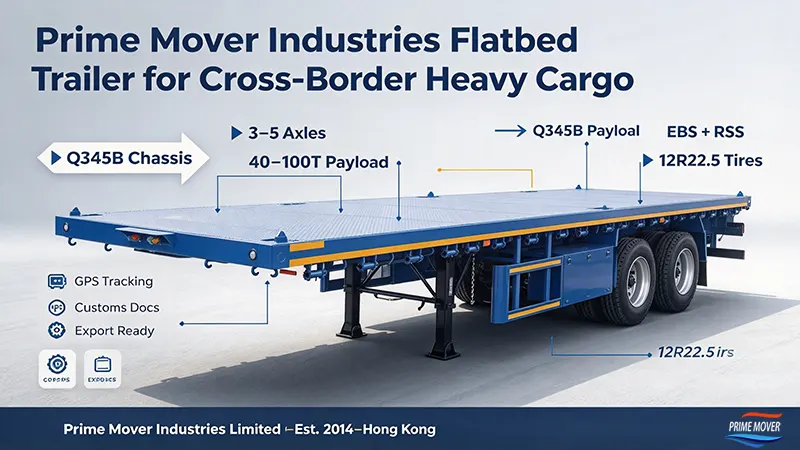
- Custom specifications — 2–5 axles, 40–100+ ton payload
- Q345B high-strength steel chassis — 345 MPa yield strength
- Global component standards — 12R22.5 tires, FUWA/BPW axles, WABCO valves
- Export documentation — full set for customs clearance
- Third-party inspection — SGS, BV, or buyer-nominated inspector
- After-sales support — spare parts and technical documentation
For fleet operators sourcing a flatbed trailer for cross-border heavy cargo transport in 2026, Prime Mover Industries delivers a specification matched to your cargo, routes, and regulatory environment.
Cross-Border Flatbed Trailer Buying Checklist
| Step | Action | Why It Matters |
|---|---|---|
| 1 | Define cargo envelope | Prevents wrong trailer type |
| 2 | Choose trailer type | Matches cargo and route |
| 3 | Evaluate material and tare weight | Maximizes payload |
| 4 | Match axle configuration | Ensures legal compliance |
| 5 | Specify suspension and braking | Improves safety and stability |
| 6 | Use globally available tires and axles | Simplifies repairs |
| 7 | Verify cross-border compliance | Prevents border delays |
| 8 | Understand customs and HS codes | Controls landed cost |
| 9 | Add telematics and tracking | Improves visibility and security |
| 10 | Select an experienced manufacturer | Protects long-term ROI |
Conclusion
The Top 10 flatbed trailer buying guide for cross-border heavy cargo transport in 2026 comes down to one principle: match the trailer to the cargo, the route, and the regulations. A flatbed trailer is a long-term asset. Choosing the wrong specification can cost thousands in permits, repairs, downtime, and lost contracts. Choosing the right specification delivers higher payload, lower operating costs, and reliable cross-border performance.
By following these ten steps, fleet operators and logistics managers can source a heavy-duty flatbed trailer that meets legal requirements, maximizes payload, and delivers strong return on investment for years to come.
Written by
Prime Mover Industries
Editor Wang
WhatsApp:+86-189 5386 6163
Email:wlei66@126.com
- Top 7 Must-Have Fuel Tanker Trailer Features for Diesel & Petrol Haulage in 2026
- 9 Costly Mistakes When Importing Fuel Tanker Trailers from China
- Top 7 Benefits of Bulk Cement Tank Trailers in 2026: Why Construction Fleets Choose Pneumatic Tankers for Cement, Fly Ash & Mineral Powder Transport
- Best 5 Axle Flatbed Trailer Specifications You Should Know
PRIME MOVER
INDUSTRIES LIMITED