
PRIME MOVER
INDUSTRIES LIMITED
Top 7 Fuel Tanker Trailer Safety Standards: ADR & IMDG Compliance Checklist for 2026
A fuel tanker trailer is not simply a vessel on wheels. It is a regulated pressure system, a dangerous-goods transport unit, and — when it leaves a road and boards a vessel — a marine cargo item subject to a second, entirely separate legal framework. The overlap between ADR for road transport and IMDG for sea transport is where most compliance failures occur, particularly for exporters whose trailers must satisfy both regimes across a single shipment.
The regulatory pressure is intensifying. The EU’s Delegated Directive (EU) 2025/1801 introduced a unified ADR inspection checklist across European enforcement authorities, with full mandatory implementation by June 24, 2026, along with a three-tier risk violation classification that treats missing documentation or a non-functional fire extinguisher as grounds for immediate vehicle stoppage or correction. Separately, ADR 38/05 has made Trailer Electronic Braking Systems with roll stability functionality effectively mandatory on most heavy trailers, not merely advisable.
This checklist covers the top 7 fuel tanker trailer safety standards that procurement and compliance teams should verify in 2026, spanning physical tank construction, braking and stability, surge control, emergency isolation, electrical grounding, periodic inspection, and documentation. Each item includes the specific parameter or interval that determines compliance, and the final section addresses the IMDG overlay for sea transport.
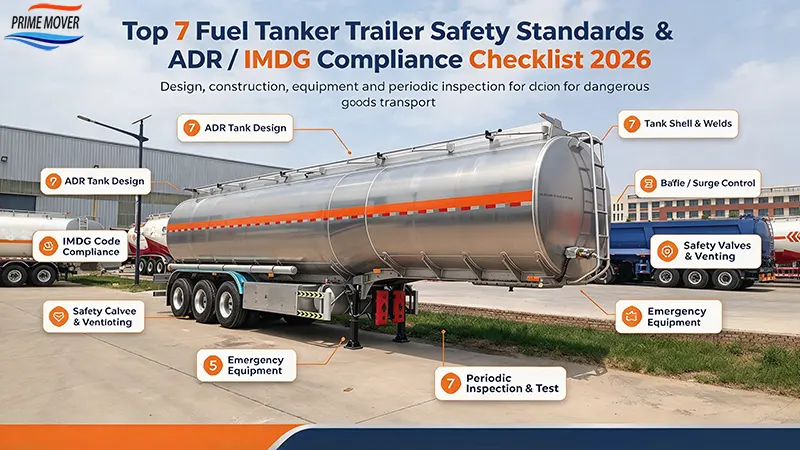
Standard 1: Tank Shell Material and Minimum Wall Thickness
The first compliance gate is the tank body itself. ADR does not specify a single universal wall thickness; it requires the shell to be calculated against material yield strength, tank diameter, and corrosion allowance. For carbon steel tanks with a diameter exceeding 1.8 metres, the minimum shell thickness is 5 mm. For stainless steel, the minimum drops to 4 mm, but the corrosion allowance must still be factored into the calculation.
| Parameter | Carbon Steel | Stainless Steel | Aluminum (ADR reference) |
|---|---|---|---|
| Minimum shell thickness | 5 mm (diameter >1.8 m) | 4 mm | Commonly 6 mm minimum for ADR-compliant aluminum tankers |
| Corrosion allowance | Required | Required | Required |
| Weld inspection | 100% radiographic or ultrasonic testing on longitudinal and circumferential welds; welding process certified to ISO 3834 | ||
For fuel tankers transporting gasoline (UN 1203) or diesel (UN 1202), the applicable ADR tank code is typically LGBF or L4BH, depending on flash point and vapour pressure. The shell thickness is not a catalogue default — it must be traceable to the design calculation submitted for type approval. A trailer that passes a visual inspection but cannot produce the thickness calculation is not ADR-compliant, regardless of how it looks.
Standard 2: EBS with Roll Stability Function — The ADR 38/05 Requirement
Braking compliance for heavy fuel tanker trailers has moved beyond ABS. Under ADR 38/05, Trailer Electronic Braking Systems are essentially mandated on most heavy trailers, and those systems are required to include automated roll stability control in addition to anti-lock braking. European legislation further specifies that Class O4 trailers with up to three axles and air suspension, certified from July 2010 onward, must be equipped with a stabilisation function integrated into the EBS.
| Compliance checkpoint | Requirement | Verification method |
|---|---|---|
| EBS fitted | Trailer Electronic Braking System, not ABS alone | Data plate / EBS status light / diagnostic tool |
| Roll stability function | Active RSS integrated into EBS | EBS diagnostic parameter check |
| Fault-free operation | No active EBS fault codes | Diagnostic scan before dispatch |
| Status indication | TEBS operation and warning light functionality | Visual check of trailer-mounted status display |
For buyers sourcing trailers for ADR markets, the practical check is to request the EBS data plate or diagnostic confirmation showing that the roll stability function is enabled, not merely that an EBS module is installed. A disconnected or unparameterised RSS function is a compliance failure, not a minor defect.
Standard 3: Anti-Surge Baffles — Capacity Trigger and Minimum Count
ADR regulates surge plates, not merely recommends them. Any tank with a capacity exceeding 7,500 litres must be fitted with baffles to limit liquid surge. For a 40,000-litre fuel tanker, the applicable minimum is at least five transverse baffles, typically configured with a cut-out area of approximately 40% to manage flow while retaining structural resistance.
The regulatory logic is straightforward: liquid surge is most severe at partial fill levels, and a 40,000-litre tank operating at 50% fill contains 20 tonnes of liquid with enough free surface to generate destructive momentum. Baffles divide that free surface into smaller compartments, reducing the peak force transmitted to the tank shell and the vehicle’s centre of gravity.
| Tank capacity | Baffle requirement | Typical configuration |
|---|---|---|
| ≤ 7,500 L | Baffles not triggered by the capacity threshold | Bulkheads may still be required for product segregation |
| > 7,500 L | Baffles mandatory | Transverse baffles with controlled-flow perforations |
| 40,000 L reference | At least 5 transverse baffles | ~40% cut-out area per baffle |
Baffle inspection is equally part of compliance. Cracks at the baffle-to-shell weld, elongation of perforations, or deformation after a surge event compromise the surge-control function. The baffles should be examined during the 3-year intermediate inspection and the 6-year periodic inspection, not only at initial manufacture.
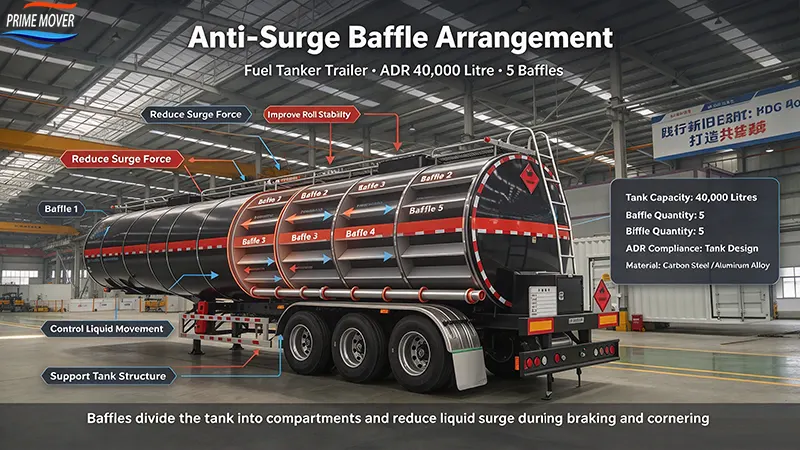
Standard 4: Emergency Shut-Off Valve — Response Time and Testing Interval
The emergency shut-off valve at the bottom loading/discharge point is the last physical barrier against uncontrolled release if the vehicle moves during transfer or a discharge line ruptures. ADR requires the valve to close automatically under those conditions, with a response time not exceeding 2 seconds.
The valve must also be accessible from ground level, and critical piping associated with the system should be protected or insulated against fire exposure where required. Functional testing is not a one-time factory check: the emergency shut-off valve must undergo a functional test every 6 months.
| Checkpoint | Specification | Interval |
|---|---|---|
| Automatic closure response | ≤ 2 seconds after trigger | Every functional test |
| Ground-level accessibility | Operator can reach and actuate from ground | Design verification / annual inspection |
| Functional test | Valve closes and seals without leakage | Every 6 months |
| Shear section integrity | Sealing mechanism remains intact under external impact | At 6-year hydraulic test / after any impact |
A tanker trailer with a manual bottom valve, or with an automatic valve that has never been cycle-tested, does not satisfy this standard. The 2-second response and 6-month test interval are the two parameters that distinguish a compliant emergency isolation system from a nominal one.
Standard 5: Static Electricity Grounding — The 10-Ohm Limit
Flammable liquid transfer generates static charge. ADR requires all metal parts of the tanker installation to be in good electrical contact with each other and with earth, with the resistance to earth at all points not exceeding 10 Ω. The same threshold appears in ADR 6.8.2.1.27, which requires tanks for flammable liquids and gases to have devices for discharging static electricity, with electrical resistance not exceeding 10 Ω.
| Grounding checkpoint | Limit | Practical note |
|---|---|---|
| Resistance to earth, any point | ≤ 10 Ω | Measured with a calibrated earth resistance tester |
| Continuity between metal components | ≤ 10 Ω | Includes chassis, tank shell, piping, and valves |
| Static reel continuity | End-to-chassis continuity should be low; the 10 Ω earth limit remains the governing threshold | Inspect cable strands and clamp condition, not only continuity |
The grounding check is frequently reduced to a visual inspection of the cable. That is insufficient. A grounding cable with broken strands can show continuity on a low-voltage tester yet fail under an actual static discharge. The 10 Ω measurement, taken with the clamp attached to a verified earth point and the tester connected to the chassis, is the only reliable pass/fail criterion.
Standard 6: Periodic Inspection — 3-Year Intermediate and 6-Year Full Test
ADR establishes a fixed inspection cadence for tank vehicles. The 3-year intermediate inspection covers leakage testing and equipment function checks. The 6-year periodic inspection is more extensive: internal and external examination of the tank, a hydraulic pressure test, and a leakage and equipment function test.
The hydraulic test pressure is not a single universal number. ADR 6.8.2.4.1 requires the test pressure to be at least 1.3 times the maximum working pressure, or for gravity-discharge tanks, at least 1.3 times the static pressure of the substance to be carried — and in no case less than 0.2 bar (20 kPa) above atmospheric. The water pressure test must be performed separately on the tank shell and on each compartment of a subdivided tank.
| Inspection type | Interval | Scope |
|---|---|---|
| Intermediate inspection | Every 3 years | Leakage test, equipment function check |
| Periodic inspection | Every 6 years | Internal and external examination, hydraulic pressure test, leakage and function test |
| Hydraulic test pressure | At each 6-year test | ≥ 1.3 × maximum working pressure; gravity-discharge minimum 0.2 bar gauge |
For a buyer acquiring a used fuel tanker trailer, the inspection certificate expiry date is as important as the tank’s physical condition. A trailer whose 6-year hydraulic test is due within the delivery window will require immediate off-hire for testing, which erodes the apparent purchase-price advantage.
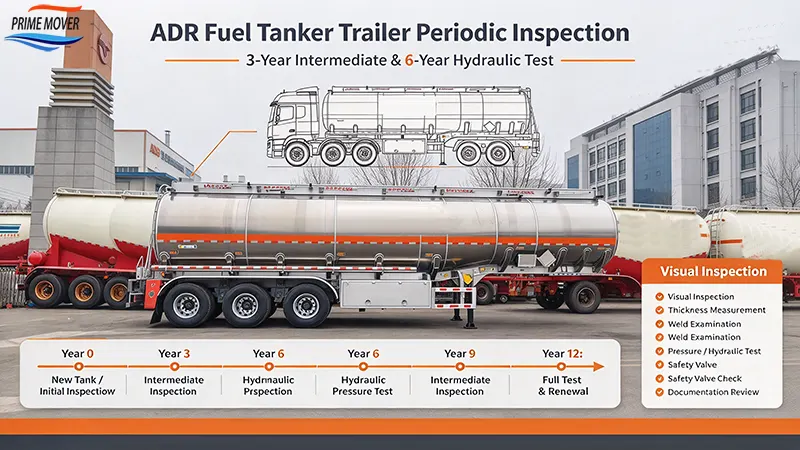
Standard 7: Documentation, Marking, and Driver Certification
Compliance is not complete when the hardware is correct. ADR enforcement at roadside checks begins with documents and markings, and the absence of a single required document can trigger a Category I high-risk violation under the EU’s 2025/1801 framework.
| Document / marking | Requirement | Validity / specification |
|---|---|---|
| ADR Driver Training Certificate | Driver must hold and carry it | Valid 5 years; refresher training and examination required for renewal |
| Transport document (waybill / CMR) | UN number, proper shipping name, hazard class, packing group, quantity | Must accompany every shipment |
| Instructions in Writing (IiW) | Standard-format emergency instructions in a language the driver understands | Carried in the cab |
| Vehicle approval certificate | ADR approval for the specific dangerous goods | Where required by goods type |
| Orange-coloured plates | Hazard identification number and UN number | Black digits 100 mm high, 15 mm stroke; displayed front and rear |
| Fire extinguishers | At least 2 units, each ≥ 6 kg capacity | Within inspection date |
The 2026 enforcement environment is less forgiving of documentation gaps. Under Delegated Directive (EU) 2025/1801, a missing document or absent ADR driver certificate is classified as Category I high risk, requiring immediate vehicle stoppage. For exporters, this means the documentation package must be assembled at the point of shipment, not reconstructed at the border.
The IMDG Overlay: What Changes When the Tanker Trailer Goes to Sea
ADR governs the trailer on the road. When the same trailer is shipped as a transport unit, IMDG applies, and several requirements shift. The tanker trailer is treated as a dangerous goods transport unit or portable tank, and the sea-leg compliance items below are additional to the ADR checklist.
| IMDG checkpoint | Requirement | Parameter |
|---|---|---|
| Multimodal dangerous goods declaration | IMDG Chapter 5.4 declaration with UN number, proper shipping name, class, packing group, flash point | Example: gasoline UN 1203; diesel UN 1202 |
| Placarding | Diamond placards on both sides and both ends of the unit | Minimum 250 mm × 250 mm |
| Valve position and sealing | All valves closed and fitted with tamper-evident seals during sea transport | Tank kept sealed for the voyage |
| Stowage and segregation | On-deck or mechanically ventilated closed compartment; separation from Class 1 explosives and Class 5.2 organic peroxides | At least 3 m horizontal separation; 4.5 m from accommodation and machinery spaces if flash point <23°C |
| Tank-container periodic examination | If shipped as a tank container under IMDG 6.7, periodic examination not exceeding 30 months (2.5 years) | Intermediate every 2.5 years; periodic including hydrostatic test every 5 years |
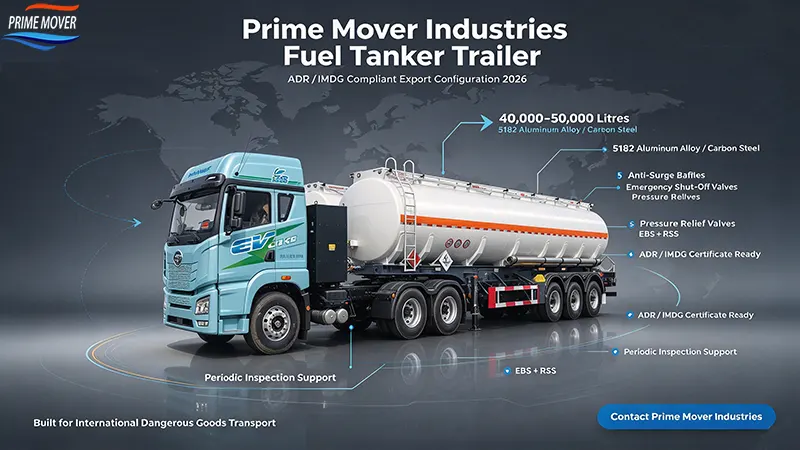
Prime Mover Industries: ADR & IMDG-Aligned Fuel Tanker Trailer Configuration
Prime Mover Industries is a Hong Kong-based manufacturer and global exporter established in 2014. Its fuel tanker trailer line is configured around the compliance parameters above — not as optional add-ons, but as the baseline specification for export markets that reference ADR and IMDG requirements.
| Compliance area | Prime Mover standard configuration | Verification support |
|---|---|---|
| Tank shell | Q345B carbon steel or 5182 aluminum; thickness per ADR calculation | Material certificates, design calculation |
| Baffles | Transverse anti-surge baffles for tanks >7,500 L; count per capacity | Baffle layout drawing |
| Braking | WABCO ABS standard; EBS 2S/2M with RSS optional | EBS data plate / diagnostic confirmation |
| Emergency shut-off | Pneumatic bottom valves, ground-level accessible | Functional test record |
| Grounding | Static grounding reel and continuity bonding | Resistance test ≤ 10 Ω |
| Inspection | 3-year / 6-year ADR inspection schedule support | Inspection documentation package |
| Marking / documents | Orange plates, placard mounting provisions, export document set | Pre-shipment document checklist |
For buyers procuring for ADR-referencing markets, Prime Mover Industries provides third-party inspection through SGS or BV and a specification-to-documentation package that aligns the physical trailer with the compliance evidence required at border and roadside checks.
Conclusion
The top 7 fuel tanker trailer safety standards for 2026 are not abstract regulatory ideals. They are measurable parameters: 5 mm carbon steel shell thickness, EBS with active roll stability, five transverse baffles in a 40,000-litre tank, a 2-second emergency valve response tested every 6 months, a 10 Ω earth resistance limit, a 3-year/6-year inspection cycle with a 1.3× working pressure hydraulic test, and a documentation set that includes the 5-year ADR driver certificate and the transport document.
The IMDG overlay adds a second compliance layer for sea transport: multimodal declaration, 250 mm placards, sealed valves, segregation distances, and a 30-month tank-container examination cycle where applicable. Exporters who treat ADR and IMDG as sequential checkpoints — rather than interchangeable labels — avoid the most common cause of port delay and border rejection.
For procurement teams, the checklist is most useful at the specification stage, not the inspection stage. A trailer built to these parameters is compliant by design. A trailer that must be retrofitted to meet them is a compliance liability with a delivery date.
Written by
Prime Mover Industries
Editor Wang
WhatsApp:+86-189 5386 6163
Email:wlei66@126.com
PRIME MOVER
INDUSTRIES LIMITED