
PRIME MOVER
INDUSTRIES LIMITED
Top 12 Must-Have Flatbed Trailer Maintenance Tips to Extend Service Life in 2026
A flatbed trailer is one of the most heavily loaded assets in any fleet. It carries steel coils, construction machinery, containers, lumber, and prefabricated components across tens of thousands of kilometers every year. Unlike an enclosed van, a flatbed trailer has no protective shell — its chassis, deck, suspension, and braking components are directly exposed to rain, road salt, UV radiation, and impact damage from loading equipment.
The economics of flatbed trailer maintenance are straightforward. A new 3-axle flatbed trailer costs between 10,000 and 18,000 USD FOB China, or 25,000 to 45,000 USD in Western markets. With a disciplined maintenance program, that asset can deliver 12 to 15 years of reliable service. Without one, structural repairs or premature replacement can cut that lifespan in half. Industry data shows that fleets which move from reactive repair to preventive maintenance reduce annual maintenance costs by an average of 24 percent, and predictive maintenance programs can cut costs by 25 to 40 percent.
This technical guide covers the top 12 flatbed trailer maintenance tips that fleet operators should implement in 2026. Each section includes specific inspection intervals, measurement tolerances, and cost data. The keyword flatbed trailer appears at a natural density throughout the article to support search visibility without disrupting readability.
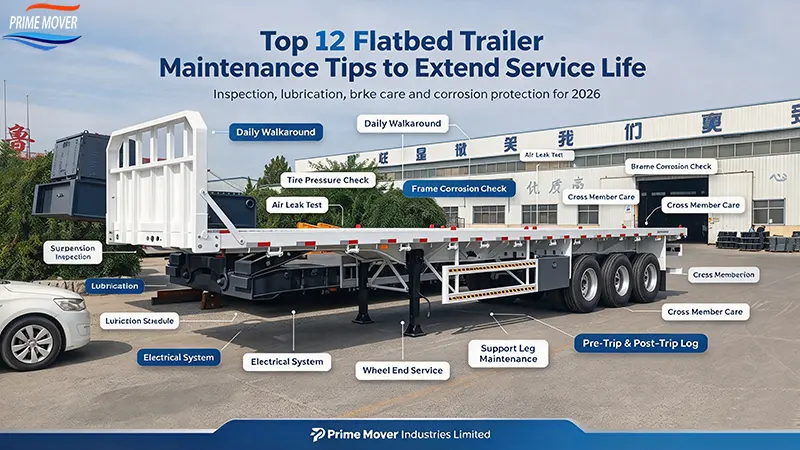
1. Chassis and Main Beam Inspection
The chassis and main beam carry the entire payload and absorb every dynamic force generated by braking, cornering, and road impacts. Main beam cracks are the single most expensive flatbed trailer repair, often costing between 3,000 and 8,000 USD depending on severity and access.
Most flatbed trailer main beams use Q345B steel with a yield strength of 345 MPa. The typical cross-section is 500 mm in height, with a 14 mm top flange, 16 mm bottom flange, and 8 mm web. Stress concentrates at the web-to-flange weld zones, making these areas the most common crack initiation points.
Inspection procedure
- Pressure-wash the chassis to remove dirt, grease, and road grime that hide cracks and corrosion.
- Use a flashlight and inspection mirror to examine the full length of the main beam, especially the weld zones.
- Look for orange-brown staining along weld seams. This often indicates a crack underneath the paint layer.
- Tap suspect areas with a hammer. A dull sound may indicate internal corrosion or delamination.
- Measure beam deflection with the trailer empty. A difference greater than 10 mm between the center and the ends may indicate structural fatigue.
- Check kingpin bolts, suspension bracket bolts, and cross-member bolts against manufacturer torque specifications.
| Condition | Recommended Action | Estimated Cost (USD) |
|---|---|---|
| Surface rust only | Sand, prime, repaint | 100–300 |
| Minor crack under 50 mm | Weld repair with reinforcement plate | 500–1,500 |
| Major crack over 50 mm or multiple cracks | Section or beam replacement | 3,000–8,000+ |
| Severe corrosion with section loss | Trailer replacement | Full replacement cost |
A West African fleet case study found that four out of ten flatbed trailers from a supplier using thin paint films developed main beam cracks in less than 12 months, with corrosion beginning beneath the paint layer. Specifying complete chassis sandblasting plus two coats of anticorrosive primer and two topcoats at the time of order prevents this failure mode.
2. Axle and Wheel Bearing Maintenance
The 3-axle configuration holds approximately 42 percent of the global flatbed trailer market. Each axle requires periodic bearing service to prevent seizure, excessive play, and spindle damage.
Wheel bearings should be inspected for play, noise, and grease condition every 50,000 to 60,000 miles. Repack or replace bearings at this interval. A leaking axle seal allows grease to escape and water to enter. Replacing a 20 USD seal immediately prevents a 500 USD bearing and spindle replacement.
Axle alignment should be checked every 12 months or after any significant impact. Misaligned axles cause uneven tire wear and increase rolling resistance. Laser alignment tools provide precision far beyond string-and-tape methods and typically cost 200 to 400 USD for a full flatbed trailer alignment.
| Component | Check | Interval |
|---|---|---|
| Wheel bearings | Play, noise, grease condition | Every 50,000–60,000 miles |
| Axle seals | Leakage, water ingress | Monthly |
| Spindle condition | Scoring, pitting, corrosion | Every bearing service |
| Axle alignment | Toe, camber, thrust angle | Every 12 months |
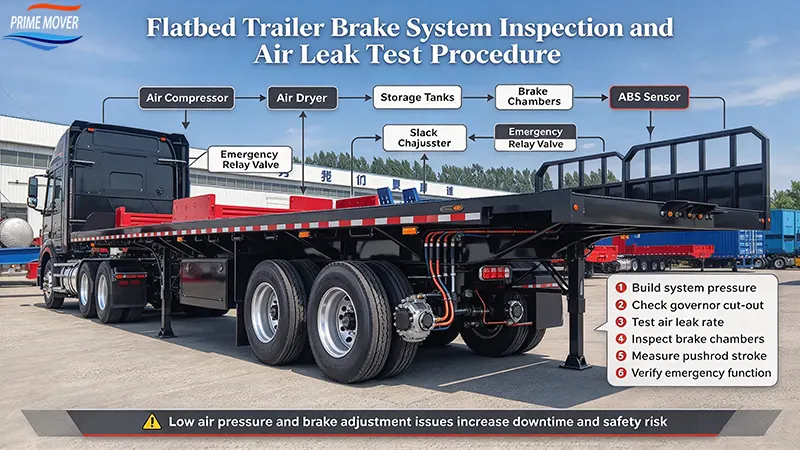
3. Brake System Inspection and Adjustment
The braking system is the most safety-critical component on any flatbed trailer. For trailers operating in the 25.1 to 50 ton capacity segment, which represents 35 percent of the global flatbed market, brake failure is a catastrophic risk rather than an inconvenience.
Key measurements
- Brake chamber push rod stroke must not exceed 40 mm.
- Brake lining thickness must be at least 6 mm.
- Air system pressure loss must not exceed 3 psi for a single vehicle or 4 psi for a tractor-trailer combination over a five-minute period at 100 psi system pressure.
- ABS sensor gap to tone ring should be between 0.5 and 1.5 mm depending on manufacturer specification.
Air leaks are the most common brake system deficiency. A single leaking brake chamber can reduce braking force by 15 to 20 percent, significantly increasing stopping distance on a loaded flatbed trailer. Use a soapy water solution on all connections, hoses, and chambers to locate leaks.
Roadside breakdowns cost an average of 500 to 1,000 USD. Fleets that perform predictive brake maintenance based on sensor data can reduce total maintenance costs by 25 to 40 percent.
4. Tire Pressure and Tread Management
Tires are the second-largest operating cost for flatbed trailer fleets after fuel. A typical 3-axle flatbed trailer runs 12 tires in size 12R22.5 tubeless. At 300 to 500 USD per tire, a full set represents a 3,600 to 6,000 USD investment.
Underinflation is the leading cause of tire failure on flatbed trailers. A tire that is 20 percent underinflated runs 15 percent hotter and wears 25 percent faster than a properly inflated tire. Correct tire pressure monitoring can extend tire lifespan by up to 9 percent and improve fuel efficiency by up to 4 percent. Even a 10 percent deviation from recommended pressure increases fuel consumption by more than 250 liters over 120,000 km.
| Check | Specification | Frequency |
|---|---|---|
| Tire pressure | 100–120 psi (manufacturer specification) | Daily visual, weekly gauge |
| Tread depth | Minimum 1.6 mm legal, replace at 4 mm | Monthly |
| Sidewall condition | No cuts, bulges, or exposed cords | Monthly |
| Wheel nut torque | 450–500 ft-lbs | Every 5,000 miles |
The uneven load distribution common in flatbed operations, such as steel coils on one side and machinery on the other, makes regular pressure checks more critical than on uniformly loaded trailers. A tire carrying 60 percent of the load will lose pressure faster than one carrying 40 percent.
5. Suspension System Service
Most heavy-duty 3-axle flatbed trailers use multi-leaf spring suspension with 10 to 13 layers of 90 by 13 mm or 90 by 16 mm spring steel. Air suspension systems are increasingly specified for their superior ride quality and two to three times longer service life compared to leaf springs.
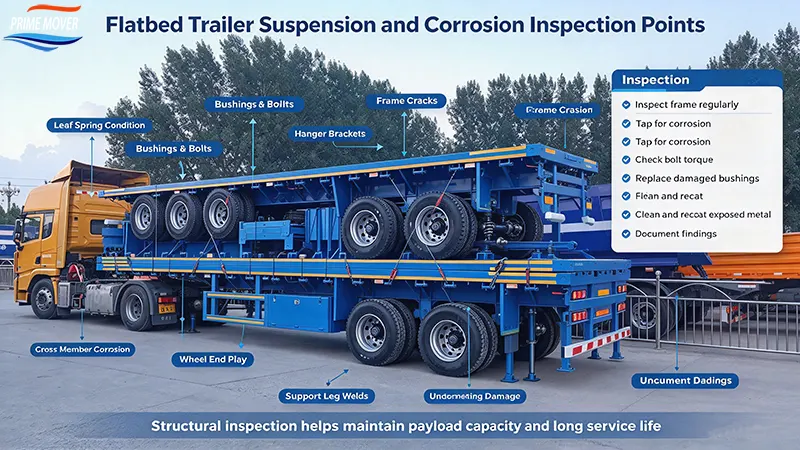
Leaf spring inspection points
- Cracked, broken, or sagging leaves
- Spring bushing wear and lubrication condition
- U-bolt torque, corrosion, and stretching
- Equalizer wear and movement
- Hanger cracks and weld integrity
- Shackle wear and bolt condition
The center bolt that holds the leaf spring pack together is a common failure point. A broken center bolt allows the leaves to shift, causing misalignment and accelerated wear. Inspect this bolt at every preventive maintenance service.
For air suspension, inspect air springs for cracks, abrasion, and leaks monthly. Check height control valve adjustment and linkage quarterly. Based on 2025 fleet audits across Germany, Poland, and UAE, the breakeven point for air suspension occurs at 18 months for fleets averaging more than 75,000 km per year.
Lubrication intervals for flatbed trailer suspension components are 10,000 miles for leaf spring bushings and equalizer bushings, and 15,000 miles for air suspension pivot points. Use lithium-complex grease, which resists water washout and maintains viscosity across temperature extremes.
6. Corrosion Prevention and Coating Maintenance
Corrosion is the silent killer of flatbed trailers. Unlike a crack or broken spring, which announces itself immediately, corrosion works slowly and invisibly. By the time rust is visible on the surface, structural damage underneath may already be significant.
The industry standard coating system for flatbed trailers consists of sandblasting to Sa 2.5 standard, two coats of anticorrosive epoxy primer, and two coats of polyurethane topcoat, with a total dry film thickness of 80 to 120 microns.
| Area | What to Look For | Action |
|---|---|---|
| Main beam web | Paint blistering, rust staining | Sand, prime, repaint |
| Cross members | Surface rust, pitting | Sand, prime, repaint |
| Side rails | Paint peeling, rust bleeding | Sand, prime, repaint |
| Stake pockets | Water accumulation, internal rust | Drain, clean, repaint |
| Floor plate | Rust around welds, pitting | Sand, prime, repaint |
| Kingpin area | Heavy corrosion, paint loss | Sand, prime, repaint |
Touch-up best practices require cleaning the area thoroughly, applying primer immediately to bare steel, using epoxy primer for bare metal and zinc-rich primer for high-abrasion areas, applying topcoat within the recoat window, and never painting over rust. Schedule a full chassis repaint every three to four years for flatbed trailers operating in coastal or northern climates with road salt. The cost of 1,500 to 3,000 USD is far less than structural repair or premature replacement.
7. Electrical System and Lighting Inspection
Electrical failures are the most common cause of roadside inspections and out-of-service violations for flatbed trailers. A single non-functioning brake light or turn signal can result in a 100 to 500 USD fine and a delayed load.
Modern flatbed trailers increasingly use 24V LED lighting systems instead of incandescent bulbs. LED lights last 50,000 hours or more compared to 2,000 to 5,000 hours for incandescent, draw less power, resist vibration, and illuminate instantly. The trade-off is a higher upfront cost of 15 to 40 USD per light versus 3 to 8 USD for incandescent, but LED units last 10 to 25 times longer.
Wiring best practices
- Protect all wiring with split loom or conduit to prevent chafing against the chassis.
- Use heat-shrink connectors with adhesive lining rather than crimp connectors. Moisture is the enemy of electrical connections.
- Clean the frame ground point and use star washers for solid contact. A poor ground causes dim lights, flickering, and intermittent failures.
- Measure voltage at each light with a multimeter. A reading below 12V on a 12V system indicates resistance in the circuit.
- Carry a spare kit with bulbs, fuses, and connectors. A 20 USD spare kit can prevent a 500 USD roadside repair bill.
8. Kingpin and Upper Coupler Maintenance
The kingpin and upper coupler connect the flatbed trailer to the tractor and transmit all towing forces. A worn or damaged kingpin is a critical safety hazard and will fail roadside inspection.
Inspect the kingpin for cracks, wear, and deformation quarterly. Standard kingpin diameters are 50 mm (2 inches) and 90 mm (3.5 inches). Measure wear against manufacturer specification. Lubricate the upper coupler plate and kingpin at every coupling or at least weekly during high-use periods.
Check the upper coupler for cracks, deformation, and bolt torque. The bolster plate should be flat and free of excessive wear. A worn bolster plate causes uneven loading and accelerated kingpin wear.
9. Deck and Floor Plate Inspection
The deck carries the cargo and absorbs loading impact. Most flatbed trailers use 3 mm diamond plate or checkered plate steel flooring. Some premium models use 4 mm plate for heavier applications.
Inspect the deck monthly for cracks, corrosion, and deformation. Pay particular attention to weld seams where the floor plate meets the cross members and side rails. Rust around welds is a common failure point and should be treated immediately.
Wooden decking, where used, should be inspected for rot, splintering, and loose fasteners. Replace damaged boards promptly to prevent cargo damage and tripping hazards during loading.
10. Fastener Torque and Structural Bolt Verification
Loose or stretched fasteners cause elongation of bolt holes, loss of clamping force, and eventual structural failure. Every flatbed trailer has hundreds of structural bolts that must be maintained at correct torque.
| Fastener Group | Typical Torque | Check Interval |
|---|---|---|
| Wheel nuts | 450–500 ft-lbs | Every 5,000 miles |
| Kingpin bolts | Manufacturer specification | Quarterly |
| Suspension bracket bolts | Manufacturer specification | Quarterly |
| Cross-member bolts | Manufacturer specification | Quarterly |
| Landing gear mounting bolts | Manufacturer specification | Quarterly |
Use a calibrated torque wrench. Visual inspection alone cannot detect a bolt that is 20 percent below specified torque. Mark verified fasteners with a paint pen so missed bolts are immediately visible during the next inspection.
11. Lubrication Schedule
Proper lubrication prevents premature wear on suspension, steering, and coupling components. A flatbed trailer has multiple grease points that require service at defined intervals.
- Leaf spring bushings and equalizer bushings: grease every 10,000 miles.
- Air suspension pivot points: grease every 15,000 miles.
- Upper coupler plate and kingpin: lubricate weekly during high-use periods.
- Landing gear: lubricate every 30,000 miles or seasonally.
- Fifth wheel plate: lubricate at every coupling.
Use lithium-complex grease for suspension and chassis applications. It resists water washout, maintains viscosity across a wide temperature range, and provides good extreme-pressure protection. Avoid mixing incompatible grease types, which can cause the lubricant to break down and lose effectiveness.
12. Storage and Seasonal Maintenance
Flatbed trailers that sit idle for extended periods deteriorate faster than trailers in regular service. Proper storage procedures prevent corrosion, tire flat spotting, and bearing damage.
Storage checklist
- Clean the flatbed trailer thoroughly before storage. Dirt and road salt accelerate corrosion.
- Park on a hard, dry surface. Avoid grass or dirt, which retain moisture.
- Elevate the trailer on jack stands to remove weight from tires and suspension.
- Cover the trailer if stored outdoors, or store indoors if possible.
- Disconnect the battery if the trailer has telematics or auxiliary power.
- Apply a protective coating to exposed metal surfaces.
- Inspect before returning to service. Check tire pressure, brake function, and lighting.
For flatbed trailers in seasonal service, schedule a comprehensive inspection before each operating season. This should include a full brake system test, chassis crack inspection, tire condition assessment, and electrical system diagnostic.
Preventive Maintenance Schedule Summary
| Interval | Tasks |
|---|---|
| Daily pre-trip | Visual tire check, brake light and turn signal function, coupling check |
| Weekly | Tire pressure check, marker light check, visual chassis inspection |
| Monthly | Full brake inspection, tire tread depth, chassis crack inspection, electrical system check, suspension visual check, deck inspection |
| Quarterly | Axle bearing inspection, brake drum inspection, suspension bushing check, ABS/EBS diagnostic scan, kingpin and upper coupler check, fastener torque verification |
| Every 5,000 miles | Wheel nut torque check |
| Every 10,000 miles | Suspension lubrication, brake adjustment check |
| Every 50,000–60,000 miles | Wheel bearing repack or replacement, brake pad replacement |
| Annually | Full chassis corrosion inspection and touch-up, axle alignment check, air system leak test, full electrical diagnostic |
| Every 3–4 years | Full chassis repaint for coastal or northern climate flatbed trailers |
Cost Comparison: Reactive vs Preventive vs Predictive Maintenance
| Approach | Annual Cost per Trailer (USD) | Expected Service Life | 10-Year Total Cost (USD) |
|---|---|---|---|
| Reactive (repair on failure) | 2,500–4,000 | 6–8 years | 25,000–40,000 plus premature replacement |
| Preventive (scheduled PM) | 1,200–2,000 | 12–15 years | 12,000–20,000 |
| Predictive (data-driven) | 1,500–2,200 | 15+ years | 15,000–22,000 |
The data supports the preventive approach. Fleets that move from reactive repair to a preventive health model reduce maintenance costs by an average of 24 percent. Predictive maintenance programs based on sensor data have reduced costs by 25 to 40 percent and saved one fleet more than 1.3 million USD in a single year across a 3,000-trailer fleet.
Prime Mover Industries: Built for Maintainability
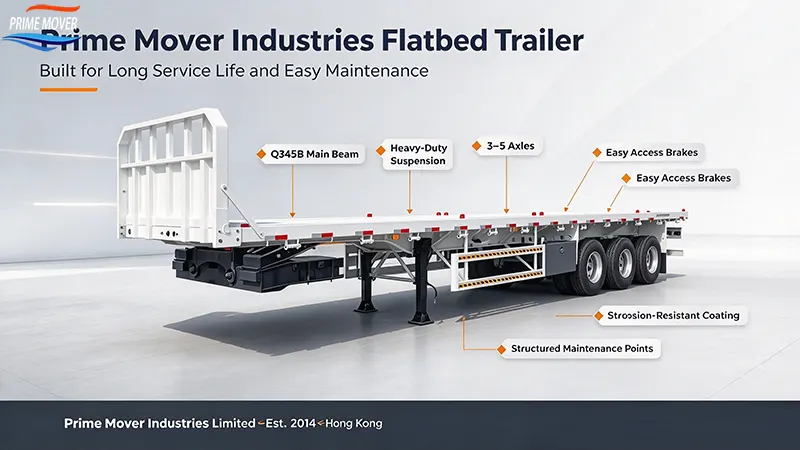
Prime Mover Industries, a Hong Kong based manufacturer and global exporter established in 2014, builds flatbed trailers engineered for long service life and easy maintenance. The company serves construction, logistics, agriculture, and heavy industry clients across Africa, Southeast Asia, the Middle East, and beyond.
Maintenance-friendly design features across the Prime Mover flatbed trailer line include:
| Feature | Benefit |
|---|---|
| Q345B high-strength steel chassis | 345 MPa yield strength, excellent crack resistance |
| Sandblast plus two primer and two topcoats | 80–120 micron coating system for corrosion protection |
| Standardized components | 12R22.5 tires, WABCO valves, FUWA/BPW axles available globally |
| Bolt-on cross members | Easier replacement than welded cross members |
| Accessible grease points | All suspension lubrication points easily reachable |
| 24V LED lighting | 50,000-hour lifespan, vibration resistant |
| Full documentation | Maintenance manual, parts catalog, and wiring diagrams included |
Prime Mover Industries offers factory-direct pricing, third-party inspection support through SGS or BV, and full export documentation. For fleet operators seeking a flatbed trailer that delivers 12 to 15 years of reliable service with proper maintenance, Prime Mover delivers the build quality and specification flexibility to match your operating profile.
Conclusion
The top 12 flatbed trailer maintenance tips outlined in this guide cover chassis inspection, axle and bearing service, brake adjustment, tire pressure management, suspension care, corrosion prevention, electrical system upkeep, kingpin maintenance, deck inspection, fastener torque verification, lubrication, and proper storage. Together, these practices form a complete preventive maintenance program that can extend flatbed trailer service life from 6 to 8 years to 12 to 15 years.
The financial case is clear. Preventive maintenance costs 1,200 to 2,000 USD per year but saves 13,000 to 20,000 USD over ten years compared to reactive repairs and premature replacement. A flatbed trailer that receives regular inspection, timely lubrication, proper tire care, and corrosion protection will outlast and outperform a neglected trailer by five to seven years.
Maintenance is not an expense. It is an investment in asset longevity. For fleet operators in 2026, that distinction is the definition of return on investment.
Written by
Prime Mover Industries
Editor Wang
WhatsApp:+86-189 5386 6163
Email:wlei66@126.com
- Top 7 Must-Have Fuel Tanker Trailer Features for Diesel & Petrol Haulage in 2026
- Best GPS Tracking Solutions for Flatbed Trailers: 7 Must-Have Telematics Features for 2026
- Flatbed Semi Trailer Innovations – Load Security, Eco-Design, and Modularity
- Top 6 Flatbed Trailer Maintenance Tips to Extend Service Life in 2026
PRIME MOVER
INDUSTRIES LIMITED